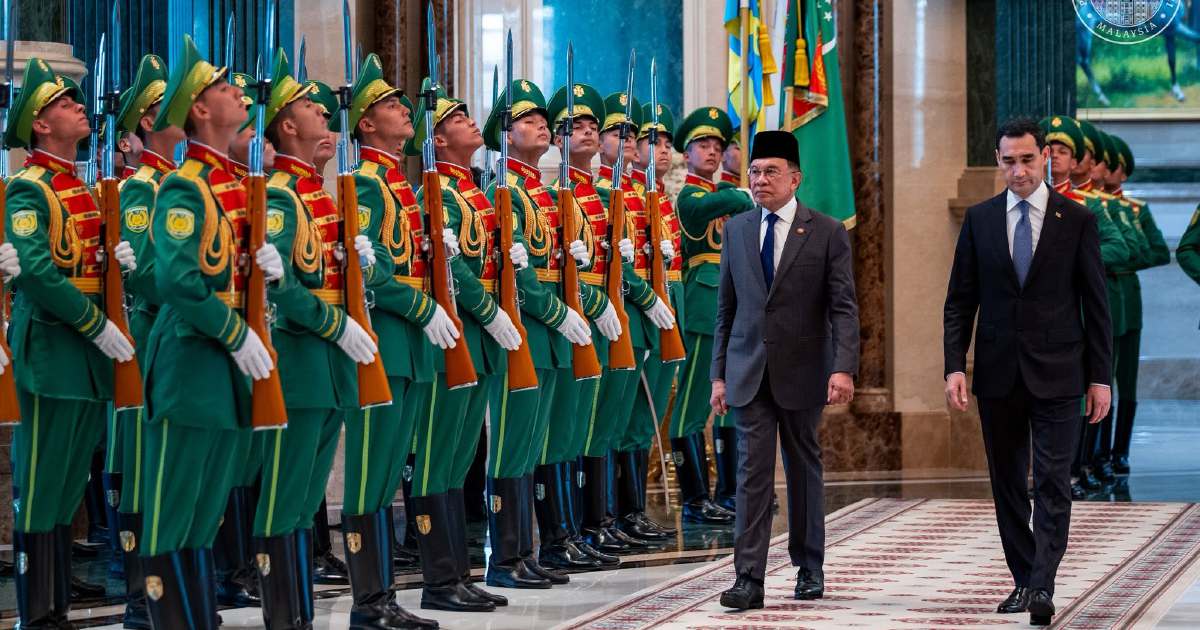
Prime Minister Datuk Seri Anwar Ibrahim was accorded full ceremonial honours at the Presidential Palace in Ashgabat, underscoring the diplomatic significance of his maiden official visit to Turkmenistan since assuming office. The formal reception signals an important milestone in bilateral relations between Malaysia and the Central Asian nation, as Kuala Lumpur seeks to deepen ties with energy-rich markets beyond Southeast Asia's traditional sphere.
The visit represents a strategic pivot in Malaysia's foreign policy architecture, reflecting the government's commitment to expanding engagement across diverse geopolitical regions. Turkmenistan, sitting atop substantial natural gas reserves and positioned along critical trade corridors linking East and West, has become an increasingly important partner for resource-dependent nations seeking energy security and market diversification. Malaysia's outreach to the country demonstrates recognition of these strategic realities and suggests a willingness to cultivate relationships that transcend purely regional boundaries.
Central Asia has undergone significant transformation in recent years, becoming an area where multiple powers compete for influence and commercial advantage. For Malaysia, establishing high-level diplomatic presence in the region offers opportunities to position itself as a trustworthy partner in Muslim-majority markets and to explore investment possibilities. Turkmenistan's government has also shown interest in strengthening connections with Asian democracies, making the timing of Anwar's visit particularly propitious for advancing mutual interests.
The ceremonial nature of the reception at the Presidential Palace indicates that Turkmenistan's leadership views the Malaysian delegation with considerable importance. State visits of this calibre typically accompany substantive discussions on trade, investment, cultural exchange, and strategic cooperation. Such formality suggests both governments anticipate tangible outcomes from the engagement, whether in commercial partnerships, diplomatic coordination, or people-to-people connections.
Energy cooperation likely features prominently in bilateral discussions, given Malaysia's status as a petroleum-dependent economy and Turkmenistan's vast hydrocarbon resources. Beyond crude supplies, there may be conversations about liquefied natural gas procurement, technology transfer, and infrastructure development. Such partnerships can provide Malaysia with additional sources of energy security while offering Turkmenistan reliable and diversified export markets for its resources.
The visit also carries implications for Malaysia's broader positioning within Asian geopolitics. As China, Russia, and Western powers jostle for influence across Central Asia, Malaysia's presence signals that Southeast Asian nations are active participants in shaping regional dynamics rather than passive observers. This assertiveness could enhance Malaysia's standing in multilateral forums and strengthen its capacity to forge independent foreign policy positions.
Tradition and protocol governing state visits underscore mutual respect between nations. The Presidential Palace reception, with its full ceremonial apparatus, demonstrates Turkmenistan's recognition of Anwar's stature as Malaysia's political leader. Conversely, Anwar's personal participation in this inaugural visit emphasises Malaysia's seriousness about cultivating enduring relationships with Central Asian partners rather than treating them as peripheral to national interests.
The visit occurs against a backdrop of evolving global alignments and shifting economic patterns. Malaysian companies may discover opportunities in Turkmenistan's infrastructure development, particularly in transportation, telecommunications, and energy sectors. Conversely, Turkmen investors might find Malaysia an attractive gateway for accessing Southeast Asian markets and establishing regional headquarters for broader Asian operations.
Cultural and educational exchanges often follow high-level diplomatic visits. Enhanced people-to-people connections through student programmes, professional exchanges, and cultural initiatives can generate long-term benefits beyond immediate commercial transactions. Such relationships foster mutual understanding and create networks of goodwill that prove invaluable during future consultations.
Anwar's visit also reflects Malaysia's evolution as a nation confident in pursuing multidirectional foreign policy. Rather than concentrating exclusively on Southeast Asian concerns or maintaining purely reactive diplomatic postures, Malaysia actively cultivates relationships across diverse regions and political systems. This approach positions the country as a serious regional actor capable of managing complex international relationships simultaneously.
For Southeast Asian observers, Malaysia's engagement with Turkmenistan demonstrates that regional nations need not wait for great power initiatives to shape their international standing. By independently pursuing strategic partnerships and demonstrating diplomatic initiative, Malaysia enhances its relevance in global affairs. This model of proactive diplomacy may inspire similar ventures among Malaysia's neighbours, contributing to a more dynamic and autonomous Southeast Asian role in international relations.
Looking ahead, the success of Anwar's visit will be measured not merely by ceremonial exchanges but by concrete agreements establishing frameworks for sustained cooperation. Whether through trade agreements, investment protocols, or institutional arrangements facilitating regular dialogue, lasting partnerships require mechanisms ensuring continuity beyond initial high-level encounters. The foundations laid during this Presidential Palace reception may well prove instrumental in shaping Malaysian-Turkmen relations for years to come.

