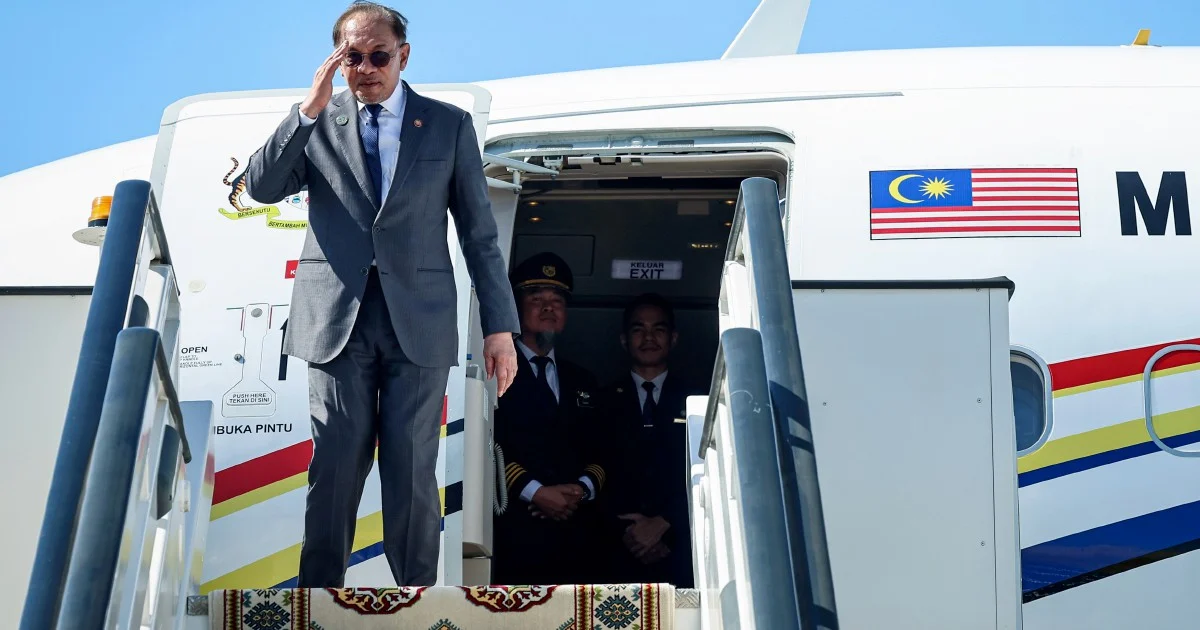
Prime Minister Datuk Seri Anwar Ibrahim touched down in Penang today, stepping directly off the diplomatic circuit following the conclusion of his official visit to Turkmenistan. The arrival at Butterworth underscores the government's determination to maintain momentum on multiple policy fronts simultaneously—from international relations and economic partnerships to domestic institutional engagement. This rapid transition reflects the demanding schedule expected of the nation's chief executive as he balances regional diplomacy with domestic commitments spanning media engagement and business development initiatives.
The centrepiece of his Penang visit is attendance at the grand finale of Hawana 2026, the National Journalists' Day celebration held annually to recognise the media fraternity's contributions to national discourse. Hawana serves as Malaysia's principal platform for honouring journalists across print, broadcast, and digital platforms who have demonstrated excellence and integrity in their reporting. The event carries symbolic weight beyond ceremonial recognition, signalling government commitment to press freedom and the crucial role journalism plays in democratic accountability and public information dissemination.
For Malaysian readers accustomed to seeing prime ministerial visits concentrated in Kuala Lumpur, Anwar's itinerary demonstrates the geographic distribution of administrative attention. Penang, as one of Malaysia's most economically dynamic states and a major trading hub on the Strait of Malacca, holds particular significance in national investment and commerce strategies. The decision to conduct multiple substantive engagements during a single visit maximises diplomatic and administrative efficiency while reinforcing Penang's status as a centre of political and economic consequence within the federation.
The investment-related events scheduled during the Penang portion of the visit suggest ongoing government efforts to stimulate capital inflow and business confidence, particularly in the northern corridor. These gatherings typically bring together government officials, private sector representatives, and potential investors to discuss opportunities in sectors ranging from technology and manufacturing to tourism and green energy. Such forums have become increasingly important as Malaysia competes for foreign direct investment amid intensifying regional and global economic competition.
Anwar's Turkmenistan trip preceding the Penang engagement represents continuation of Malaysia's broader Central Asian engagement strategy. While detailed outcomes from the Turkmenistan visit were not immediately disclosed in the reporting, such official missions typically encompass discussions on bilateral trade enhancement, infrastructure development partnerships, and diplomatic cooperation mechanisms. Central Asian nations, though geographically distant, hold relevance for Malaysian strategic interests given their energy resources, positioning along historic trade routes, and emerging economic reforms.
The sequencing of these events—concluding high-level international diplomacy then immediately engaging with domestic media and investment communities—reveals the interconnected nature of modern prime ministerial responsibilities. International relationships increasingly depend on domestic economic strength and internal stability, while sustained domestic progress requires external partnerships and foreign confidence in national direction. By maintaining presence across both domains within a compressed timeframe, Anwar demonstrates recognition that Malaysia's development trajectory depends on simultaneous cultivation of external relationships and internal stakeholder engagement.
For the media sector specifically, Hawana's 2026 grand finale at which Anwar will be present offers an opportunity to reset the relationship between government and press. Malaysia's media landscape has evolved considerably, with digital platforms fragmenting audiences and traditional gatekeeping mechanisms becoming less effective. Prime ministerial participation in journalists' celebrations signals willingness to acknowledge press contributions while presumably reinforcing expectations of responsible coverage. In the Malaysian context, where press freedom measures remain contested in international rankings, such visible government-media engagement carries interpretive weight among both domestic and foreign observers.
The investment component of the visit addresses Malaysia's persistent challenge of diversifying economic drivers beyond traditional sectors. Penang specifically has built considerable reputation as a semiconductor and electronics manufacturing hub, though economic authorities continue seeking opportunities in higher-value segments including research and development, financial services, and creative industries. By convening business forums at prime ministerial level, the government signals priority commitment to investment promotion while allowing entrepreneurs and executives direct access to senior policymakers for discussing regulatory, infrastructural, or sectoral concerns.
Regionally, Malaysia's positioning within ASEAN and broader Indo-Pacific frameworks means that high-level diplomatic visits such as the Turkmenistan engagement carry implications beyond bilateral relationships. These interactions contribute to Malaysia's diplomatic footprint and influence on issues ranging from regional security to trade architecture. Anwar's evident capacity to conduct intensive international diplomacy while maintaining domestic engagement schedules reinforces projections of Malaysian stability and leadership continuity to international observers and investors alike.

