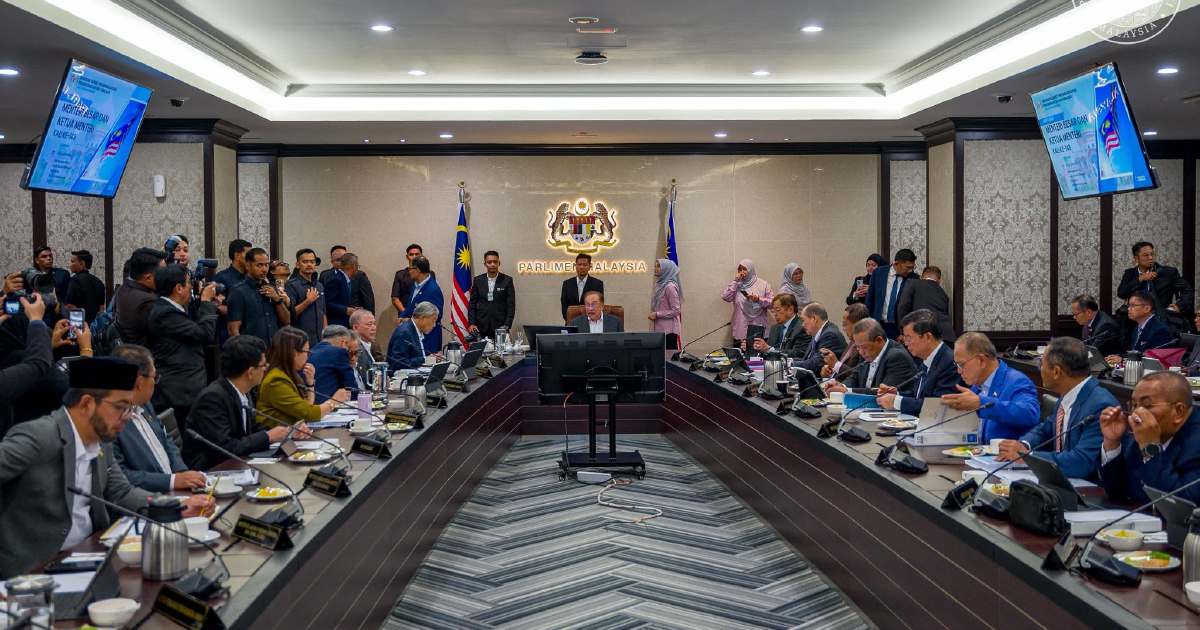
Prime Minister Datuk Seri Anwar Ibrahim brought together Malaysia's state leaders for the 149th Meeting of Menteris Besar and Chief Ministers at the Parliament building in Kuala Lumpur, directing discussion towards national economic stabilisation and growth initiatives. The gathering, which positioned state executives at the centre of policy coordination, underscored the administration's commitment to federal-state cooperation in navigating an increasingly complex global landscape marked by regional conflicts and economic volatility.
The convening of state leadership reflects Malaysia's federal structure, where chief ministers and menteris besar exercise considerable authority over development, commerce and investment within their respective jurisdictions. Bringing these officials into a unified strategic session signals that economic recovery requires coordinated action across all 13 states and three federal territories, rather than fragmented, state-by-state approaches. This centralised coordination mechanism enables federal and state governments to align policies, share best practices and mobilise resources collectively towards shared prosperity objectives.
Global uncertainty stemming from Middle Eastern conflicts presents distinct challenges for the Malaysian economy. The region's instability threatens maritime trade routes upon which Southeast Asia's commerce depends, potentially disrupting supply chains and increasing logistics costs. Energy markets remain volatile, affecting fuel prices and inflation pressures that ripple through Malaysia's manufacturing and transportation sectors. These external shocks demand proactive domestic responses, which explains the emphasis on economic revival at state level where much investment attraction and business development occurs.
The focus on economic strengthening comes as Malaysia continues recovery from pandemic-related disruptions and navigates structural economic transformations. State governments control critical levers for growth, including land use decisions, infrastructure development, and business licensing. By aligning these state-level mechanisms with federal economic strategy, the government can accelerate investment flows, reduce bureaucratic friction and create more cohesive business environments across regional boundaries. This coordination proves especially valuable when international investors evaluate Malaysia against competing Southeast Asian destinations.
The state leaders' meeting serves as a critical information-sharing platform where challenges specific to particular regions can be discussed and solutions debated. Whether addressing labour shortages in Sabah's resource sector, managing Selangor's rapid urbanisation, or supporting Penang's electronics manufacturing base, state executives bring ground-level insights that shape national policy effectiveness. Conversely, federal government perspectives on global market positioning and national infrastructure priorities inform state-level planning and resource allocation decisions.
Middle Eastern tensions carry particular significance for Malaysian economic strategy given the nation's energy imports and substantial trading relationships with Gulf states. Escalating conflicts risk disrupting oil and liquefied natural gas supplies, constraining Malaysian industries reliant on competitive energy pricing. Simultaneously, regional instability may redirect investment flows as multinational corporations reassess Asia-Pacific presence or shift operations to less volatile environments. Malaysia's positioning as a stable Southeast Asian economy becomes increasingly valuable under such circumstances, provided the government demonstrates effective coordination and confidence.
The 149th meeting represents one in a series of formal coordination mechanisms between federal and state authorities. These regular sessions establish rhythm for government coordination and signal seriousness about inter-governmental collaboration. State leaders gain opportunity to brief the Prime Minister on regional challenges and opportunities, while the federal government communicates national priorities and expectations. Such structured engagement prevents policy misalignment and ensures resources flow efficiently toward agreed objectives.
Economic revival encompasses multiple dimensions requiring state government participation. Infrastructure development, port and airport expansion, industrial park management, and skills training programmes all fall substantially within state jurisdiction. Attracting foreign direct investment requires competitive state-level business environments including predictable regulatory frameworks and efficient permit systems. The meeting likely discussed removing state-level obstacles to business and investment, harmonising standards across territories to ease inter-state commerce, and prioritising infrastructure projects with national economic significance.
The emphasis on reviving economic momentum reflects concerns about Malaysia's relative competitive position in Southeast Asia. Neighbouring economies including Singapore, Vietnam and Indonesia pursue aggressive investment attraction strategies. Malaysia's multi-level governmental structure can either facilitate faster, more responsive decision-making through state-level flexibility or create coordination challenges that disadvantage national competitiveness. Positioning state leaders as central to economic revival strategy suggests the government views federal-state coordination as competitive advantage rather than administrative burden.
Longer-term, successful state-led economic recovery requires sustaining cooperation beyond individual meetings. State governments must maintain confidence that federal coordination improves rather than constrains their jurisdictional autonomy and economic prospects. The federal government must demonstrate that national economic strategies genuinely strengthen state economies rather than extracting resources for centralised priority projects. This mutual benefit framework encourages ongoing collaboration and prevents the political fragmentation that might otherwise undermine coordinated national responses to external economic shocks.

