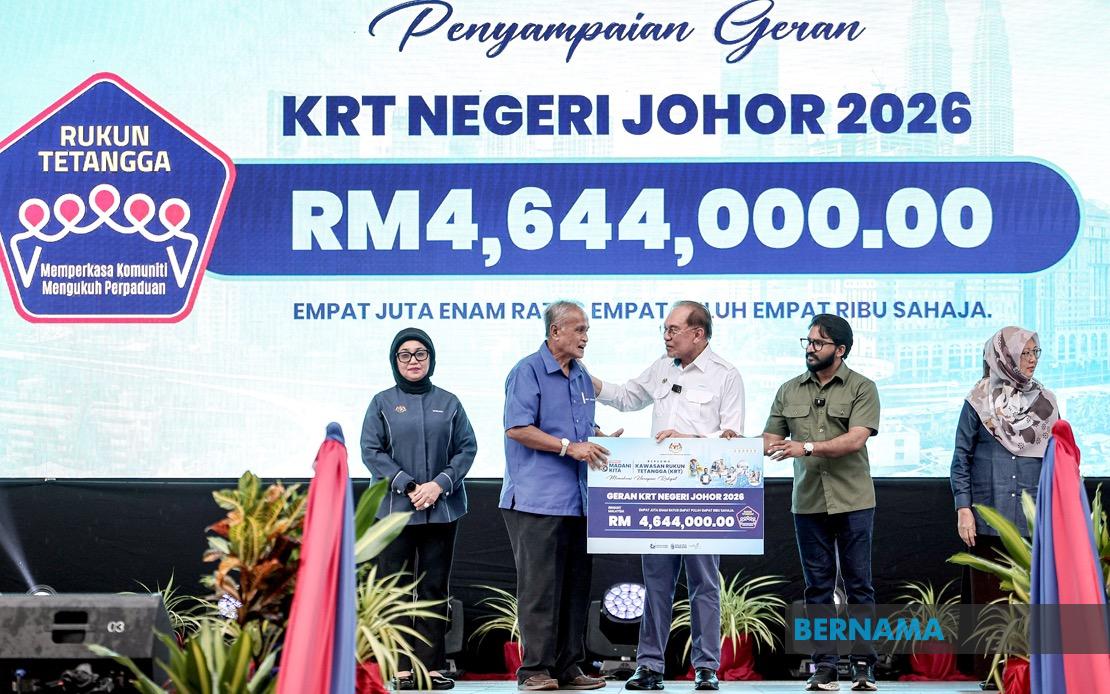
Prime Minister Datuk Seri Anwar Ibrahim has approved a substantial increase in the annual grant distributed to Neighbourhood Watch Areas (KRT) across Malaysia, raising the allocation from RM6,000 to RM10,000 beginning January 1, 2027. The announcement, made during a MADANI KITA Programme event at Dataran Segamat in Johor, signals renewed government commitment to strengthening community-level governance structures that have remained largely underfunded for a decade.
The funding freeze that kept KRT allocations at RM6,000 for ten consecutive years reflected a broader pattern of deferred investment in grassroots institutions despite their expanding responsibilities. By maintaining the nominal grant at its previous level while inflation eroded purchasing power, the government had effectively reduced real funding for these volunteer-led safety and community development groups. Anwar acknowledged this oversight explicitly, framing the increase as a necessary correction that recognizes both the institution's expanding demands and its proven effectiveness in linking federal policy to village-level implementation.
The Prime Minister emphasized that KRT institutions play a foundational role in sustaining Malaysia's distinctive multicultural stability. Rather than treating ethnic, religious and cultural pluralism as a liability requiring management, he characterised these differences as inherent strengths that must be actively celebrated. This framing matters significantly for KRT operations, since these groups often function as the frontline mechanism through which government initiatives—from public health campaigns to security measures to economic programmes—navigate community sensitivities and build acceptance across diverse populations.
KRT groups serve multiple functions that justify the enhanced funding. They facilitate intelligence-sharing between security agencies and residential areas, assist in emergency response coordination, support local dispute resolution, and mobilise community participation in development initiatives. By strengthening these organizations' financial capacity, the government aims to enhance their ability to conduct community outreach, maintain basic operational infrastructure, and compensate volunteer coordinators. The increased grant recognizes that effective grassroots governance requires more than goodwill and unpaid labour.
The timing of this announcement—with implementation delayed until 2027—suggests the allocation has been incorporated into medium-term budgetary planning rather than sourced from immediate reserves. For KRT coordinators nationwide, the phased timeline provides advance notice to incorporate the expanded funding into planning cycles, though it also means another year-and-a-half operating under constrained budgets. The decision to disburse funds on January 1 aligns with annual administrative cycles, simplifying implementation across Malaysia's thousands of registered KRT groups.
During the same Segamat event, Anwar announced complementary infrastructure investments underscoring the government's broader development agenda in Johor. An immediate allocation of RM3.205 million for repair and upgrading work at Islamic educational institutions—including religious schools, madrasahs, study centres and tahfiz institutions across Batu Pahat, Muar and Segamat districts—reflects parallel investment in faith-based community infrastructure. This spending acknowledges both the widespread maintenance backlogs affecting these facilities and their role in the broader educational ecosystem.
The government simultaneously approved RM1.0 million for urgent repair work on Royal Malaysian Police (PDRM) quarters in Johor, framing improved security personnel accommodation as essential to maintaining operational morale and national stability. Anwar positioned this allocation within a wider responsibility framework: adequate welfare and working conditions for security forces contribute directly to their capacity to maintain public order and protect civilian populations. This interconnection between institutional investment and national security underscores the administration's view of comprehensive governance.
For Malaysian readers, these announcements carry several implications. At the neighbourhood level, residents can expect KRT groups to operate with expanded resources, potentially translating into more frequent community meetings, improved communication channels, and enhanced capacity to address local concerns. At the policy level, the KRT funding increase signals that grassroots institutions remain central to how the federal government implements nationwide programmes, particularly those requiring community buy-in across Malaysia's diverse neighbourhoods.
The broader context matters for understanding the KRT decision. Malaysia's unique strength lies in maintaining social cohesion across multiple religious, ethnic and cultural communities—a balance that requires deliberate institutional investment at the local level. KRT groups, composed of ordinary residents committed to neighbourhood welfare, function as crucial bulwarks against social fragmentation. By increasing funding after a decade of stagnation, the government acknowledges that community resilience cannot be sustained indefinitely through volunteer effort alone.
Regionally, Malaysia's experience with KRT-style grassroots governance structures offers lessons for neighbouring Southeast Asian nations navigating similar challenges around community-level integration and security coordination. The recognition that stable pluralistic societies require ongoing investment in local institutions—not merely top-down policy implementation—reflects democratic governance principles increasingly relevant across the region as countries contend with urbanization, migration and evolving community dynamics.
Looking ahead, the effectiveness of the enhanced KRT funding depends substantially on how allocated resources are deployed. Groups that use additional resources for meaningful community engagement and transparent local governance will strengthen neighbourhood resilience, while those treating grants as administrative supplements may squander the opportunity. The government's decision to require KRT reporting on activities and development suggests accountability mechanisms are being tightened alongside funding increases.
The January 2027 implementation date provides time for preparation but also represents a test of the government's commitment to execute the allocation as announced. For KRT coordinators planning ahead, the funding increase enables more ambitious programming and potentially allows modest compensation structures recognizing volunteer contributions. The broader message—that grassroots governance matters enough to warrant real investment—carries significance beyond funding mechanics.

