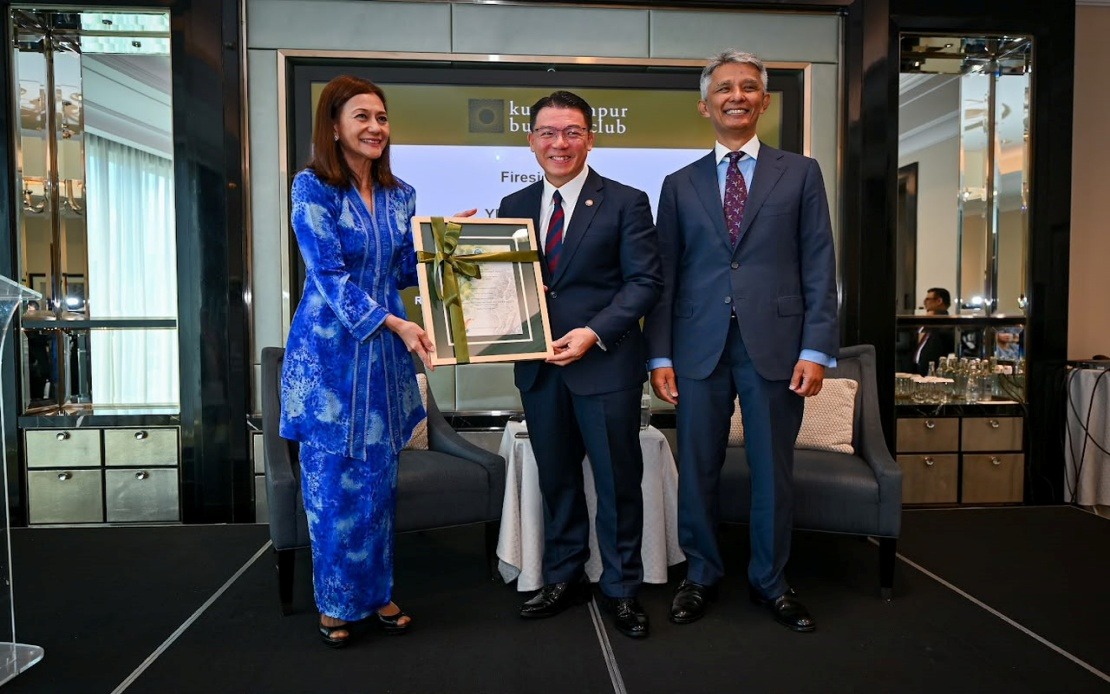
Malaysia's economic transformation hinges on unwavering commitment to the policies established under the MADANI framework, Housing and Local Government Minister Nga Kor Ming has stressed, emphasizing that stability in governance will prove decisive as the nation pursues deeper structural reforms. Speaking following a fireside discussion held by the Kuala Lumpur Business Club, Nga outlined how consistent policy implementation remains the cornerstone for translating reform initiatives into tangible economic progress that extends far beyond the immediate term.
The minister's remarks come at a pivotal moment as Malaysia navigates a complex global economic landscape characterized by uncertainty and shifting trade dynamics. Nga argued that investors require assurance of direction and predictability in how the government approaches economic management, regulatory frameworks, and strategic partnerships. Without such consistency, he contended, Malaysia risks losing competitive advantage to rival nations in Southeast Asia and beyond that are aggressively pursuing investment attraction strategies. The continuity principle, he suggested, extends beyond simple policy maintenance to encompass a broader institutional commitment to reform trajectories that have already demonstrated preliminary success.
Under Prime Minister Datuk Seri Anwar Ibrahim's leadership, the MADANI government has initiated reforms spanning governance structures, economic administration, and international diplomacy that have begun yielding measurable outcomes. Nga cited improvements across multiple indices as evidence of this trajectory: Malaysia has strengthened its position as an investment destination through clearer policy frameworks and demonstrated political stability, while simultaneously enhancing its credibility in international credit markets. These developments reflect not merely isolated policy wins but rather a cohesive approach to structural reform that requires sustained momentum to achieve its full potential.
Among the concrete achievements Nga highlighted is Malaysia's enhanced standing on the Corruption Perceptions Index, an improvement reflecting the government's anti-corruption initiatives and institutional transparency efforts. Similarly, stronger international credit ratings demonstrate that the private capital markets and sovereign investors perceive Malaysia as increasingly credible in its fiscal management and macroeconomic commitments. Such ratings improvements carry substantial practical significance for Malaysian businesses and the government alike, as they reduce borrowing costs and enhance access to international financing for both public infrastructure projects and private sector expansion.
The minister specifically referenced strategic international partnerships as examples of how policy consistency generates tangible returns. Malaysia's RM52.73 billion strategic partnership arrangement with Turkmenistan and ongoing long-term energy collaboration initiatives with Russia exemplify how sustained diplomatic engagement and clear economic partnership frameworks open new avenues for investment, technology transfer, and resource security. These partnerships, Nga implied, could not have been negotiated or implemented effectively without a government that could credibly commit to long-term engagement and demonstrate consistency in its foreign policy orientation.
Nga's emphasis on institutional capacity building complements the policy continuity argument, suggesting that sustained reform efforts strengthen the machinery of government itself. When agencies and institutions operate within a stable policy environment, they can develop expertise, implement complex initiatives, and coordinate across sectors more effectively than under conditions of frequent policy reversals or unclear direction. This institutional deepening becomes particularly important for executing ambitious urban development strategies, which require coordination among multiple government levels and private sector stakeholders over extended timeframes.
The timing of these remarks reflects broader considerations about Malaysia's electoral cycle and governance mandates. Nga explicitly noted that a second-term government would possess the stability necessary to deepen structural reforms and fully realize long-term economic transformation plans already in motion. This argument recognizes that major economic reforms cannot reach completion within single election cycles; they require multiyear commitments to legislative changes, institutional restructuring, and policy experimentation. Discontinuity in government or inconsistent policy direction fundamentally undermines the ability to execute such ambitious agendas.
From an investor perspective, the consistency theme addresses one of the primary concerns when evaluating emerging market investments: policy risk and the possibility of sudden reversals that erode project viability. Nga's message that Malaysia intends to maintain its current reform trajectory provides reassurance to both foreign direct investors and domestic capital allocators that the conditions making Malaysia attractive today will persist. This is particularly significant given regional competition from Indonesia, Thailand, and Vietnam, all of which are pursuing similar foreign investment strategies.
The Kuala Lumpur Business Club dialogue, themed around future cities and urban economic transformation, provided an appropriate venue for these remarks. Malaysia's urban development vision under MADANI encompasses not merely infrastructure construction but rather integrated approaches to sustainability, digital integration, and livelihood creation. Executing this vision requires exactly the kind of policy continuity Nga described, as it involves coordinating across housing, local government, economic development, and technology sectors over many years.
For Malaysian businesses and the broader economy, the minister's emphasis on policy consistency carries both reassuring and cautionary implications. The reassurance derives from signals that the government intends to maintain its current reform trajectory, providing a foundation for medium-term business planning. The cautionary note suggests that business leaders should recognize that Malaysia's competitive advantages depend partly on continuous policy implementation; any future disruption to this continuity could quickly erode the improvements Nga cited. This interdependence between business confidence and government stability underscores why political stability and governance consistency rank among Malaysia's most valuable economic assets in an increasingly competitive region.

