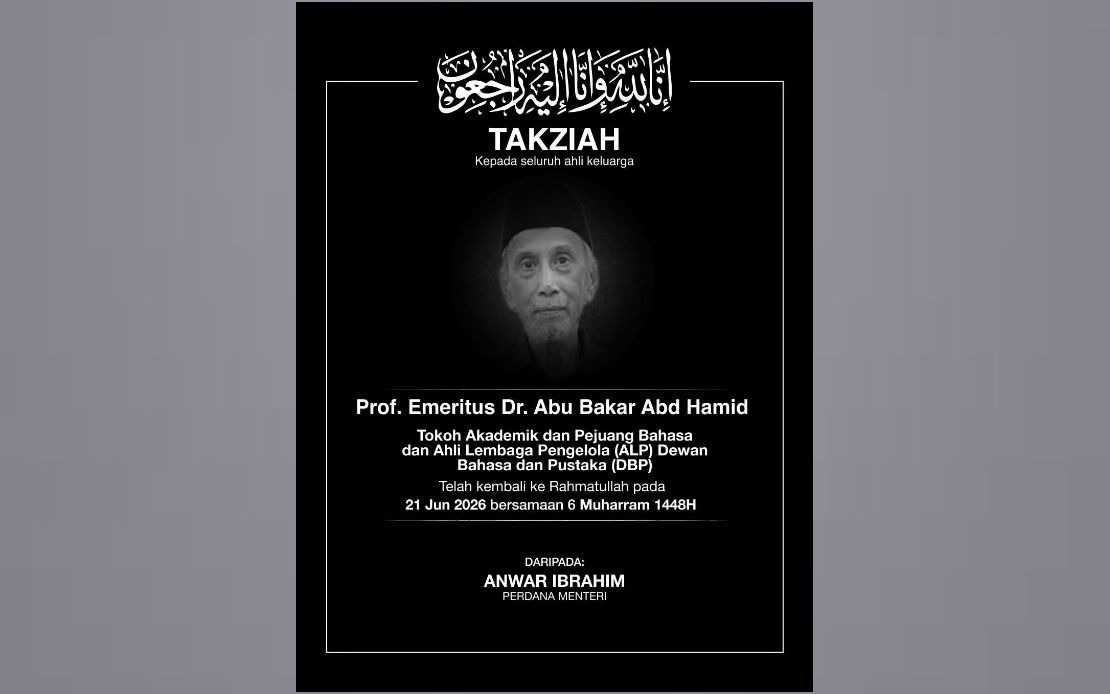
Prime Minister Datuk Seri Anwar Ibrahim has paid tribute to the memory of Professor Emeritus Datuk Abu Bakar Abd Hamid, a distinguished academic and literary luminary whose contributions shaped Malaysia's intellectual landscape. The scholar, who passed away on June 21 at his Petaling Jaya residence following a sudden health episode, left behind an enduring legacy spanning decades of service to higher education and cultural advancement. Anwar shared his condolences through a Facebook post on June 24, reflecting on both the personal bond they shared and Abu Bakar's broader significance to the nation's academic community.
The untimely death of Abu Bakar, a native of Johor, occurred around 10.30pm at his home when he suffered acute respiratory distress. His passing marked the end of a remarkable career that witnessed pivotal moments in Malaysia's university system and literary development. The funeral ceremony took place the following day, with Abu Bakar laid to rest at Bukit Kiara Muslim Cemetery in the capital, drawing mourners who recognized his substantial contributions to the nation's educational institutions and cultural heritage.
As Prime Minister, Anwar emphasised Abu Bakar's pivotal role in establishing Universiti Kebangsaan Malaysia, the country's premier national university dedicated to Malay scholarship and indigenous knowledge systems. During the formative years of UKM's creation in 1968, Abu Bakar served as joint secretary of the steering committee, helping to architect an institution that would become central to advancing Malay language studies, literature, and humanities throughout Southeast Asia. This foundational work positioned him as more than an academic administrator but rather as a visionary who recognised the strategic importance of preserving and promoting Malay intellectual traditions during a transformative period in the nation's history.
Beyond his institutional contributions, Abu Bakar held the position of deputy vice-chancellor at Universiti Malaya, one of the country's oldest and most respected universities. His appointment to this senior leadership role in 1987 reflected widespread recognition of his scholarly standing and administrative acumen. Throughout his tenure in various capacities at UM, he worked to strengthen the university's commitment to literary studies and cultural research, ensuring that Malay language and literature remained central to the university's academic mission during an era of increasing globalisation.
Anwar's remarks carried particular poignancy given their personal relationship as student and mentor. The Prime Minister described Abu Bakar not merely as an instructor in the technical sense, but as an intellectual guide whose passion for knowledge and commitment to inspiring others transcended conventional pedagogical boundaries. Such tributes underscore how Abu Bakar's influence extended through generations of Malaysian scholars and leaders, shaping their intellectual worldviews and instilling in them a deep appreciation for literary excellence and cultural scholarship.
During the 1990s, Abu Bakar's stature in Malaysia's information landscape was further recognised when he assumed the chairmanship of the Board of Governors at Bernama, the Malaysian National News Agency, a position he held from 1996 until 2000. His guidance during this period helped anchor Malaysia's primary news organisation at a time of significant technological and political transition, demonstrating his expertise extended beyond literature into the broader domains of public communication and institutional governance. His leadership at Bernama reflected the deep respect he commanded across multiple sectors of Malaysian society.
Throughout his lifetime, Abu Bakar accumulated numerous prestigious accolades acknowledging his scholarly contributions and service to national development. These awards represented formal recognition of what his colleagues and students already understood—that he was among the foremost guardians and interpreters of Malay literary tradition in the modern era. His research publications, academic papers, and critical analyses became foundational texts for subsequent generations of literature scholars working across Malaysia, Brunei, and broader Southeast Asia where Malay cultural studies hold significance.
The passing of Abu Bakar represents a significant loss to Malaysia's intellectual community at a moment when the preservation and promotion of indigenous languages and literary traditions face mounting challenges from globalisation and digital transformation. His career demonstrated how scholars could navigate between rigorous academic inquiry and public service, between traditional humanistic values and modern institutional demands. For Malaysian universities and cultural institutions, his departure removes a direct link to earlier generations of nation-builders who saw education and literature as central to forging national identity and social cohesion.
Anwar's public mourning carries broader implications for how contemporary Malaysian leadership acknowledges intellectual contributions and cultural heritage. By openly honouring Abu Bakar through official channels, the Prime Minister signalled to the academic and literary communities that such service remains recognised and valued at the highest levels of government. This gesture affirms that in an era increasingly dominated by economic metrics and technological advancement, the nation still maintains reverence for scholars whose life work centred on preserving, interpreting, and transmitting cultural knowledge and literary excellence to subsequent generations.

