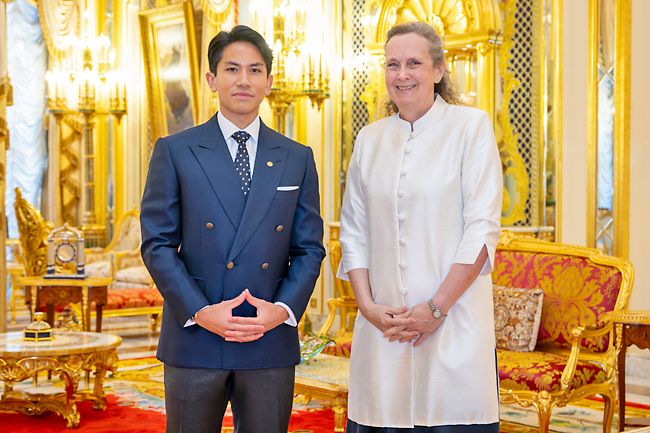
In a formal diplomatic ceremony on Saturday, Brunei's Foreign Affairs Minister Prince 'Abdul Mateen received outgoing United States Ambassador Caryn R McClelland at Istana Nurul Izzah in Bandar Seri Begawan. The farewell audience marked the conclusion of McClelland's tenure representing American interests in the sultanate, a position that had involved navigating the complex relationship between Washington and one of Southeast Asia's most strategically important micro-states.
During the meeting, Prince 'Abdul Mateen extended formal appreciation for McClelland's diplomatic contributions throughout her posting. The prince specifically commended the ambassador's efforts in consolidating the historic partnership between the two nations, characterising her work as instrumental in fortifying bonds that have deep historical roots and contemporary relevance. The recognition reflected the high regard in which the Brunei government holds the diplomatic channel with the United States, particularly given Brunei's geographic position in the South China Sea region where American interests remain substantial.
The bilateral relationship between Brunei and the United States extends across multiple strategic dimensions that have expanded notably in recent years. Defence cooperation stands as a cornerstone of the partnership, with the two countries maintaining regular military exchanges and coordination on regional security matters. Educational collaboration has likewise flourished, with hundreds of Bruneian students pursuing tertiary qualifications at American universities annually, creating people-to-people linkages that transcend formal government channels and foster long-term mutual understanding between societies.
Economic engagement forms another pillar of the relationship. Both nations have worked to deepen trade connections and facilitate investment flows, recognising mutual benefits in commercial partnership. American companies maintain a presence in Brunei's energy sector and broader economy, while Bruneian sovereign wealth funds and private entities have made strategic investments across American markets. These commercial threads interweave with diplomatic objectives, creating multifaceted incentives for sustained cooperation regardless of broader geopolitical shifts.
The deepening of cooperation across these diverse domains during McClelland's tenure reflects a deliberate policy choice by both governments to elevate bilateral engagement beyond ceremonial exchanges. Officials from both capitals have emphasised the importance of strengthening the relationship at precisely the moment when regional geopolitical tensions have intensified, particularly concerning territorial disputes in the South China Sea where Brunei holds maritime claims. The United States has positioned itself as a guarantor of freedom of navigation and regional stability, roles that align with Brunei's own interests in maintaining an open, rules-based international order.
People-to-people exchanges constitute an often-underappreciated dimension of the bilateral relationship that McClelland's tenure evidently prioritised. Beyond the thousands of students traversing the Pacific annually, cultural organisations, academic institutions, and civil society groups from both nations engage in regular interactions. These connections create constituencies within each country invested in positive relations with the other, providing diplomatic resilience during periods when governments might face pressure to adopt more adversarial stances.
For Malaysia and other Southeast Asian nations, the US-Brunei relationship holds broader significance within the architecture of regional engagement. As the United States seeks to maintain strategic influence in Southeast Asia and strengthen alliance networks, its bonds with smaller states like Brunei serve important purposes. Brunei's membership in ASEAN means that American cultivation of bilateral relationships with individual members complements broader strategies of engaging the organisation as a collective. McClelland's successful tenure likely enhanced Washington's standing within ASEAN capitals, signalling American commitment to sustained engagement even with states that lack significant military or economic leverage.
McClelland had formally presented her credentials to His Majesty Sultan Hassanal Bolkiah, Sultan and Yang Di-Pertuan of Brunei Darussalam on May 24, 2022, marking the official beginning of her diplomatic posting. The intervening period had encompassed significant regional developments, from evolving great power competition in Asia to the ongoing implications of the pandemic for bilateral exchanges and travel. Her departure coincides with a moment of continued reflection within American foreign policy circles about optimal approaches to sustaining influence in a region where China has substantially expanded its diplomatic and economic footprint.
The manner in which Prince 'Abdul Mateen conducted the farewell audience reflected diplomatic protocol while underscoring the importance Brunei places on the American relationship. The venue selection—Istana Nurul Izzah, one of the sultanate's principal royal residences—indicated the formality and significance attached to the occasion. This contrasts sharply with routine diplomatic departures that might receive more perfunctory treatment, suggesting that Brunei views the ambassador's tenure as having materially contributed to national objectives.
As McClelland's successor begins the process of assuming duties in Bandar Seri Begawan, both governments will presumably seek to maintain the trajectory of expanding cooperation that characterised recent years. The farewell exchange provides an opportunity for institutional memory transfer and continuity assurance, essential elements in sustaining diplomatic relationships through transitions in personnel. For observers tracking American strategic priorities in Southeast Asia, the investment of senior political attention in formally recognising McClelland's contributions to the bilateral relationship signals enduring commitment to the region despite competing demands on American diplomatic resources elsewhere globally.
The broader context of this farewell audience underscores how even relationships between states of vastly different sizes and capabilities can achieve substance and depth when both parties invest strategic attention. For smaller Southeast Asian states like Brunei, cultivating meaningful partnerships with major powers provides security reassurances and economic opportunities while maintaining strategic autonomy. The formal nature of McClelland's farewell reflected mutual recognition that these relationships require constant attention and renewal to remain vibrant across changing regional circumstances.

