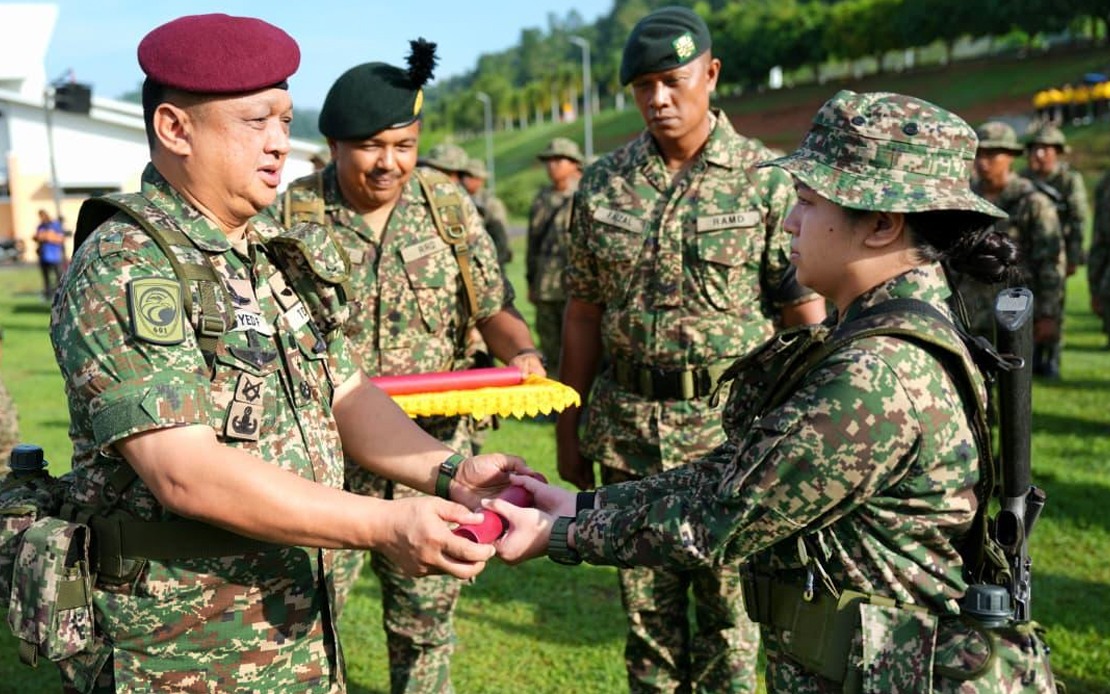
Hajah Sharifah Farah Adriana Jamalullail, the second daughter of the Raja Muda of Perlis and the Raja Puan Muda of Perlis, has become among the latest graduates of the Malaysian Army's Voluntary Young Soldier Basic Course (APMS), completing the intensive two-week programme at Universiti Malaysia Perlis from early to mid-June. The 25-year-old's successful conclusion of the training programme marks a significant moment for Perlis's royal institution, which has increasingly positioned itself as a beacon for national duty and civic responsibility across all strata of society.
The closing parade, held at the Boulevard Field on UniMAP's Pauh Putra Campus in Arau, was presided over by the Raja Muda of Perlis, Tuanku Syed Faizuddin Putra Jamalullail, in the presence of the Raja Puan Muda of Perlis, Tuanku Dr Hajah Lailatul Shahreen Akashah Khalil. The formal ceremony underscored the institutional weight placed on the APMS initiative, with the palace emphasising through an official statement that the course's completion by a member of the royal household sends a powerful signal about the universal nature of defence obligations in Malaysia. The message conveyed was deliberate: patriotism and love for the nation are not confined to any particular segment of society but represent a binding principle that should permeate across every demographic group and social class.
Istana Arau's formal statement articulated a sophisticated vision of national defence as a collective endeavour rather than the exclusive domain of professional military personnel. By framing the daughter's participation as a demonstration that "safeguarding the nation's defence is a shared responsibility," the palace leveraged the symbolic weight of royal involvement to reinforce broader messaging about civic duty. This rhetorical approach carries particular significance in Malaysian political culture, where the monarchy functions as both ceremonial figurehead and moral authority, capable of influencing public perception on matters of national importance through measured gestures and carefully calibrated public appearances.
Hajah Sharifah Farah Adriana brings considerable educational credentials to her military training commitment. She holds a Bachelor of Business (Management) degree from RMIT University in Australia and a Master of International Business degree from Monash University Malaysia, indicating a trajectory of intellectual development and international exposure. Her decision to undertake the APMS course following her corporate education suggests a deliberate choice to engage with military service frameworks, a decision that carries weight precisely because it emerges from someone with cosmopolitan educational backgrounds and presumably abundant alternative career pathways.
The Raja Muda himself articulates a sophisticated strategic vision for the Territorial Army's development that extends beyond simple recruitment metrics. As Commander of the 504th Territorial Army Regiment, Tuanku Syed Faizuddin Putra has positioned the course initiative as part of a comprehensive approach to strengthening Malaysia's reserve military capacity. His comments reveal an understanding that attracting "physically fit young people who meet the minimum requirements" requires not merely open doors but compelling narratives about national purpose and collective security consciousness.
The Raja Muda's elucidation of the Territorial Army's institutional mandate—"To Raise, Train and Maintain"—demonstrates how contemporary Malaysian military strategy conceptualises reserve force development. The "Raise" component is reframed beyond numerical expansion to encompass strategic human resource preparation, acknowledging that military effectiveness depends upon recruiting individuals possessing both the requisite physical attributes and the psychological orientation toward integrated defence operations. This nuanced formulation reflects broader global military thinking about reserve force composition in an era when technological advancement and complex security environments demand more sophisticated personnel management.
The emphasis on "Train" as quality preparation for integrated operations with the Regular Force reveals how Malaysia's defence establishment views its reserve components—not as separate parallel structures but as integral elements within a unified force posture. Personnel must be capable of functioning seamlessly alongside professional soldiers, requiring standardised training protocols that prioritise interoperability and mutual understanding of operational doctrines. This integration imperative shapes recruitment strategies, training curriculum design, and the broader narrative around why young citizens like Hajah Sharifah Farah Adriana should consider APMS participation as a meaningful national contribution.
The "Maintain" pillar addresses the enduring challenge facing reserve forces globally: preserving readiness amid the reality that part-time soldiers face competing professional and personal obligations. The Raja Muda's insistence on consistency in readiness preservation acknowledges that reserve forces represent latent capacity that must be continuously reinforced through periodic training, updated skill development, and psychological recommitment to operational roles. Without such maintenance mechanisms, reserve components risk degrading into nominal status, becoming liability rather than asset during actual security crises.
From a broader Malaysian and Southeast Asian perspective, the Perlis royal family's engagement with military training initiatives reflects wider trends across the region's monarchies in demonstrating commitment to national defence frameworks. In an environment where security anxieties span maritime domain challenges, transnational terrorism concerns, and evolving great power competition dynamics, national leaders increasingly employ symbolic gestures—including royal participation in military activities—to reinforce public consciousness about collective defence requirements. Perlis's approach contributes to this regional pattern while also addressing specific Peninsular Malaysian security considerations.
The timing and execution of the APMS course at UniMAP carries additional significance for Perlis as a state increasingly positioning itself as an attractive location for defence and security sector activities. By hosting the Voluntary Young Soldier Basic Course locally, rather than routing Perlis recruits through facilities in other states, Perlis establishes institutional infrastructure that can develop into a recognised centre for military training excellence. This territorial dimension of defence development connects broader strategic infrastructure investment with human capital development, suggesting that state-level authorities view military preparedness as integral to economic development narratives rather than as purely security matters.
The course's conclusion demonstrates the capacity of Malaysia's military institutions to design and execute programmes that attract participation across socioeconomic strata. When members of the royal family complete identical training to ordinary citizens, it potentially reshapes public perceptions about military service—moving beyond perception of armed forces as career pathways for economically constrained youth toward recognition of defence commitment as an obligation transcending class boundaries. Such perception shifts, however subtle, contribute to the legitimacy of recruitment messaging and broaden the potential recruitment base for both regular and reserve force components.
Looking forward, the success of initiatives like the APMS in attracting high-quality recruits may influence how Malaysian defence institutions approach reserve force development more comprehensively. If royal participation helps normalise military training among university-educated professionals with international backgrounds, it could expand the demographic profile of reserve force recruitment, introducing individuals with skill sets—language capabilities, technical expertise, international experience—that enhance overall force effectiveness. The symbolic and practical dimensions of Hajah Sharifah Farah Adriana's course completion thus intersect in ways that may shape Malaysia's defence posture development across coming years.

