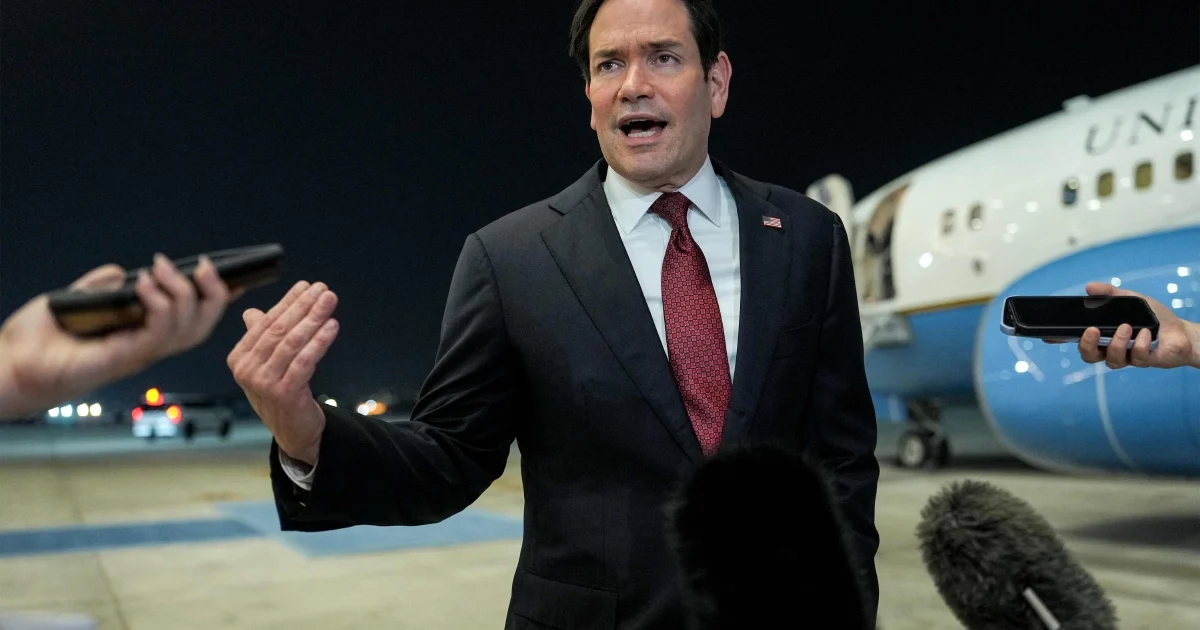
The United States has firmly rejected any Iranian scheme to charge fees or tolls on vessels transiting the Strait of Hormuz, US Secretary of State Marco Rubio declared on Tuesday, marking a significant flashpoint in the delicate diplomatic efforts aimed at de-escalating Middle Eastern tensions. Rubio's unequivocal stance underscores Washington's commitment to maintaining freedom of navigation through one of the world's most strategically vital waterways, a position that sits at odds with Tehran's apparent negotiating position.
The Strait of Hormuz, the narrow passage between Iran and Oman that connects the Persian Gulf to the Gulf of Oman and Arabian Sea, carries roughly one-third of all globally traded seaborne petroleum. Any disruption or levy system imposed by Tehran would reverberate through global energy markets and supply chains, directly affecting economies across Southeast Asia and beyond. For Malaysia and other regional trading nations that depend heavily on stable maritime commerce, the outcome of these disputes holds substantial economic implications.
Rubio's declaration reflects Washington's zero-tolerance approach to Iranian assertions of control over the international waterway. The strategic importance of the Strait cannot be overstated—it serves as a critical artery for energy exports from the Gulf region, with millions of barrels flowing through daily. The United States has historically positioned itself as a guarantor of freedom of passage, and Rubio's comments reaffirm this traditional posture even as broader negotiations unfold.
The toll proposal appears to be part of Tehran's wider negotiating strategy as discussions progress on multiple fronts. Beyond shipping fees, the talks are reportedly grappling with thornier issues, including the resumption and scope of international nuclear inspections on Iranian soil, as well as constraints on Iran's missile development programme. These three dimensions—maritime control, nuclear transparency, and weapons capabilities—represent the core contentions that have historically stalled diplomatic breakthroughs between Washington and Tehran.
Nuclear inspections have long served as a focal point of international concern regarding Iranian activities. The International Atomic Energy Agency has struggled to obtain unrestricted access to Iranian facilities and military sites suspected of harbouring weapons research. Any agreement emerging from current negotiations would need to establish verifiable mechanisms for ongoing inspections, a requirement Washington appears determined to enforce, as Rubio's firm language suggests.
Missile development presents another considerable sticking point. Iran has invested substantially in ballistic missile programmes that regional allies of the United States, particularly in the Gulf Cooperation Council, view as destabilising threats. The Biden administration's predecessors had emphasised missile constraints as essential to any durable settlement, and Rubio's presence in these discussions indicates the Trump administration is unlikely to soften that position.
These early disagreements hint at the formidable obstacles remaining in the negotiation process. Both sides appear to be testing the other's resolve and flexibility on fundamental issues. For Southeast Asian nations, watching these developments is prudent, as any major breakthrough or breakdown could alter regional security dynamics and energy supply patterns. Malaysia, as both a maritime state and an energy importer, has stakes in both the security architecture and the economic flows that depend on Hormuz remaining open and toll-free.
The rejection of toll schemes sends an implicit message that Washington views Iranian proposals as non-starters, effectively setting boundaries early in the negotiation phase. Rubio's declarative approach may be designed to prevent Tehran from treating toll proposals as bargaining chips to be traded for concessions elsewhere. Such firmness, while clear in intent, can also entrench positions and make compromise more difficult as talks advance.
Historical precedent suggests that maritime chokepoint disputes between major powers typically require creative diplomatic solutions. The Panama Canal, the Suez Canal, and the Malacca Strait have all been subject to various international arrangements balancing sovereignty with access rights. Whether Iran and the United States can construct a similarly workable framework remains to be seen, but Rubio's stark rejection indicates Washington is currently unwilling to acknowledge Iranian jurisdiction over Hormuz tolling.
The trajectory of these negotiations will influence not only bilateral US-Iran relations but also the broader Middle Eastern security environment and global energy stability. For Malaysian policymakers and businesses, developments deserve close monitoring, particularly regarding implications for shipping routes, energy prices, and regional geopolitical alignments. The coming weeks will reveal whether both parties can move beyond initial posturing to substantive bargaining.
The convergence of disputes over the Strait, nuclear inspections, and missiles suggests that achieving a comprehensive agreement will require simultaneous progress on multiple fronts, with each side seeking to link concessions across these domains. Rubio's unambiguous rejection of toll proposals on Tuesday indicates the United States is beginning that process by drawing a clear line on maritime sovereignty—a position unlikely to shift unless coupled with substantial Iranian concessions on nuclear and missile matters.

