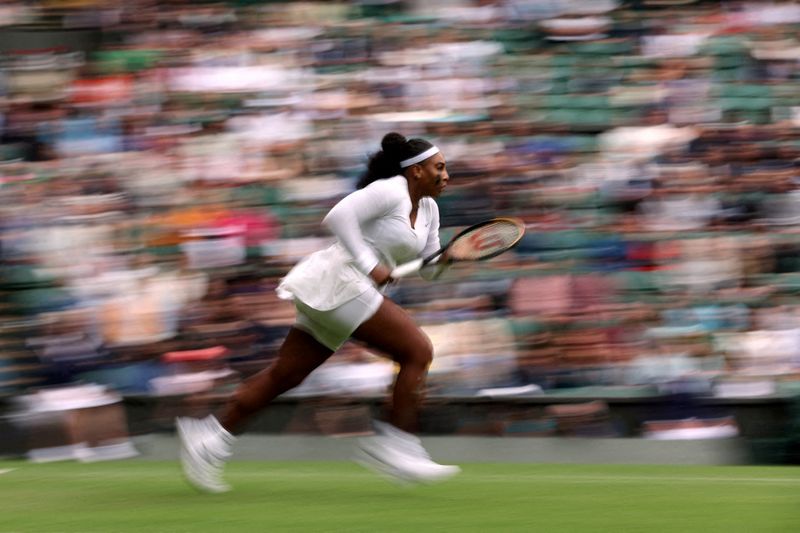
The 2024 Wimbledon women's singles championship arrives at a pivotal moment for the sport, yet nothing looms larger than the unexpected return of Serena Williams. A decade after the American legend captured her seventh title at the All England Club in 2016, her decision to mount a comeback at age 44 injects unprecedented narrative tension into an already fractured and competitive field. Williams' participation on grass courts for the first time since 2022 transforms what would otherwise be a wide-open tournament into a global spectacle centred around one improbable storyline.
The landscape of women's tennis has shifted dramatically in the years of Williams' absence. World number one Aryna Sabalenka carries the weight of favouritism into the tournament, yet her trajectory suggests vulnerability rather than dominance. The Belarusian powerhouse's collapse at Roland Garros—where she surrendered the final ten games of her quarter-final match—exposed the psychological fragility that occasionally undermines her otherwise formidable technique. Her Berlin preparation proved equally troubling, losing a deciding set 6-0 to Jessica Pegula, demonstrating that her mental resilience cannot be taken for granted on grass. Despite holding the top ranking since October 2024, Sabalenka faces the daunting prospect of delivering under immense pressure in a tournament where confidence proves as valuable as raw power.
Beyond the established order, a cadre of accomplished challengers threatens from multiple angles. Poland's Iga Swiatek arrives as the defending champion, seeking to become the first player since Williams herself in 2016 to claim back-to-back Wimbledon titles—a feat that underscores how competitive the modern women's game has become. At just 19 years old, Russian sensation Mirra Andreeva recently became the youngest French Open champion in 34 years, bringing an audacious and unorthodox style that could flourish on Wimbledon's pristine surfaces. American Coco Gauff, perpetually seeking her breakthrough on grass, faces another opportunity to conquer a surface that has eluded her throughout her career. Elena Rybakina, the 2022 champion, possesses an understated but devastatingly effective power game that makes her a perpetual threat. Even Emma Raducanu, buoyed by home support, harbours hopes of delivering Britain's first women's singles champion since 1977.
Serena Williams' wildcard selection, the eighth and final allocation from Wimbledon organisers, represents a calculated gamble by both player and tournament. Her four-year hiatus from competitive singles play since the 2022 U.S. Open would ordinarily disqualify any athlete from serious title contention. Yet Williams is no ordinary competitor. She has meticulously prepared for this moment, rejoining the anti-doping pool in December, shedding approximately 20 pounds through weight-loss medication, and working intensively with coach Rennae Stubbs. Her doubles appearance alongside Victoria Mboko at Queen's Club provided a glimpse of her physical condition, with her legendary 120 mph serve—arguably the most devastating weapon in women's tennis history—remaining formidably intact alongside her baseline power.
The psychological dimension of Williams' comeback cannot be overstated. Her decision to launch her singles return at Wimbledon, rather than competing in preparatory tournaments, reflects extraordinary confidence that borders on audacity. Former world number one Andy Roddick marvelled at this mindset, noting that most players would schedule seven warm-up events before returning to Grand Slam competition after such an absence. Williams' willingness to plunge directly into the sport's most hallowed grass court championship reveals either supreme self-belief or a clear-eyed assessment that her window for competitive participation remains limited. Fellow American Grand Slam champion Lindsay Davenport warned that success would not come easily, emphasising how grass courts demand particular physical and technical adaptability. Yet Davenport ultimately acknowledged that if any athlete possessed the requisite skill and mental fortitude to defy the odds, Williams remained the obvious candidate.
From a statistical perspective, women's tennis has fragmented into unprecedented parity since Williams' last Wimbledon triumph. Eight different players have claimed the title in the past decade, underlining the absence of a dominant figure capable of sustained Grand Slam success. While Sabalenka, Swiatek, Gauff, Rybakina, and Ash Barty have accumulated multiple Grand Slam titles, none approaches the reign of terror Williams exercised during her pomp. This fragmentation creates genuine uncertainty about the tournament outcome while simultaneously rendering Williams' experience and championship pedigree extraordinarily valuable. In a field lacking clear dominance, the intangibles that Williams possesses—composure, tactical intelligence, and competitive hunger—could prove decisive.
The commercial and broadcasting implications of Williams' return merit serious consideration. Her participation guarantees soaring television ratings and will drive social media engagement to unprecedented levels. For Malaysian audiences and Southeast Asian viewers generally, Williams' comeback provides compelling narrative beyond mere sporting excellence. The resurrection of a generational talent who transcended tennis to become a global cultural figure offers a storyline that transcends traditional sports coverage. Her journey from apparent retirement to competitive return embodies resilience and ambition that resonates across cultures and demographic groups.
Should Williams advance in the tournament, the matchup possibilities generate tantalising analytical scenarios. A potential encounter with Sabalenka would present a psychological minefield for the world number one. Facing an opponent with four years of inactivity yet possessing Williams' legendary killer instinct and championship experience would create no upside for Sabalenka. Victory would generate limited acclaim—defeating a returning 44-year-old carries diminished prestige—while defeat would prove catastrophic to her title credentials. Conversely, Williams would face the immense physical and tactical challenge of deploying her experience against athletes trained on modern grass court techniques and equipped with contemporary equipment.
The record for oldest singles match winner at Wimbledon belongs to Martina Navratilova, who triumphed at age 47 in 2004. Williams, at 44, theoretically possesses the physical capacity to establish a new benchmark, though the intervening years of inactivity introduce legitimate uncertainty. Her first singles opponent remains undetermined, but the entire women's draw now hinges on the possibility that Williams might derail the carefully laid plans of Sabalenka, Swiatek, Andreeva, and their fellow contenders. This uncertainty—this invisible thread of possibility woven through the tournament bracket—transforms Wimbledon 2024 from a straightforward championship into something far more compelling. The story of women's tennis itself has become secondary to the extraordinary personal narrative of one athlete's improbable return to the sport's grandest stage.

