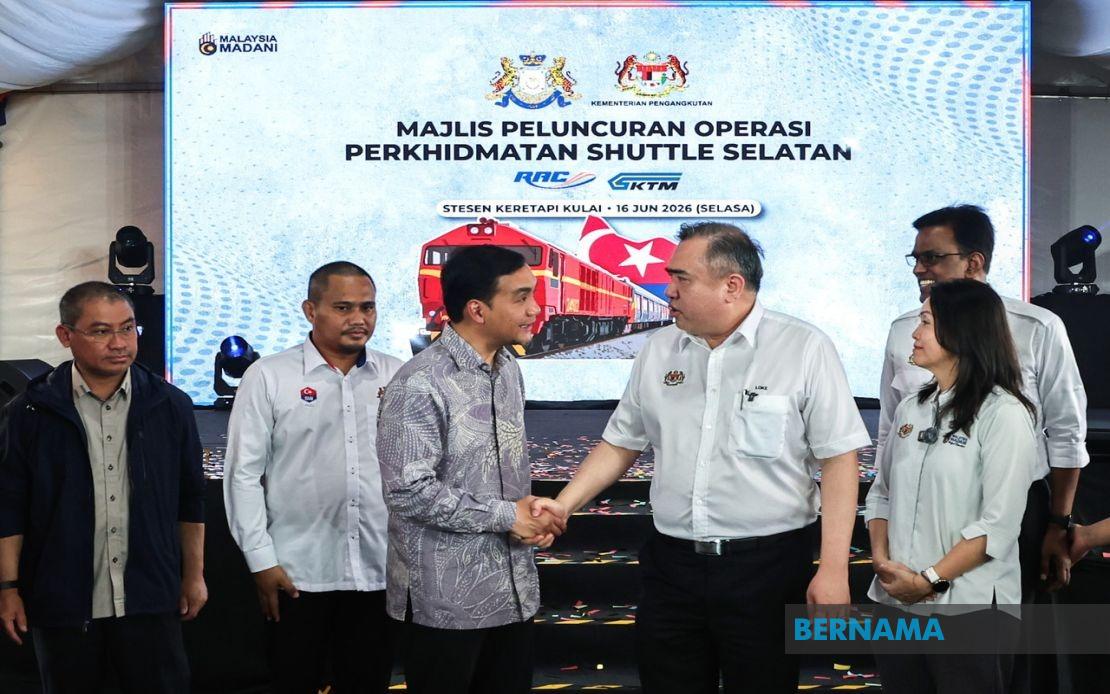
Transport Minister Anthony Loke formally launched the Shuttle Selatan service on June 16, introducing a much-anticipated rail connection that weaves together three strategic hubs in southern Johor: Kulai, JB Sentral and Pasir Gudang. The new service represents a significant infrastructure milestone for the state, with projections suggesting it could benefit more than two million residents across the tri-state corridor. Johor Menteri Besar Datuk Onn Hafiz Ghazi and state public works chief Mohamad Fazli Mohamad Salleh attended the official inauguration at Kulai KTM station, underscoring the regional importance of the project.
The service rolls out with two principal operational routes designed to maximise coverage in high-density areas. The Kulai-JB Sentral-Kulai circuit offers commuters a direct 40-minute journey between two major economic nodes, whilst the Kempas Baru-Pasir Gudang-Kempas Baru link provides equivalent time efficiency across a 40 to 45-minute corridor. This phased approach allows authorities to stress-test operational capacity and passenger demand before deploying additional resources. The routing strategy deliberately targets the commuter corridor that encompasses residential sprawl, commercial districts and industrial zones, positioning Shuttle Selatan as both a convenience and an economic enabler.
Ambitious expansion plans extend well beyond the current configuration. The government has already sketched a longer route stretching from Paloh through Kluang, Renggam and Layang-Layang stations before terminating at Kulai, effectively creating a northern gateway into the southern industrial heartland. Three supplementary stations—Taman Daya, Bandar Baru Sri Alam and Pasir Putih—are earmarked for future development. This staged expansion reflects a deliberate strategy to gradually increase accessibility whilst managing operational costs and building ridership incrementally. Such planning mirrors successful transit systems elsewhere in Southeast Asia that grew from core routes into comprehensive networks.
First- and last-mile connectivity has been engineered into the service architecture from inception. The government has coordinated feeder bus services, aligned Bas.My route scheduling, established a dedicated shuttle at Kempas Baru station and created park-and-ride facilities at AEON Bandar Dato' Onn. These complementary measures address a critical pain point in Malaysian public transport: the gap between residential locations and transit stations. Without such integration, even efficient rail services struggle to attract car-dependent commuters. The thoughtful layering of transport modes represents a departure from earlier infrastructure projects that arrived without adequate supporting mobility ecosystems.
Financial incentives form a cornerstone of the adoption strategy. The government has introduced the Commuter MADANI Shuttle Selatan Card, distributing 3,000 passes free to Johor residents as an initial pilot. Each RM50 card grants unlimited travel rights over a defined period, effectively subsidising the behavioural shift away from private vehicles. The Railway Assets Corporation has committed more than RM150,000 specifically to incentivise public transport uptake during the critical first phase. Such direct financial support, whilst modest in absolute terms, signals serious commitment to mode shift and contrasts with passive infrastructure provision that expects adoption without active encouragement.
Johor's rapid industrialisation creates genuine demand for this service. The state ranks among Malaysia's fastest-growing economies, with expansion across manufacturing, logistics, port operations, education and trade sectors driving employment growth and commuter pressure. Population movement patterns have fractured traditional commuting geographies; workers no longer cluster near single industrial parks but range across distributed clusters. Shuttle Selatan directly addresses this dispersed labour market by connecting residential zones with multiple employment centres simultaneously. The service thus functions as economic infrastructure rather than mere convenience, enabling employers to tap broader talent pools whilst allowing workers flexibility in job searching and relocation.
Connectivity between residential agglomerations, commercial hubs and industrial precincts represents the service's core strategic purpose. Johor's development trajectory has historically emphasised port-led and petrochemical-led clusters, but contemporary growth encompasses diverse sectors requiring different spatial distributions. Shuttle Selatan creates a spine connecting these varied activity zones, reducing congestion on parallel road networks and distributing traffic pressure across modal alternatives. For commuters, the reliability and speed advantage over highway congestion offers tangible daily benefits, particularly during morning and evening peaks when highway bottlenecks routinely extend journey times beyond 60 minutes.
The implementation partnership between the Ministry of Transport, Keretapi Tanah Melayu Berhad and the Railway Assets Corporation demonstrates institutional coordination that remains uncommon in Malaysian infrastructure delivery. KTMB brings operational expertise and track assets, whilst RAC manages financial sustainability and commercial viability. This tri-partite structure avoids the traditional monopoly fragmentation that has historically hampered integrated transport development. The model's success in Johor could establish a template for other regional corridors facing similar connectivity challenges, particularly in the Klang Valley and Penang conurbations where commuter pressure continues building.
The broader context of Malaysian transport policy reveals Shuttle Selatan as part of a deliberate pivot toward public transport promotion. Earlier initiatives focused on urban metros and inter-city services, leaving secondary cities and regional corridors underserved. Shuttle Selatan fills this gap by targeting the secondary-tier connectivity that nonetheless affects millions daily. The emphasis on feeder services, card-based pricing and park-and-ride facilities reflects accumulated lessons from transport systems globally, incorporating proven practices into the Johor context. Malaysian policymakers increasingly recognise that sustainable urban growth requires proactive public transport architecture rather than reactive road expansion.
For regional observers across Southeast Asia, Shuttle Selatan illustrates the practical application of transport-oriented development theory to a middle-income economy context. Unlike affluent city-states or advanced economies with decades of transit infrastructure investment, Malaysia must build functional systems relatively rapidly whilst managing cost constraints. The mixed approach—combining targeted free distribution of trial passes with infrastructure investment and feeder service coordination—demonstrates pragmatic adaptation. Neighbouring economies facing similar urbanisation pressures and industrial dispersal patterns may extract relevant lessons regarding service design, pricing strategy and institutional partnerships that facilitate implementation without requiring transformational budget allocations.
The initial success metrics will determine trajectory for future expansion. Ridership targets, fare box recovery rates and modal shift percentages will guide decisions regarding schedule expansion, additional rolling stock procurement and route extension timelines. Johor's growth trajectory suggests sustained demand, but actual passenger behaviour often diverges from projections. The free card distribution provides crucial early-stage data regarding price elasticity and route preferences, enabling evidence-based refinement before permanent operational patterns calcify. This approach privileges learning and adaptation over rigid adherence to predetermined expansion schedules, increasing the likelihood that subsequent phases align with genuine community needs rather than theoretical models.