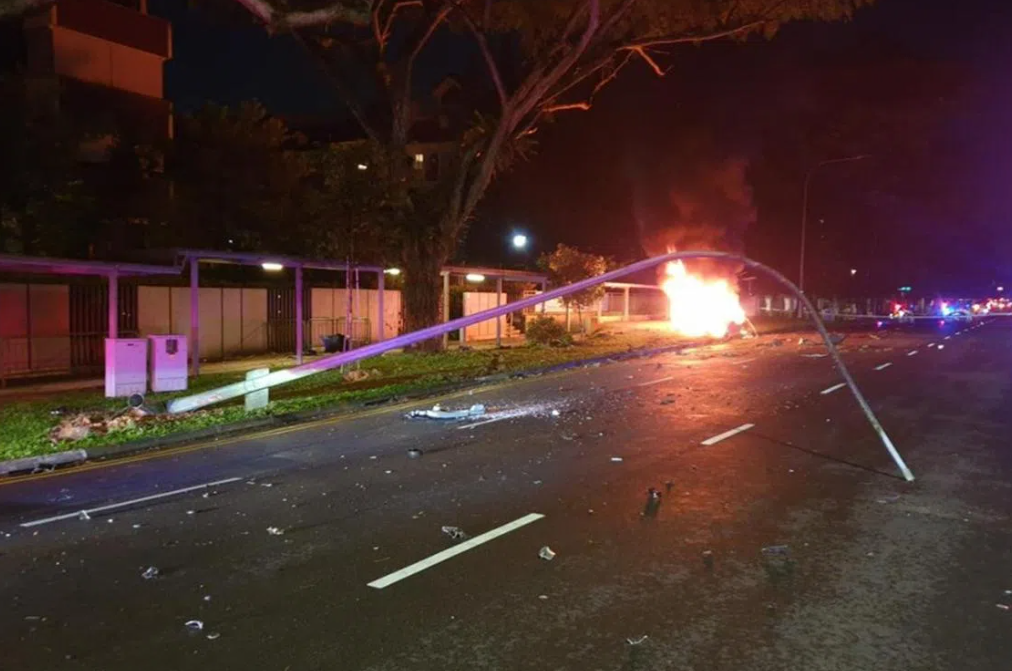
A 29-year-old man in Singapore is confronting serious criminal charges after a chaotic early-morning driving incident on March 6 that resulted in collisions with a school bus and lamp post, leaving a trail of injuries and a burning vehicle in its wake. Aaron Tan Yao Cong appeared in court on Thursday, June 18, facing five separate charges related to the incident, which exposed the dangers posed by repeat traffic offenders and highlighted vulnerabilities in child safety on public transport.
The sequence of events that morning revealed a cascade of dangerous driving behaviours that unfolded over mere minutes. Around 5.50am, Tan allegedly failed to follow a traffic sign requiring him to proceed straight along Cavenagh Road towards Bukit Timah Road. Instead, he steered his vehicle leftward into a bend that directed him directly into oncoming traffic. He subsequently halted on the left side of the two-lane Cavenagh Road, orientation toward Buyong Road. Court documents indicate that Tan had three passengers in his vehicle at this point, and all four occupants would eventually escape the burning wreckage that awaited them minutes later.
Police began closing in on Tan at approximately 6am, but rather than cooperating, he accelerated away from the scene. What followed was a high-speed chase through the early morning streets of Singapore's northern residential areas. Between 6.16am, officers tracked Tan along Bukit Timah Road toward Upper Bukit Timah Road, where he was weaving between vehicles at an average speed of 114 kilometres per hour—significantly exceeding safe highway velocities in urban settings. He maintained this dangerous pattern of erratic lane changes between Coronation Road and Anamalai Avenue, creating hazardous conditions for other motorists navigating the same roads during peak commute hours.
The collision occurred at the junction of Sixth Avenue when Tan allegedly disregarded a red traffic light signal. At that precise moment, a private minibus carrying a driver and two young passengers—both aged nine and ten—was executing a U-turn. The impact between Tan's vehicle and the school bus was forceful enough to cause his car to careen forward and strike a lamp post. The energy from this second collision ignited the vehicle, which quickly became engulfed in flames. Despite the dramatic circumstances, all occupants of both vehicles managed to evacuate before the fire fully consumed the automobile.
Emergency responders transported all involved parties to hospital for assessment and treatment. While the adults in both vehicles were examined, the two schoolchildren riding on the bus required ongoing medical attention following the collision, illustrating the particular vulnerability of young passengers to injury in traffic accidents. The fact that children were involved significantly elevates the severity and societal concern surrounding Tan's driving behaviour, adding a child safety dimension to what is already a serious criminal matter.
Alcohol was a critical factor in this incident. When police apprehended Tan, he refused to cooperate with a breathalyser test at the scene. Nevertheless, subsequent testing revealed that his blood alcohol concentration measured approximately 148 milligrams per 100 millilitres of blood—a reading that substantially exceeded Singapore's legal driving limit of 80 milligrams per 100 millilitres. This level of intoxication, combined with the dangerously high speed and poor judgment demonstrated throughout the morning, created a catastrophic situation that could easily have resulted in fatalities.
Tan's criminal history compounds the gravity of his current predicament. Court records show that he was previously convicted in 2019 of both drink-driving and driving without due care and attention. Rather than serving as a deterrent, his prior convictions appear not to have altered his behaviour, making him a repeat offender in the eyes of Singapore's justice system. This pattern of recidivism often results in substantially harsher sentencing recommendations and increased penalties compared to first-time offences.
The five charges Tan now confronts encompass the breadth of his unlawful conduct that morning: drink-driving as a repeat offender, dangerous driving causing hurt, leaving a vehicle in a position likely to endanger others, failing to provide a breath specimen when legally required, and driving against the flow of traffic. Each charge carries distinct potential consequences, and the cumulative sentencing exposure is considerable. If convicted of drink-driving as a repeat offender, Tan faces imprisonment up to two years and fines reaching $20,000 Singapore dollars. The dangerous driving charge carries similar maximum terms, though repeat offenders face increased fine thresholds of up to $20,000.
Additional charges carry more modest individual penalties but collectively extend his exposure. The vehicle position charge allows for up to three months' imprisonment or $1,000 in fines. Failure to provide a breath specimen carries potential detention of six months and fines up to $5,000, with repeat offenders subject to enhanced penalties reaching one year imprisonment and $10,000 fines. The final charge—driving against traffic flow—carries three months' imprisonment or $1,000 fines, escalating to six months and $2,000 for repeat offenders. The cumulative maximum exposure significantly exceeds what any single charge might impose.
Singapore's approach to repeat traffic offenders reflects broader regional concerns about road safety. The island nation has consistently implemented strict penalties to discourage reckless behaviour, particularly drink-driving. The case of Aaron Tan Yao Cong demonstrates both the effectiveness of enforcement mechanisms in apprehending dangerous drivers and the challenges posed by offenders who repeatedly disregard traffic laws and safety regulations despite previous legal consequences. His scheduled return to court on July 16 will determine whether he enters guilty pleas to any charges or maintains his current position.
For Malaysian observers and those across Southeast Asia, the Singapore case underscores persistent challenges with repeat traffic offenders and the inadequacy of prior convictions alone in preventing future violations. It raises questions about how judicial systems balance rehabilitation with public protection, and whether custodial sentences and financial penalties represent optimal approaches to modifying dangerous driving behaviour. The involvement of schoolchildren also highlights broader concerns about child safety in transit, an issue affecting transport systems throughout the region where students rely on buses for daily school access.