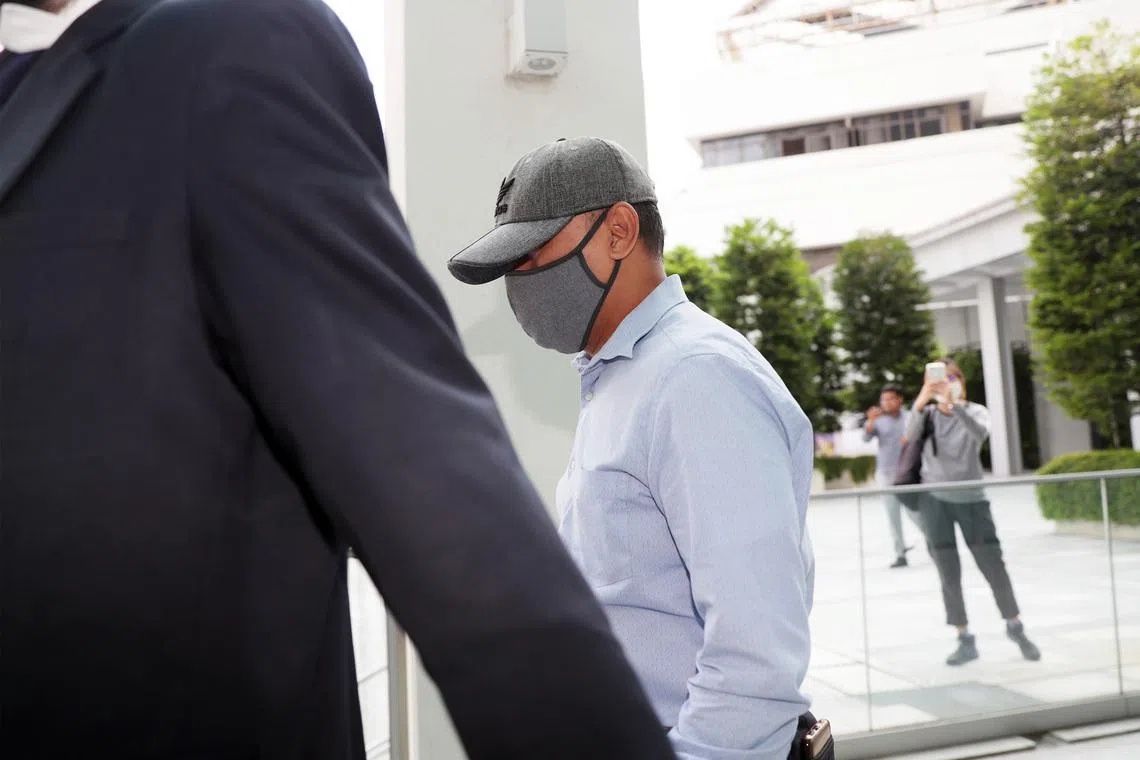
A 59-year-old former executive chairman of two Singapore mosques has been handed a 14-month jail sentence for orchestrating a corruption scheme that compromised competitive bidding on construction projects. Abdul Rahim Mawasi, who led both Darul Aman Mosque on Jalan Eunos and Sallim Mattar Mosque in MacPherson, exploited his position to provide a long-standing acquaintance with crucial inside information on pricing, enabling that friend's construction company to secure contracts valued at S$223,000.
The case, prosecuted by Deputy Public Prosecutor Bryan Wong, illustrates how officials with oversight responsibility can manipulate procurement processes for personal gain. Mawasi held dual roles as executive chairman of the two mosques' management boards while simultaneously serving as a senior officer with the Islamic Religious Council of Singapore, known as MUIS, to which he was formally seconded. This arrangement placed him at a critical juncture where mosque operations intersected with his official duties, creating conditions ripe for abuse of authority. The court found him guilty in April following a trial, with sentence delivery occurring on June 26.
The corruption originated in July 2018 when Mawasi proposed to his friend Mohd Mustaqim Kam—also known as Kam Hock Beng—a partnership proposition: establish a pilgrimage travel company requiring no initial capital outlay from Mawasi. In exchange, Mawasi undertook to facilitate construction contracts from the two mosques, with profits feeding into the venture's operating capital. Kam, then 66 years old, directed Zeal-Con Engineering, a construction firm positioned to benefit substantially from this arrangement. The scheme capitalized on Mawasi's insider access while simultaneously creating financial incentives for him through an equity stake held indirectly via his son.
When Darul Aman Mosque sought vendors for yard construction work in 2018, Zeal-Con submitted competing quotations. The first proposal, dated August 20, 2018, priced the work at S$128,600. However, following extensive discussions between Mawasi and Kam regarding bid strategy—conversations that remained unknown to the mosque's management board—Zeal-Con resubmitted a revised quote on September 12 at S$118,000. This figure undercut the next-lowest competing bid by S$7,500, submitted by an alternative contractor at S$125,500. The competitive advantage derived entirely from Mawasi's confidential guidance on pricing thresholds.
The prosecution demonstrated that Mawasi had deliberately provided Kam with "crucial price indications" that allowed Zeal-Con to calibrate its bid precisely, securing the contract award on September 26, 2018. The mosque's board remained unaware of these behind-the-scenes negotiations, operating under the assumption that a fair competitive process had produced the most economical option. Similar patterns emerged at Sallim Mattar Mosque, where Zeal-Con submitted a quotation of S$115,700 in September 2019 for roof and reception area works. By July 2019, a revised quote of S$105,000 for identical scope emerged, again reflecting Mawasi's advice to reduce pricing for competitive advantage.
Mawasi's scheme extended beyond simple bid manipulation into deliberate concealment infrastructure. In November 2019, the travel venture was formalized as Amal Travel and Tour, capitalized at S$100,000 with 100,000 shares issued. Rather than holding shares directly—which would trigger disclosure requirements to MUIS—Mawasi arranged for his son to receive 25,000 shares valued nominally at S$1 each. This stratagem served to obscure his beneficial interest in the joint venture, breaching his duty to declare conflicts arising from the partnership with a contractor holding mosque contracts. The prosecution characterized this concealment as deliberate evasion designed to prevent detection.
During trial proceedings, Mawasi's legal counsel, Satwant Singh Sarban Singh, maintained that his client bore no involvement in Amal Travel and Tour and held no equity stakes whatsoever. The defence positioned the arrangement as Kam's independent initiative, unconnected to Mawasi's facilitation of construction contracts. However, the evidence trail—spanning price discussions, quota reductions, and the structured share allocation through his son—proved incongruent with claims of disconnection. The court determined that Mawasi's corruption constituted a serious public sector offence motivated by financial gain, warranting substantial custodial punishment.
Interestingly, prosecutors acknowledged that neither mosque sustained measurable financial loss from the arrangement. Zeal-Con executed the construction work satisfactorily, delivering completed projects meeting technical specifications. This fact, however, did not mitigate culpability. The corruption lay not in defective outcomes but in the procedural violations and integrity breaches that compromised the institutional trust underlying mosque governance. Religious institutions depend fundamentally on stewardship by officials demonstrating unquestionable probity; Mawasi's exploitation of sacred trust compounded the offence's severity.
Mawasi's co-conspirator, Kam, received a six-month jail sentence in February 2025, reflecting his secondary role as the contractor beneficiary rather than the official orchestrating the scheme. The disparity in sentencing—14 months versus six months—underscores how courts weight the responsibilities borne by public servants. Officials holding fiduciary positions face heightened accountability standards; Mawasi's breach of such duties amplifies culpability beyond that of a contractor merely accepting advantageous conditions.
The case resonates across Southeast Asia's civil service and institutional governance frameworks. Corruption prosecutions targeting religious institution officials remain relatively uncommon in the region, making this conviction notable for establishing prosecutorial willingness to pursue corruption within faith-based organizations. Malaysia's own Islamic administrative bodies warrant noting: JAKIM, state Islamic departments, and mosque management boards operate similar committee structures where officials wield discretion over procurement and contract awards. The Mawasi case underscores vulnerability within such systems where oversight mechanisms prove insufficient to prevent officials from manipulating vendor selection.
Mawasi's bail has been set at S$30,000, with his sentence commencing on July 10. His previous unblemished record—no prior convictions—did not persuade the court toward leniency; the nature of the corruption and deliberate concealment strategies overrode mitigation arguments. This stance signals judicial determination to enforce accountability standards regardless of an offender's historical conduct. For regional observers, the conviction reinforces that corruption within religious institutional contexts attracts serious penalties in developed jurisdictions, establishing precedent that may influence prosecutorial approaches across Southeast Asia's own faith-based bureaucracies.

