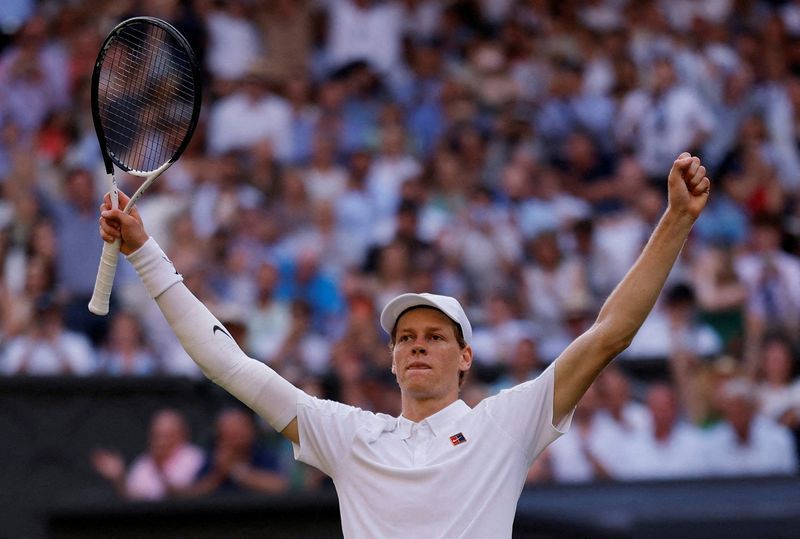
Jannik Sinner returns to the All England Club as defending Wimbledon champion, yet the Italian's commanding grip on men's tennis has visibly loosened. The world number one enters the tournament seeking to restore confidence after an unexpected collapse at Roland Garros last month, where a 30-match winning streak spanning from February was suddenly halted in the second round. Sinner's physicality, the foundation of his dominance, became a liability in Paris, and now experts and rivals alike are scrutinising whether the 24-year-old can bounce back on grass or whether the cracks exposed in France signal deeper fragility when Grand Slam pressure intensifies.
The circumstances surrounding Sinner's withdrawal from Paris merit closer examination for understanding his prospects at Wimbledon. The Italian had engaged in an exceptionally demanding schedule across the two months preceding Roland Garros, with minimal recovery periods and insufficient opportunity to conduct intensive training sessions. This relentless programme depleted his reserves precisely when he needed them most, leaving him physically drained rather than mentally unprepared. Seven-time Grand Slam champion Mats Wilander offered this perspective to La Gazzetta dello Sport, suggesting that Sinner's underlying quality remains intact despite the setback. Wilander observed that the player is now properly rested and should arrive in strong condition, though he cautioned that grass surfaces present unique challenges that differ markedly from the claycourt environment where Sinner thrives.
Wilander's assessment represents the measured view within professional tennis circles—that Sinner remains the tournament favourite despite obvious vulnerability. The absence of injured Spanish champion Carlos Alcaraz, who won Wimbledon in 2023 and 2024, removes arguably the only other contemporary player with demonstrated mastery across multiple surfaces. Alcaraz's presence would have created a fascinating matchup with Sinner, but his injury creates a power vacuum in the draw. However, this void has simultaneously enlarged the field of genuine contenders, transforming what might have been a coronation into a genuinely competitive championship.
Novak Djokovic emerges as the most formidable challenger to Sinner's reign. The 39-year-old Serbian champion possesses distinctive strengths on grass that other contenders lack: his exceptional returning of serve and economical movement allow him to dictate points that opponents believe they should win. Djokovic has not claimed the Wimbledon title since 2022, yet his four previous championship victories at the venue demonstrate sustained mastery. More substantially, Wimbledon represents perhaps his final realistic opportunity to capture an elusive 25th Grand Slam title outright, breaking the tie with Roger Federer's record. Time operates relentlessly against the aging champion, and he will be acutely conscious that this championship may represent his final genuine chance at immortal status within the sport.
Three-time Wimbledon finalist Andy Roddick articulated on his podcast why Djokovic cannot be discounted despite his early exit at Roland Garros. Roddick argued that an early French Open departure need not diminish Djokovic's prospects at the All England Club, particularly given the Serb's historical dominance on grass. He suggested that Djokovic possesses the tactical intelligence to convince himself of his viability as tournament favourite, especially with Sinner's recent struggles now widely documented. For Djokovic, Wimbledon represents not merely another tournament but potentially a transformative moment in his late career narrative—an opportunity to rewrite recent history through one final major triumph.
Alexander Zverev enters this championship with arguably the strongest recent credentials among Sinner's pursuers. The German champion secured his first Grand Slam title at Roland Garros, finally breaking through on the sport's biggest stages after years of promising but unfulfilled campaigns. That breakthrough victory carries psychological weight that extends beyond Paris itself; Zverev now understands viscerally that he possesses the capacity to defeat the world's finest players in championship matches. His powerful serve represents a natural advantage on grass, where serves prove more difficult to return than on slower surfaces. Boris Becker, the six-time Grand Slam champion and fellow German who understands grasscourt tennis intimately, effectively declared Zverev the favourite in an Eurosport interview, citing both his current momentum and the comparative vulnerability of his chief rivals.
Becker's pronouncement carries weight from genuine authority. The legendary German observed that with Alcaraz unavailable and Sinner's fitness questionable, Zverev possesses precisely the weaponry required for Wimbledon success. Becker emphasised that a powerful serve essentially provides a player with semi-automatic passage to the semi-finals at the All England Club, reducing the probability of extended baseline rallies that favour different skill sets. Zverev must adapt his game to grasscourt demands, certainly, but Becker judged these adjustments within his capabilities. For Malaysian readers following international tennis, Zverev's emergence as a legitimate title contender illustrates how quickly fortunes shift in professional sport—his Paris breakthrough has materially altered perceptions of his viability at subsequent majors.
Djokovic's presence at Wimbledon creates an intriguing subplot for Asian tennis followers. The Serbian champion has historically dominated the Australian Open, Wimbledon, and the US Open, establishing himself as the hard and grass court master of his generation. However, his recent trajectory has declined notably, with younger challengers increasingly imposing their will. For Malaysian sports enthusiasts accustomed to following regional players and understanding the tournament dynamics across different surfaces, Djokovic's final chapter at the game's highest level warrants close attention. His pursuit of meaningful Grand Slam titles continues, and Wimbledon represents his most accessible remaining opportunity.
Beyond the established hierarchy, several secondary contenders possess the capacity to trouble Sinner and his immediate rivals. American players Ben Shelton, Taylor Fritz, and Frances Tiafoe all possess the aggressive, serve-oriented games that translate effectively to grass. Italian Roland Garros runner-up Flavio Cobolli represents the next generation pressing for advancement, embodying the wave of emerging players seeking to establish themselves among tennis's elite. The absence of Alcaraz has therefore created a genuinely open draw where unexpected runs and surprise results become plausible rather than shocking exceptions to anticipated outcomes.
Sinner's preparation for Wimbledon has itself generated discussion about his readiness. The defending champion consciously avoided tune-up tournaments in the weeks preceding the Grand Slam, opting instead for focused preparation. This decision contrasts with traditional approaches where players seek competitive rhythm through warm-up events. Sinner's choice suggests either exceptional confidence in his grasscourt preparation or, alternatively, lingering physical concerns that necessitate cautious management. The tennis world will scrutinise his early-round performances closely for indications of whether he has genuinely recovered or whether vulnerabilities identified in Paris persist beneath the surface.
For Malaysian readers evaluating this championship, several elements merit particular attention. First, Sinner's vulnerability creates opportunities for underdogs and reinforces that even dominant athletes experience periods of struggle. Second, Djokovic's twilight pursuit of ultimate achievement provides a human dimension transcending technical tennis analysis—his quest for a 25th Grand Slam resonates emotionally beyond the sport itself. Third, Zverev's emergence as title favourite illustrates how breakthrough performances can permanently alter career trajectories. The 2024 Wimbledon championship promises competitive tennis of exceptional quality, with the traditional favourite significantly weakened and multiple challengers genuinely capable of claiming the title. Sinner's journey from imperious favourite to wounded defender seeking redemption supplies the narrative tension that distinguishes this year's championship from its predecessors.

