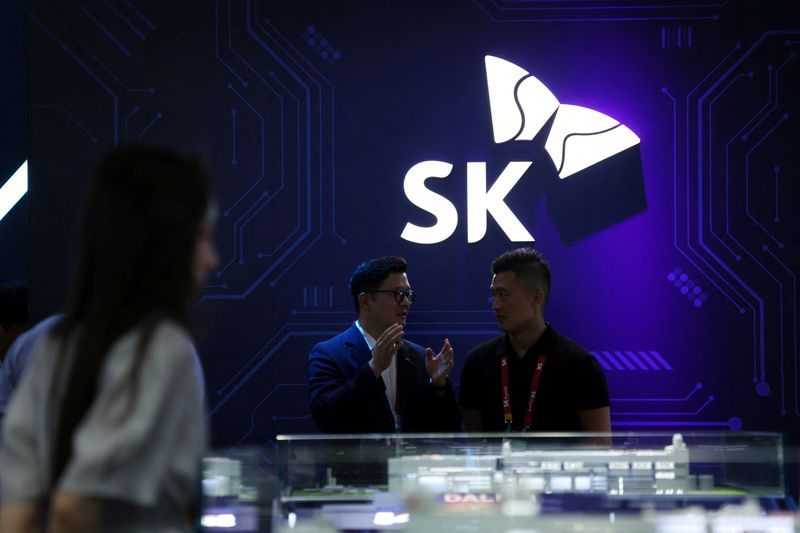
South Korea's SK Hynix is preparing for what could become the largest-ever American Depositary Receipt offering, planning to raise up to 45.45 trillion won ($29.43 billion) through a Nasdaq listing scheduled for July 10. The fundraising move underscores the semiconductor industry's recognition that artificial intelligence deployment is reshaping global computing infrastructure and capital requirements. The company filed the regulatory announcement on Wednesday, signalling its intent to tap international capital markets at a critical moment when AI-capable semiconductors command unprecedented valuations and production constraints persist across the sector.
The proposed listing represents a dramatic expansion of SK Hynix's international footprint and shareholder base beyond its South Korean core. By issuing 17.79 million new shares to back the ADR offering, the company is effectively betting that global investors will reward its strategic positioning in memory chips essential to AI systems. The conversion structure—where ten ADRs equal one common share—creates a trading mechanism designed to attract institutional and retail buyers accustomed to Nasdaq conventions. Investment banking heavyweights including BofA Securities, Citigroup Global Markets, Goldman Sachs and JP Morgan Securities are managing the offering, reflecting the transaction's significance and complexity.
The fundraising amount announced carries provisional status, as SK Hynix noted that final pricing could shift following bookbuilding sessions with institutional investors. This flexibility is standard practice in major capital raises, allowing the company to capture market conditions and investor demand at launch. However, even if the final amount differs from the ceiling, the transaction's scale signals transformative capital ambitions. For Malaysian investors and regional finance observers, such mega-offerings indicate how Southeast Asian capital markets remain secondary to global financial centres when mega-cap companies pursue strategic recapitalisations.
Capital deployment plans reveal SK Hynix's infrastructure-building strategy across its South Korean operations. The company intends to construct a chip factory in Yongin, establish an advanced packaging fabrication facility in Cheongju, and acquire sophisticated manufacturing equipment including Extreme Ultraviolet Scanners—technologies essential for producing next-generation semiconductors. These facilities represent investments in production capacity for high-bandwidth memory chips, which have emerged as critical bottlenecks in AI system deployment. The strategy reflects recognition that chip shortages, rather than demand weakness, constrain the AI revolution's pace.
SK Hynix's ascendancy in the AI semiconductor ecosystem positions the company at the intersection of geopolitical competition and technological transformation. As a dominant supplier of high-bandwidth memory chips used by customers including Nvidia and Alphabet's Google, the company commands leverage over firms accelerating AI infrastructure buildouts. The competitive advantage compounds when production constraints limit rival chipmakers' output. This supplier concentration means SK Hynix can command premium pricing and secure long-term customer commitments, justifying aggressive capital expenditure on manufacturing capacity expansion.
The significance of this listing extends beyond corporate finance into South Korean economic prominence. SK Hynix achieved distinction as the nation's most valuable company on Monday, surpassing Samsung Electronics—a symbolic moment reflecting the semiconductor industry's centrality to 21st-century competitiveness. Samsung's displacement marks a generational shift, with memory chip specialization now trumping Samsung's historical diversification across consumer electronics, chemicals and heavy industries. For South Korea, this transformation validates the country's strategic bet on advanced semiconductors as a pillar of future prosperity, though it also concentrates economic risk in a single sector vulnerable to cyclical downturns and geopolitical disruption.
If completed at the upper end of the indicated price range, the transaction would establish a new benchmark for ADR offerings globally. The previous record, Alibaba's $21.8 billion New York debut in 2014, has stood for a decade. SK Hynix surpassing this milestone would signal that semiconductor infrastructure commands investment appetite exceeding consumer technology platforms, reflecting AI's transformative economic impact. The comparison also highlights how technology sector capital requirements have escalated, with manufacturing-intensive businesses now pursuing funding volumes previously associated only with financial institutions and energy infrastructure.
Regional implications deserve careful consideration by Southeast Asian observers and policymakers. The ADR listing mechanism allows South Korean corporations to access American capital markets while maintaining primary listings in Seoul, a structure that Vietnamese, Thai and Indonesian companies have explored but rarely executed at such scale. SK Hynix's success could encourage regional technology companies to pursue international listings, though few possess comparable scale or customer relationships. More immediately, the capital raise may accelerate SK Hynix's ability to satisfy customer orders, potentially easing semiconductor supply constraints affecting regional manufacturing sectors dependent on memory chips.
The fundraising timing capitalizes on peak enthusiasm for AI-related investments. Institutional investors globally have demonstrated willingness to commit capital to firms positioned throughout semiconductor value chains, from equipment manufacturers to chipmakers to software developers. SK Hynix's proven customer relationships with industry leaders like Nvidia and Google provide conviction that capital expenditure will generate returns, distinguishing this capital raise from speculative technology listings. The company's track record of disciplined capital allocation and operational execution strengthens investor confidence in management's ability to deploy $29 billion effectively.
Geopolitical considerations shadow this transaction, particularly regarding semiconductor nationalism and supply chain resilience concerns in Western nations. While SK Hynix's production remains concentrated in South Korea, securing American capital market access and dollar-denominated funding enhances the company's stability from US policymakers' perspective. By attracting American institutional capital, SK Hynix potentially reduces exposure to future South Korean regulatory restrictions or geopolitical complications between Seoul and Washington regarding technology export controls. The listing therefore represents a hedging strategy alongside straightforward capital raising.
For Malaysian investors, SK Hynix's ADR offering presents opportunities to gain exposure to premium semiconductor manufacturing without direct equity ownership in Seoul-listed shares. American Depositary Receipts trade on Nasdaq in US dollars, offering liquidity comparable to American equities. Malaysian fund managers and institutional investors seeking semiconductor sector exposure without country-concentration risk may view SK Hynix ADRs as an accessible alternative to concentrated bets on individual advanced economies' tech ecosystems. The listing effectively globalizes access to SK Hynix's growth trajectory.
The transaction underscores how artificial intelligence adoption is reshaping global capital allocation and industrial strategy. Rather than marginal improvements to existing products, AI deployment requires wholesale infrastructure modernization—from data centres to training clusters to inference systems. SK Hynix's $29 billion capital raise represents not an exceptional outlier but rather the scale of investment that industry transformation demands. Companies positioned throughout this value chain will likely pursue comparable fundraising activities, reshaping technology sector financing patterns for years ahead.
SK Hynix's strategic positioning as a beneficiary of the AI boom creates durability in its valuation premium. Unlike speculative technology companies, SK Hynix supplies irreplaceable components for systems already deployed at scale by the world's most valuable companies. This customer concentration and mission-criticality reduce execution risk relative to consumer technology firms. As institutional investors evaluate semiconductor exposure through ADRs and other mechanisms, SK Hynix's demonstrated indispensability to contemporary technology infrastructure should support investor appetite for the July 10 listing, potentially enabling the company to achieve or exceed its ambitious fundraising target.

