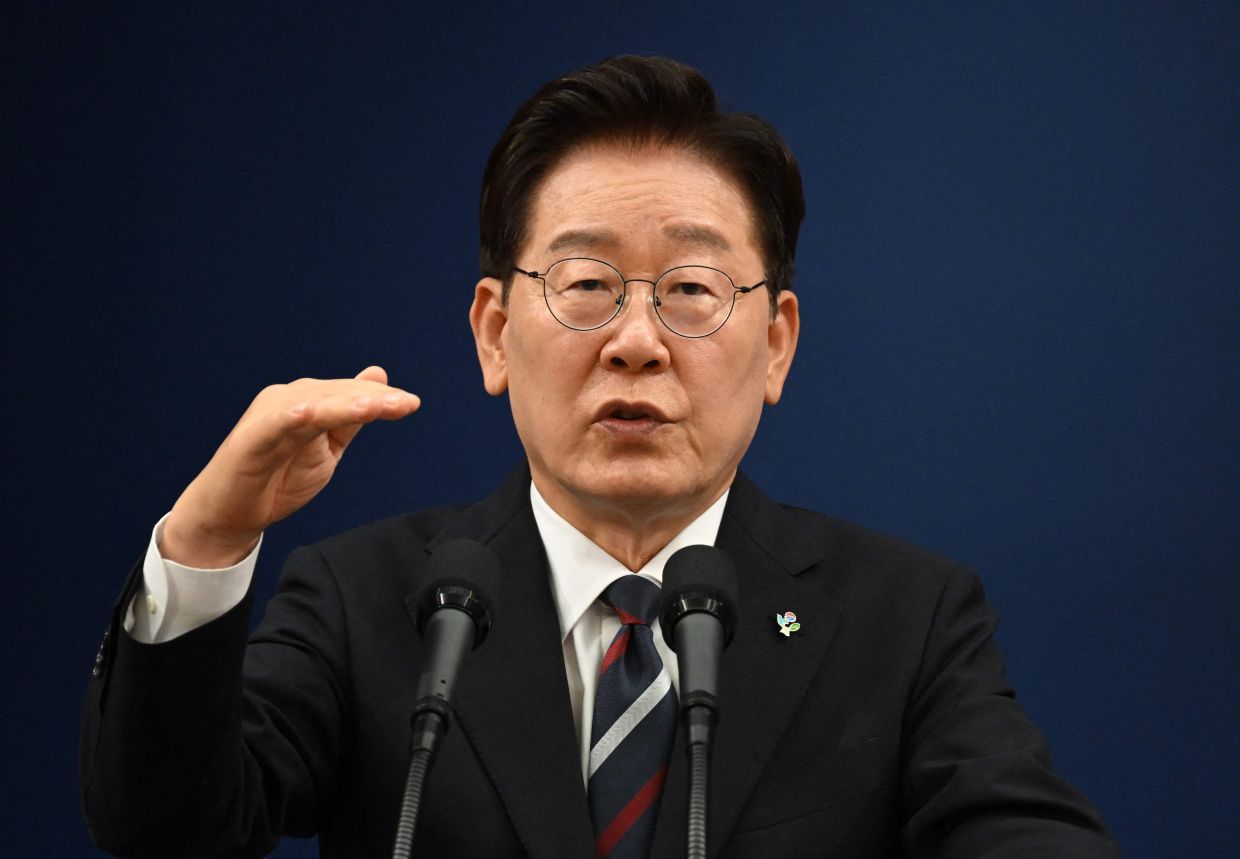
South Korean President Lee Jae Myung's political standing has deteriorated significantly, with his approval rating dropping to 46.7 per cent in the week ending June 22, marking the first occasion that public disapproval has surpassed approval since he assumed office just over six weeks earlier on June 4, 2025. The downward spiral, which has persisted for five consecutive weeks according to polling by Realmeter, represents a sharp reversal of fortune for the newly installed leader and signals potential turbulence ahead for his administration as it grapples with mounting challenges on multiple fronts.
The erosion of presidential support has been steady and pronounced. Lee's approval rating stood at a robust 60.5 per cent during the second week of May, but the trajectory since then has been relentlessly downward, moving through 59.3 per cent, 59.1 per cent, and 55.2 per cent before settling at the current level. This week-on-week decline of 4.8 percentage points represents the steepest single-week drop recorded during his tenure, underscoring the accelerating nature of the political damage. Disapproval ratings have correspondingly climbed to 49.7 per cent, a gain of 5.5 percentage points, leaving just 3.6 per cent of respondents undecided.
Contextualizing Lee's experience within the broader trajectory of recent South Korean presidents reveals the speed at which his position has weakened relative to predecessors. Former President Yoon Suk Yeol did not experience this crossover until six weeks into his administration, while Park Geun-hye took approximately 16 months to reach the same threshold and Moon Jae-in required 19 months. Lee has reached this critical inflection point in under seven weeks, suggesting either unusually severe initial crises or particular vulnerability in his political standing among the electorate.
Two interconnected crises have precipitated the sharp decline in public confidence. The first stems from administrative failures surrounding the June 3 local elections, where ballot shortages triggered widespread criticism of the government's electoral management capabilities. This operational fiasco exposed serious governance vulnerabilities at a moment when a new administration typically enjoys a honeymoon period with voters. Compounding this damage, bitter leadership succession struggles within Lee's ruling Democratic Party of Korea have consumed political attention and energy, with party members increasingly vocal about internal disputes ahead of the August 17 convention to select a new party chair. This combination of executive dysfunction and factional infighting has created a narrative of disarray that has permeated public discourse.
The polling organization attributed the decline specifically to "growing demands for accountability following the election management fiasco and escalating infighting within the ruling party over its leadership race." However, Realmeter noted that some countervailing positive developments have provided partial offsets to this damage. Lee's recently completed European trip was perceived favourably by segments of the public, and the Korean composite stock index, the Kospi, breached the psychologically significant 9,000-point threshold, indicators that might typically bolster presidential approval ratings. That these economic and diplomatic positives have proved insufficient to arrest the decline suggests the severity of the underlying crisis.
Geographic variations in disapproval reveal important patterns about which voter constituencies have been most alienated. The sharpest erosion occurred in conservative strongholds, with Lee's approval rating plummeting 9.9 percentage points to just 34.6 per cent in the southeastern provinces of Daegu and North Gyeongsang. This collapse of support in traditionally sympathetic terrain is particularly alarming for a conservative president, indicating that even his party's core demographic has grown dissatisfied. The Greater Seoul region, encompassing Incheon and Gyeonggi Province as well as the capital itself, has also swung sharply against Lee, with approval ratings declining 7.6 percentage points in each location to 44.8 per cent and 39.8 per cent respectively. These metropolitan areas, which typically exercise disproportionate influence on national political outcomes, represent a weakening foundation for presidential authority.
Demographic analysis illuminates which voter segments have been most responsive to recent events. Among moderates, approval slid 4.9 percentage points to 47.5 per cent, suggesting erosion of the centrist consensus that forms a critical stabilizing force in South Korean politics. Liberal voters, while maintaining substantially higher approval at 80.4 per cent, nonetheless registered a 3.2 percentage point decline, indicating that even the Democratic Party's traditional supporters harbor growing reservations. Conservative voters, already at merely 19.8 per cent approval, showed only minimal additional slippage of 0.7 percentage points, suggesting the floor has nearly been reached among that constituency. Notably, concerns about widening disparities in asset markets have particularly resonated with moderate voters and Seoul metropolitan residents, indicating that economic inequality has become a salient concern competing with traditional partisan attachments.
The presidential office has responded to the polling data with expressions of contrition and pledges of attentiveness. In a statement from Cheong Wa Dae, the administration acknowledged that it would "accept the numbers humbly and take greater heed of people's concerns and expectations." The response framed the approval fluctuations as reflecting public assessment of both economic conditions and the broader conduct of state affairs, attempting to position the decline within normal democratic processes rather than as a reflection of fundamental failure. However, such rhetorical acknowledgment has historically provided limited relief when institutional problems remain unresolved.
The travails of Lee's Democratic Party have created a complex political environment where factional disputes threaten the coherence required to govern effectively. A separate Realmeter survey of partisan support found the conservative People Power Party maintaining a narrow 42.3 per cent to 40.1 per cent advantage over the Democratic Party, though this gap had significantly narrowed from the prior week. The opposition party's modest gains of 2.1 percentage points have come despite mounting controversies surrounding the election administration failures, suggesting that the bipartisan agreement to launch a National Assembly investigation into these failures may have provided tactical relief. The People Power Party's support eroded by 2 percentage points as internal conflicts over leadership accountability compounded the controversies, with particularly steep declines among younger voters aged 20 to 39, who have registered double-digit approval decreases.
The Democratic Party's slight recovery appears driven partly by strategic messaging emphasizing party unity behind governmental success, even as underlying factional tensions persist beneath the surface. For Malaysian and broader Southeast Asian observers, the dynamics unfolding in South Korea offer instructive lessons about the vulnerability of newly installed administrations to operational missteps and the capacity for internal party strife to magnify electoral setbacks. Lee's experience suggests that the transition between electoral victory and effective governance requires not merely popular mandate but sustained demonstrable competence in executing core administrative functions, a requirement that transcends regional context.

