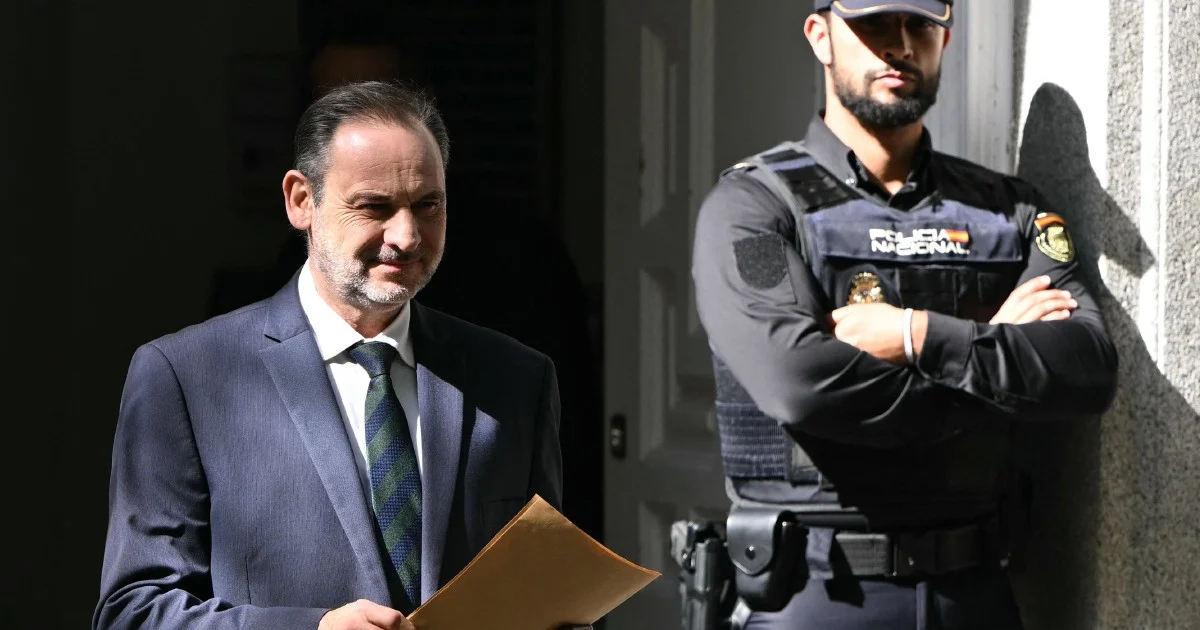
The Spanish judiciary dealt a significant blow to Prime Minister Pedro Sanchez's administration on Monday when a court in Madrid handed a 24-year prison sentence to Jose Luis Abalos, one of his most prominent former advisers who previously served as transport minister. The conviction marks a dramatic fall from grace for a political figure who once occupied one of Spain's most influential posts and enjoyed direct access to the country's highest decision-making circles.
Abalos's downfall reflects the kind of institutional pressure that European governments face when their officials become entangled in corruption allegations. Spain, like several other European Union member states, has witnessed renewed judicial scrutiny of political figures in recent years, signalling a shift towards more robust enforcement of anti-corruption laws at the highest levels of government. The case underscores that proximity to power offers little protection once prosecutors and courts decide to pursue allegations of impropriety.
The former minister's conviction carries particular significance given his role within Sanchez's government and the Socialist party's historical positioning as a reform-oriented political force. Spanish voters and civil society observers have long scrutinised the coherence between politicians' anti-corruption rhetoric and their actual conduct. This conviction demonstrates that the Spanish court system, at least in this instance, appears willing to enforce accountability regardless of an official's previous standing or political affiliation.
For Malaysia and other Southeast Asian nations, the Spanish case offers instructive lessons about institutional resilience in combating corruption. While different legal systems and political cultures shape how each country approaches high-level graft, the principle underlying the Spanish court's action—that no one, regardless of rank or connections, stands above the law—remains universally applicable. Many developing and middle-income economies, including those in ASEAN, continue wrestling with questions about how to build judicial independence robust enough to investigate powerful political actors without descending into selective prosecution.
Abalos's case also highlights the importance of transparent institutional mechanisms that can process corruption allegations systematically. The lengthy sentence suggests the court found substantial evidence of serious wrongdoing rather than minor infractions. This contrasts sharply with scenarios in various jurisdictions where high-ranking officials accused of corruption escape meaningful consequences through political interference, technicalities, or weak enforcement capacity. Spain's willingness to impose a severe penalty reflects both the severity of the charges and the court's confidence in its evidentiary foundation.
The conviction may also influence broader European attitudes towards Spanish governance and institutional performance. Countries seeking to strengthen rule of law internationally often point to examples where their own systems successfully punish corruption at senior levels. Conversely, ongoing cases involving other Spanish politicians or public figures could either reinforce or undermine perceptions of the judiciary's even-handedness. The Spanish example thus becomes part of a wider European conversation about which nations maintain genuinely independent judicial systems capable of resisting political pressure.
For Spanish society specifically, the sentencing represents a moment of institutional reckoning that either vindicates public confidence in the courts or, depending on how additional cases unfold, reveals selective application of justice. Public perception of judicial independence matters enormously for democratic legitimacy. When courts convict powerful former officials credibly and transparently, it can enhance democratic health; when prosecutions appear politically motivated or when comparably guilty officials escape consequences, it erodes confidence in institutions.
The implications for Sanchez's government warrant careful monitoring. While the former transport minister's conviction does not automatically reflect on the prime minister personally, it may complicate his political positioning, particularly if opposition parties weaponise the case to argue that corruption flourished under his watch. Alternatively, the government might argue that the conviction demonstrates the independence and effectiveness of Spain's judicial institutions, operating free from political interference even when investigating senior figures from the ruling coalition.
The case also intersects with broader European Union concerns about corruption and public trust. The EU has increasingly emphasised rule of law as a prerequisite for accessing funding and maintaining the bloc's institutional integrity. Spain's handling of this high-profile corruption case may feature in Brussels assessments of Spain's judicial independence and anti-corruption commitment, potentially affecting the country's standing in intra-EU negotiations and its eligibility for various support programmes or governance endorsements.
Looking forward, observers across Europe and beyond will watch whether Spanish courts pursue similar cases involving other public figures or whether this conviction represents an isolated effort. The consistency with which a judicial system applies anti-corruption measures to officials across party lines and at different career stages determines whether corruption deterrence functions effectively. A single dramatic conviction accompanied by broader impunity sends a weaker signal than systematic enforcement that extends to many actors regardless of their political affiliation or current influence.

