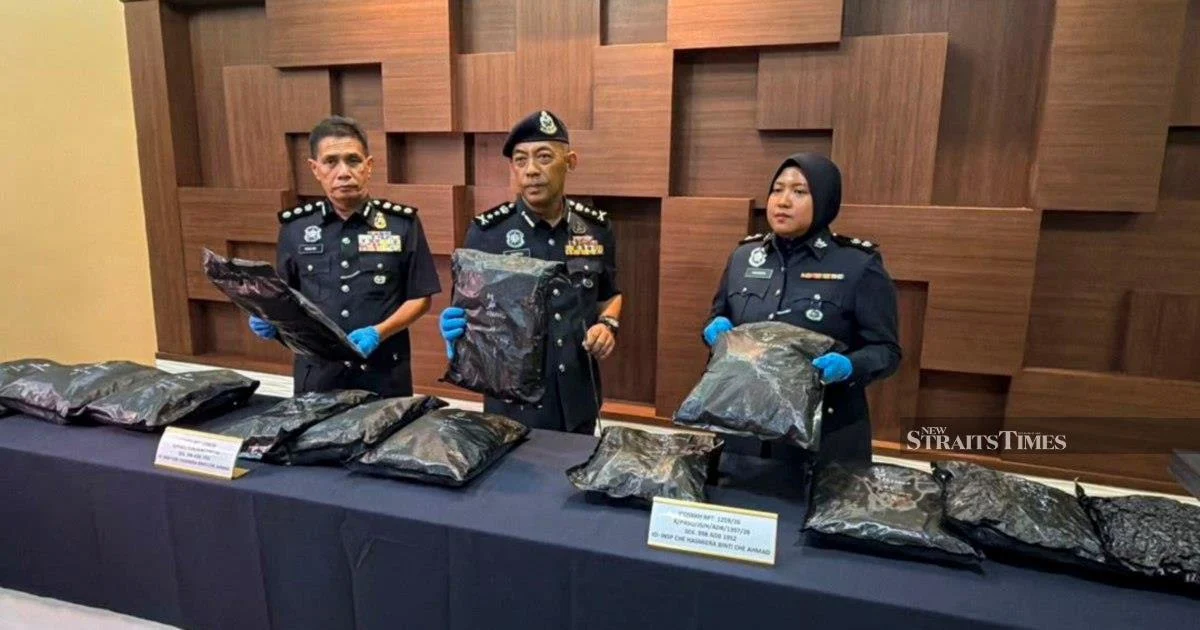
A university student enrolled at a private higher education institution was arrested on Monday at Bukit Kayu Hitam following what authorities believe was an attempt to smuggle cannabis buds across the border from a neighbouring country. The operation resulted in the seizure of 14.63 kilograms of the controlled substance, which has been valued at RM1.17 million by enforcement agencies. The capture marks another significant drug interdiction at Malaysia's northern frontier, where trafficking networks continue to exploit supply routes from across the border.
The student's apprehension underscores the growing involvement of young people, particularly those in academic settings, within transnational drug smuggling operations. Rather than operating as autonomous traffickers, university-aged individuals increasingly serve as couriers or transporters for larger criminal syndicates, compensated modestly for assuming substantial legal and physical risks. This pattern reflects the desperation that debt, financial pressure, or coercion can create, pushing otherwise law-abiding students toward participation in serious criminal enterprises.
Bukit Kayu Hitam, situated in Kedah's Kuala Nerang district, remains a critical chokepoint on the Malaysia-Thailand border. The location's heavy vehicular traffic and mixed residential-commercial character create an environment where smugglers believe they can blend criminal activity into routine cross-border movements. Enforcement agencies have increasingly concentrated resources at this checkpoint, yet the volume of vehicles and the sophistication of concealment methods continue to present operational challenges. The seizure represents a validation of those enhanced scrutiny efforts, though it also reflects how determined traffickers attempt to breach security perimeters.
The cannabis buds recovered represent a significant quantity within Malaysian street-level distribution networks. At the seized valuation, the contraband would have generated substantial retail profit margins once distributed through local dealers. The success of this single interdiction prevents what could have become dozens or hundreds of individual transactions, disrupting supply chains that sustain habitual use and addiction within communities throughout the northern states. However, experts caution that removing one shipment creates only temporary disruption; replacement supplies typically materialise within days as syndicates redirect inventory through alternative routes.
The involvement of a higher education student raises questions about recruitment mechanisms and vulnerability assessment within campus environments. Drug trafficking networks have refined targeting strategies, identifying individuals struggling financially or emotionally, offering seemingly straightforward courier work with compensation packages calibrated to appeal to student-age participants. Universities increasingly face pressure to implement prevention programming and awareness campaigns, yet educational efforts remain reactive rather than proactive in many institutions. The student's specific circumstances—whether motivated by financial necessity, substance dependency, or criminal coercion—remain under investigation.
Legal consequences for this type of trafficking offence are severe under Malaysian law. The Dangerous Drugs Act 1952 prescribes mandatory minimum sentences and significant fines for possession with intent to distribute controlled substances. Given the quantity involved, prosecutors will likely proceed with trafficking charges rather than simple possession, substantially elevating the potential custodial term. For a young offender still in early adulthood, conviction will create permanent legal records affecting employment, travel, and professional licensing opportunities throughout life. The punitive framework, while intended as a deterrent, has demonstrated limited effectiveness in preventing first-time participation by young couriers who may underestimate personal legal exposure.
Malaysia's northern frontier has emerged as a focal point within broader regional drug policy debates. Thailand's troubled relationship with amphetamine-type stimulants and cannabis availability contrasts with Malaysia's uncompromising zero-tolerance stance, creating arbitrage opportunities for trafficking organisations. The neighbouring country's inconsistent enforcement approaches, combined with substantial production capacity in border-adjacent regions, have positioned the Malaysia-Thailand boundary as a major transit corridor. Transnational law enforcement cooperation, while improving, remains complicated by jurisdictional limitations and resource constraints affecting both nations' customs and narcotics agencies.
The arrest also reflects the evolving product preferences within Asian drug markets. Cannabis trafficking has traditionally represented a lower priority compared to methamphetamine and heroin interdiction efforts; however, growing regional demand—partly driven by changing perceptions regarding medical and recreational use—has elevated cannabis seizures statistically. Syndicates have adapted supply logistics accordingly, with larger shipments channelled through traditional trafficking routes. Malaysian enforcement agencies have correspondingly adjusted resource allocation, though some observers argue that cannabis remains subordinated to stimulant-focused operations despite increasing market indicators.
Border security officials indicated that standard documentary checks and vehicle screening procedures led to discovery of the concealed shipment. Enhanced detection methodologies—including canine units and advanced scanning equipment—have gradually improved interdiction capacity at major checkpoints. Nevertheless, the frequency of successful smuggling attempts that evade detection entirely remains unknown, presenting a significant data gap in comprehensive threat assessment. Law enforcement estimates suggest that detected contraband represents perhaps 10 to 20 percent of total trafficking volume, though such figures remain speculative.
The arrested student is expected to face formal charges pending investigation completion and prosecutorial review. Authorities are also investigating potential connections to larger trafficking organisations, seeking to identify higher-level operatives who coordinated the shipment movement. Intelligence agencies view major seizures as investigative entry points, using arrested individuals' cooperation to map criminal networks extending across borders. Whether this particular case yields substantial organisational intelligence or remains isolated remains an open question in ongoing police proceedings.
This incident arrives amid broader regional discussions concerning drug policy harmonisation and enforcement coordination. Southeast Asian nations continue debating whether current prohibition approaches effectively address supply-side problems or inadvertently entrench trafficking infrastructure. While Malaysia maintains stringent drug laws, neighbouring jurisdictions display significant variation, complicating unified regional responses. Student participation in trafficking operations suggests that educational and social intervention strategies may require expansion alongside traditional enforcement mechanisms, though such approaches face budgetary constraints and institutional resistance across the region.