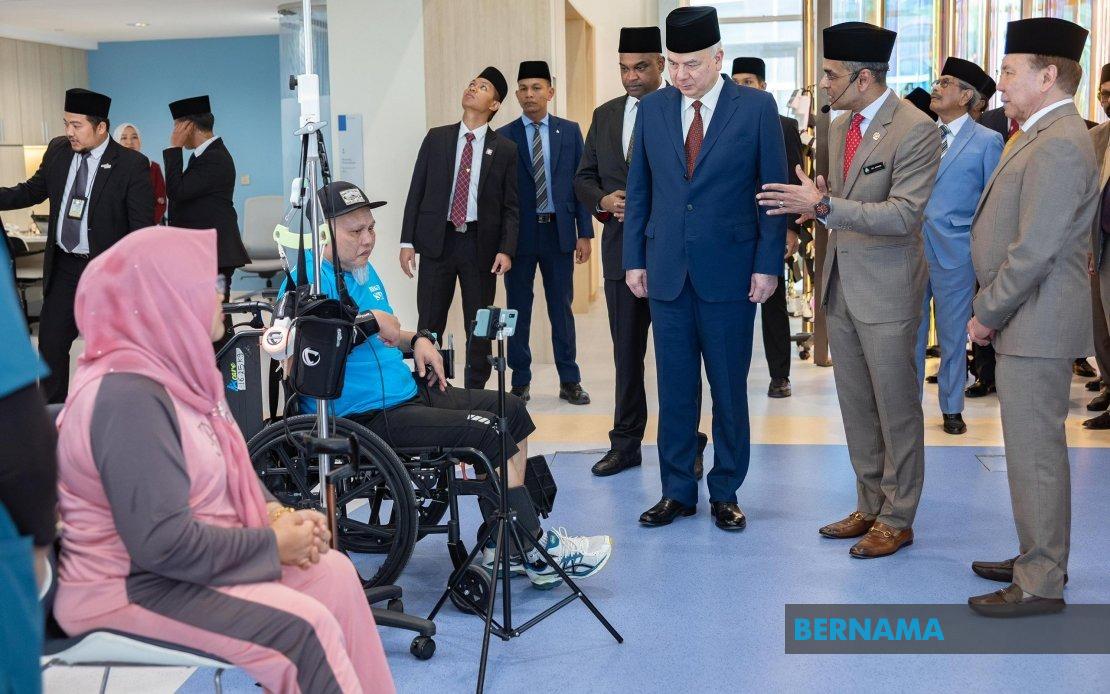
Perak's Sultan Nazrin Shah has officially opened a technologically advanced rehabilitation centre that marks a significant step forward in how Malaysia approaches the recovery and reintegration of injured workers and persons with disabilities. The Pusat Rehabilitasi Perkeso Sultan Nazrin Shah, located in Meru Raya and operated by the Social Security Organisation (PERKESO), represents an investment in both physical infrastructure and a broader philosophical shift in how the nation conceptualises rehabilitation as a pathway to restored dignity rather than mere medical intervention.
The facility's architectural design draws inspiration from traditional Malaysian gold-thread embossing, a cultural element that connects contemporary therapeutic innovation with heritage craftsmanship. Present at the June 16 ceremony alongside the Sultan were Raja Muda Perak Raja Jaafar Raja Muda Musa, Raja Di Hilir Perak Raja Iskandar Dzulkarnain Sultan Idris Shah, Menteri Besar Datuk Saarani Mohamad, and Minister of Human Resources Datuk Seri R. Ramanan, underscoring the occasion's importance across state and federal governance structures.
In his address, Sultan Nazrin emphasised that the centre's true value extends beyond its technological capabilities to encompass the multidisciplinary expertise housed within its walls. The facility integrates medical specialists, assistive technology engineers, physiotherapists, occupational and vocational therapists, social workers, and mental health professionals—a comprehensive approach reflecting evolving international best practice in rehabilitation medicine. This holistic model acknowledges that recovery from stroke, neurological injury, or traumatic brain injury demands attention to physical, psychological, and social dimensions simultaneously.
The Sultan articulated a vision of rehabilitation that reframes disability not as an endpoint but as a chapter within a larger life narrative. For stroke survivors, the centre offers technology and therapeutic expertise to restore motor function and independence. For workers recovering from neurological injury, it provides structured pathways to rebuild both physical capacity and psychological resilience. Individuals navigating traumatic brain injury recovery may access interventions targeting cognitive restoration, speech recovery, and confidence rebuilding. This specificity acknowledges that different injuries require tailored therapeutic responses, moving beyond generic disability services toward precision rehabilitation.
Central to Sultan Nazrin's message was an appeal to Malaysian society to confront and dismantle ingrained prejudices against persons with disabilities. Social attitudes often represent barriers as significant as physical or neurological limitations, and the Sultan positioned the rehabilitation centre as a symbol challenging these perceptions. By demonstrating that dignity, independence, and meaningful employment remain achievable following disability, the facility potentially influences public consciousness regarding disability inclusion and the capabilities of rehabilitation graduates.
A particularly salient aspect of the opening remarks involved highlighting PERKESO's collaboration with 7-Eleven in providing post-rehabilitation workplace training with potential employment pathways. This partnership addresses a critical gap in the rehabilitation ecosystem: the bridge between clinical recovery and sustainable employment. Without structured transition mechanisms connecting therapeutic discharge to meaningful work, rehabilitation outcomes remain incomplete, and individuals face retraumatisation through unemployment and social exclusion. The Sultan's public endorsement of this model signals governmental support for public-private initiatives addressing this integration challenge.
Sultan Nazrin issued a direct call to Malaysia's private sector to expand such collaborations through corporate social responsibility programmes, vocational training arrangements, and dedicated employment pathways for rehabilitation programme graduates. This appeal acknowledges that rehabilitation centres alone cannot generate sustainable economic independence; corporate participation is essential. For Malaysian businesses, particularly multinational operations and large domestic enterprises, this represents an opportunity to demonstrate social commitment while accessing a trained, motivated workforce segment often overlooked in conventional recruitment processes.
The Sultan's framing positioned disability support and rehabilitation-to-employment pathways as moral obligations and collective social responsibility rather than charitable benevolence. This linguistic shift carries weight, suggesting that businesses investing in such initiatives fulfil fundamental societal duties alongside commercial interests. For Malaysian policymakers and corporate leaders reading this messaging, the implication is clear: disability inclusion and rehabilitation support are becoming expected components of responsible corporate citizenship.
Underlying the Sultan's remarks was a broader critique of development metrics that privilege physical and economic indicators while neglecting social welfare infrastructure. This challenge to conventional development narratives gains particular resonance in Southeast Asia, where rapid urbanisation and industrialisation have sometimes proceeded without corresponding investment in social safety nets. By asserting that genuine national progress encompasses the capacity to provide second chances to those facing illness, injury, or disability, the Sultan positioned comprehensive social protection as integral to meaningful development rather than ancillary to economic growth.
The centre was initiated during the tenure of Ipoh Barat Member of Parliament M. Kulasegaran as Minister of Human Resources between 2018 and 2020, demonstrating that such infrastructure requires sustained political commitment across electoral cycles. This precedent matters for Malaysian readers considering the vulnerability of social programmes to shifting political priorities. The facility's survival and inauguration across different ministerial administrations suggests institutional embedding that may enhance longevity.
For workers across Malaysia and the broader region, the opening of this centre carries practical implications. Access to advanced neuro-rehabilitation technology remains limited in many Southeast Asian countries, often concentrated in private facilities beyond most workers' financial reach. A PERKESO-operated public facility potentially democratises access to such services, ensuring that rehabilitation capacity aligns with occupational injury prevention systems rather than wealth. This particularly benefits workers in manufacturing, construction, and service sectors where occupational injury rates exceed professional employment sectors.
The emphasis on psychological support and social guidance within the facility reflects growing recognition that disability recovery involves addressing mental health dimensions alongside physical rehabilitation. Workers experiencing occupational injury often face identity disruption, economic anxiety, and relationships stress requiring psychological intervention. The facility's integrated approach potentially reduces the fragmentation characterising traditional disability services where physical and mental health remain separated administratively and therapeutically.
Moving forward, the establishment of this centre's success metrics will prove crucial. Beyond capacity utilisation numbers, meaningful evaluation should assess employment outcomes for graduates, quality-of-life improvements, and corporate sector engagement levels. For Malaysian policymakers considering replication in other states, understanding what mechanisms facilitate private sector participation will prove essential. The 7-Eleven partnership offers valuable learning, yet scalability remains uncertain. If the model succeeds in generating sustainable employment pathways, it could inform national disability employment policy; if corporate participation remains limited, questions about market-driven rehabilitation outcomes would require deeper examination.