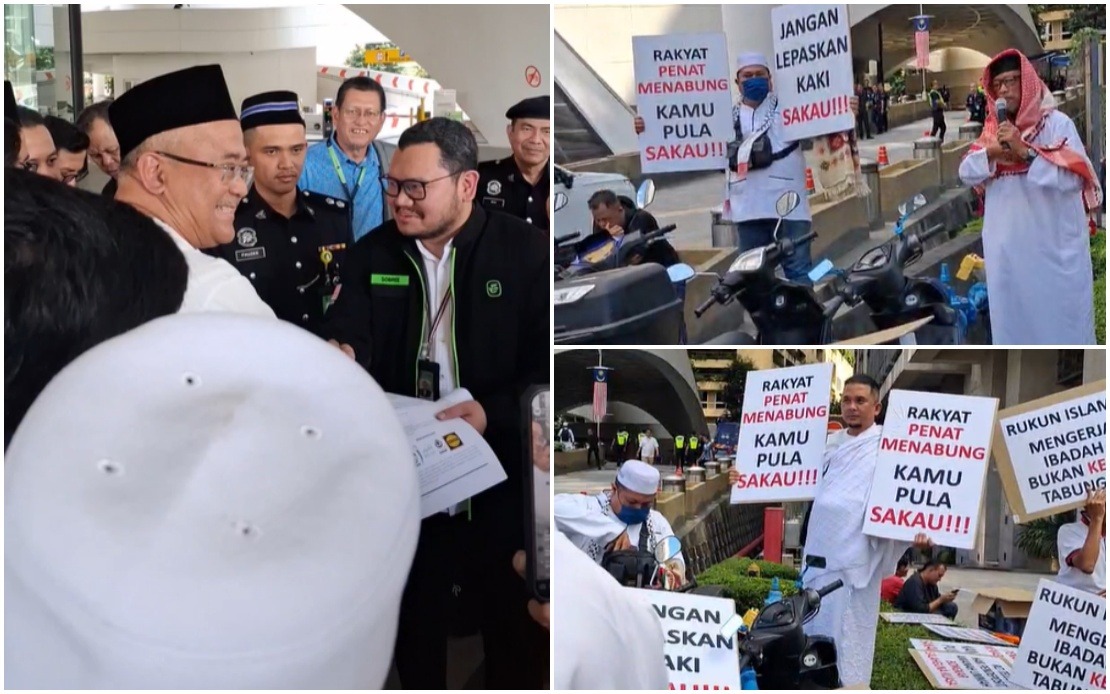
The investigation stemming from the Royal Commission of Inquiry into Lembaga Tabung Haji must be allowed to unfold with complete transparency and without any political or institutional interference, according to MADANI chairman Amir Zuhair Abdull Khalid. Speaking at a solidarity gathering held at Menara TH in Kuala Lumpur, the coalition leader underscored the critical importance of maintaining investigative independence as authorities examine the findings covering the seven-year period from 2014 to 2020.
Amir Zuhair's remarks represent a significant call for restraint from all quarters, whether government, opposition, or civil society actors who may be tempted to influence the direction or pace of the inquiry. His statement came as the Malaysian Anti-Corruption Commission (MACC) prepares to conduct formal investigations based on the RCI's conclusions. The MADANI chairman explicitly urged Prime Minister Anwar Ibrahim's administration to refrain from any interference while simultaneously appealing to other interested parties to allow the legal machinery to function without hindrance. This measured approach reflects growing concerns that high-profile cases of institutional mismanagement can become politicized, potentially undermining both the investigation's credibility and public confidence in the justice system.
The underlying concern extends beyond mere procedural propriety. At stake is the fiduciary relationship between Tabung Haji and millions of Muslim depositors who have entrusted their savings to the institution. These are primarily individuals of modest means saving for the Hajj pilgrimage, making the governance failures uncovered by the RCI particularly consequential for vulnerable constituencies. The RCI's examination identified systemic management failures and alleged instances of political interference in board appointments and governance decisions, revelations that have shaken public trust in an institution long regarded as a custodian of religious obligation savings.
Amir Zuhair emphasized that the matter transcends political party interests or electoral considerations. He articulated that those found responsible should face prosecution in court, rejecting any notion of political settlement or administrative remedies as substitutes for judicial accountability. His positioning suggests that MADANI intends to hold the government accountable for fulfilling its commitment to transparency, countering perceptions that the coalition might use the RCI findings to settle political scores with predecessors. This distinction is important, as it frames the issue as fundamentally about institutional integrity rather than partisan advantage.
The challenge of presumed innocence figures prominently in Amir Zuhair's reasoning. Those implicated in the RCI report will naturally protest their innocence, he acknowledged, but the determination of actual culpability belongs exclusively to the courts following comprehensive investigation and formal prosecution. This separation of investigative findings from judicial verdicts represents standard legal practice, yet in Malaysia's polarized political climate, it bears repeating. The RCI's role was to identify irregularities and make recommendations; it was not to render judgments of criminal or civil liability. That responsibility now transfers to law enforcement and the judiciary, requiring both institutions to resist external pressure and political considerations.
The Malaysian Islamic Movement Coalition (HIKAM) and affiliated Islamic civil society organizations have formulated ten specific demands flowing from the RCI report. These encompass immediate legal action against those identified in the inquiry, recovery of financial losses and misappropriated assets, comprehensive implementation of the RCI's remedial recommendations, and sustained governance reforms under the MADANI administration. HIKAM's constituent organizations—WADAH, IKRAM, HALUAN, and ABIM—represent significant constituencies within Malaysia's Muslim civil society, whose endorsement of the transparency agenda carries considerable weight. Their participation in the Menara TH gathering signals that expectations for accountability extend well beyond political elites into organized religious and community sectors.
The recovery of losses represents a particularly urgent component of the agenda. The RCI inquiry uncovered substantial financial mismanagement over seven years, with implications for the pension-like savings of millions of ordinary Malaysians. Unlike sophisticated investors who may absorb losses through diversified portfolios, Tabung Haji depositors typically lack alternative safety nets. Ensuring that recovered assets are restored to the institution and its account holders thus becomes not merely an administrative matter but a question of social justice. The MADANI government faces measurable pressure to demonstrate that recovery mechanisms will be pursued aggressively and that ill-gotten gains will not simply disappear into bureaucratic indifference.
The allegation of political interference in governance and board appointments during the RCI period requires particular scrutiny. If political considerations rather than merit and fiduciary competence influenced the selection of decision-makers, this speaks to systemic governance vulnerabilities extending beyond Tabung Haji itself. Many Malaysian state-linked enterprises, statutory bodies, and government-owned corporations operate under similar appointment structures where political patronage often takes precedence over professional qualification. The RCI's findings thus potentially illuminate broader patterns of institutional capture that affect Malaysia's economic governance architecture. Learning from the Tabung Haji case could catalyze systemic reforms across the public sector.
International observers monitoring Malaysia's governance trajectory will scrutinize how thoroughly the government pursues investigations and prosecutions. The MADANI administration, having campaigned on anti-corruption platforms, faces heightened expectations to demonstrate that its commitment translates into concrete outcomes. Allowing investigations to proceed independently, without political interference, provides the most credible foundation for legal actions that will withstand judicial scrutiny and international assessment. Conversely, any perception of selective prosecution or political manipulation would undermine the government's reform narrative and reinforce cynicism about institutional independence.
The call for transparency extends equally to the investigative process itself. Regular updates on investigation progress, clarity regarding evidentiary standards, and explanation of prosecutorial decisions would help maintain public confidence as the process unfolds. Citizens and civil society organizations deserve to understand why certain matters proceed to prosecution while others are discontinued, why particular individuals face charges while others escape liability, and what timeline authorities anticipate for bringing cases to trial. Transparency in process does not mean compromising investigative integrity or prejudging outcomes; rather, it involves explaining institutional reasoning in ways accessible to the public whose interests the investigation purportedly serves.
The months and years ahead will demonstrate whether Malaysia's institutional actors can rise to the challenge Amir Zuhair and civil society have articulated. The MACC must conduct rigorous investigations insulated from political direction. Prosecutors must make decisions based on evidence and legal merit rather than political considerations. The judiciary must render verdicts free from executive pressure or factional influence. These are standard expectations in mature democracies, yet in Malaysia's contested political landscape, articulating them remains necessary and valuable. The credibility of the system ultimately depends not on the RCI report itself, but on how seriously the government and law enforcement treat its findings.

