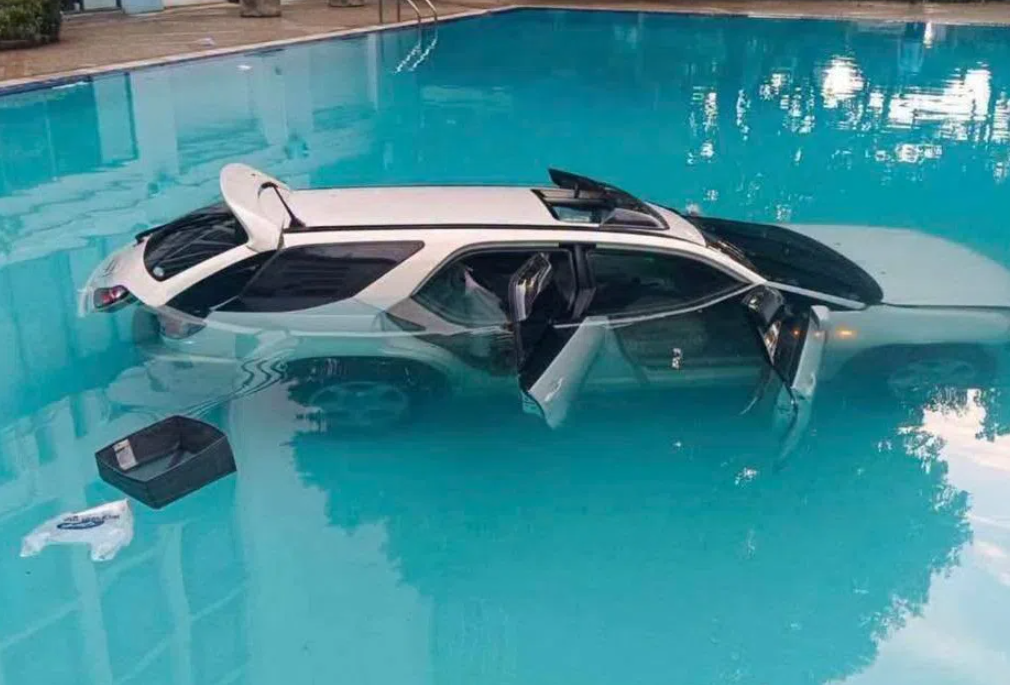
A family disagreement over housing costs escalated dramatically in Bangkok on Thursday when a 29-year-old man drove his white Toyota Harrier directly into a swimming pool at Chulalongkorn University, one of Thailand's most elite institutions. The incident, which unfolded shortly before dawn, transformed what began as a private dispute between mother and son into a high-profile spectacle that has since sparked widespread discussion about entitlement, financial dependency, and generational tensions across Thailand.
According to Thai police, the man had been engaged in a heated argument with his mother regarding monthly condominium expenses. He sought her financial assistance to cover rent payments ranging between 27,000 baht and 30,000 baht—equivalent to approximately US$775—but his mother flatly refused to continue funding his housing. The rejection apparently prompted the dramatic and destructive response that followed.
Witnesses reported that the man drove onto the Chulalongkorn University campus in central Bangkok's grounds, where security personnel attempted to intercept the vehicle. Rather than complying with their instructions to stop, the driver accelerated toward the guards, breached a security barrier, and proceeded directly into the Sasapol Building's adjacent swimming pool. The crossover sport utility vehicle became nearly completely submerged, its impact leaving the front end severely damaged and doors agape as water filled the interior.
The driver managed to extract himself from the sinking vehicle and swim to safety before emergency responders arrived at the scene. He was subsequently transported to Charoenkrung Pracharak Hospital, where medical staff treated him for injuries sustained during the crash and submersion. Authorities confirmed that no other individuals were harmed in the incident, though the physical and financial consequences extended far beyond the driver's personal injuries.
The incident has prompted police to conduct a thorough investigation into the circumstances leading to the crash and to assess the driver's mental state at the moment of impact. Officials are examining whether the destructive act was purely retaliatory or whether other factors contributed to his decision to drive onto university property and into the pool. The investigation remains ongoing as authorities piece together the sequence of events and determine appropriate charges.
Online commentary quickly highlighted the staggering disproportion between the original financial dispute and the resulting damage. Observers calculated that resolving this incident would likely cost the driver and his mother substantially more than ten times the monthly rent amount he had sought, once factoring in vehicle replacement, university property compensation, hospital expenses, potential legal fees, and administrative penalties. The nearly new-looking SUV appears destined for the salvage yard rather than repair, adding tens of thousands of additional baht to the tally.
The case has resonated deeply within Thai society, where housing affordability and economic support structures between generations remain contentious and emotionally charged issues. Rising property costs in Bangkok and other major urban centers have forced an increasing number of young adults to remain financially dependent on parents well into their twenties and thirties, a dynamic that frequently generates family tension and resentment. This incident has become emblematic of broader societal frustrations surrounding these demographic and economic realities.
Social media responses revealed limited sympathy for the driver, with most commentators interpreting his actions as a cautionary tale about the collision between privilege, entitlement, and emotional immaturity. The apparent paradox of a man financially dependent enough to require his mother's support for basic housing, yet wealthy enough to own a recently purchased Toyota Harrier, struck many as illustrative of class contradictions and skewed priorities. Users noted the striking contrast between his material possessions and his apparent emotional development.
The broader narrative that emerged painted a portrait of generational wealth without corresponding maturity or self-awareness. Critics observed that access to expensive vehicles and condominium living, combined with an expectation that parents should automatically fund such lifestyle choices, suggested a worldview divorced from the realities facing most Thais. The incident thus became a lens through which to examine privilege structures and the psychology of entitlement among certain segments of Thai society, particularly those born into affluent families.
Chulalongkorn University, which has served as Thailand's preeminent academic institution since 1917, now faces the practical burden of removing a water-damaged vehicle from its facilities and assessing structural or systems damage to the pool area. The university will likely pursue compensation from the driver through legal channels, adding further financial and legal complications to an already costly mistake. The institution's reputation, while unlikely to suffer lasting damage, has been temporarily tarnished by association with the incident.
The case serves as a reminder of how disputes over financial responsibilities can quickly escalate when emotional regulation fails and when individuals possess both economic resources and poor judgment. For Malaysian readers monitoring Thai social trends, the incident underscores similar pressures building across Southeast Asia as housing costs rise, making intergenerational financial negotiations increasingly fraught. The consequences—both financial and psychological—of allowing momentary rage to dictate decision-making have rarely been more publicly demonstrated or more expensive.

