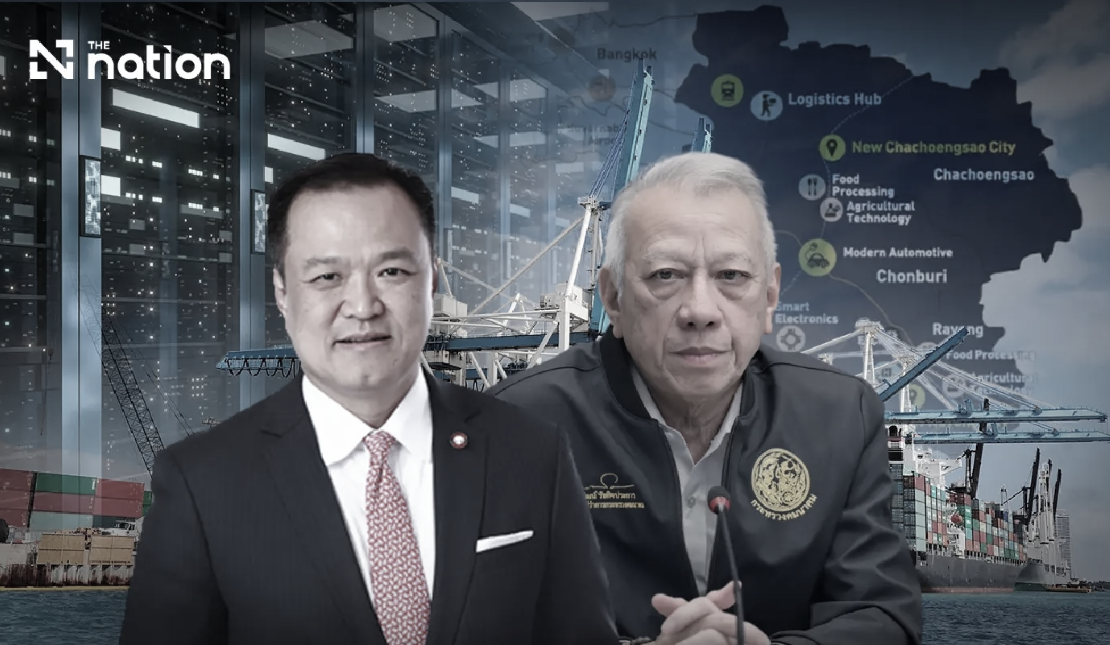
Prime Minister Anutin Charnvirakul has reasserted direct personal oversight of Thailand's Eastern Economic Corridor, moving the strategic development zone away from traditional heavy industry toward emerging sectors including global food security infrastructure and large-scale data centre facilities. The shift, formalized through Prime Minister's Office orders signed on June 15 and immediately implemented, positions Anutin as the chief architect of Thailand's renewed investment marketing strategy to foreign investors eyeing Southeast Asia.
The reshuffle saw Deputy Prime Minister and Transport Minister Phiphat Ratchakitprakarn relinquished his supervisory role over the EEC Office and his chairmanship of the Eastern Economic Corridor Policy Committee, following private discussions between the two leaders last week. Government House officials emphasised that the administrative change reflected operational considerations rather than factional tension within the ruling coalition, though Phiphat's public acknowledgement that he had received no advance warning of the Cabinet orders suggested a degree of awkwardness in the transition.
Thailand's eastern region, encompassing Rayong, Chachoengsao and Chon Buri provinces, has traditionally anchored the nation's manufacturing export economy. However, infrastructure constraints—particularly electricity and water supply pressures coupled with escalating procurement expenses—have prompted policymakers to recalibrate the corridor's comparative advantages. Anutin's repositioning strategy recognises that competing on heavy industry alone leaves Thailand vulnerable to production cost inflation and regulatory pressures facing energy-intensive sectors across the region.
The government's emphasis on food security as a cornerstone investment theme taps into genuine regional strengths. The eastern provinces command substantial livestock operations, aquaculture facilities, agricultural production, and horticultural exports. As geopolitical tensions increasingly shape global supply chain dependencies and climate variability threatens food production stability across Asia, wealthy nations and multinational food corporations seek secure sourcing partnerships and processing infrastructure. Thailand's combination of established production capacity, logistical proximity to major Asian markets, and experience in cold-chain export operations positions the EEC as a plausible hub for value-added food processing, storage, and distribution networks serving regional and international demand.
Data centre development represents a more ambitious and technically demanding pivot. The sector demands extraordinary infrastructure: uninterrupted electricity supply, massive water consumption for cooling systems, fibre-optic connectivity, and sophisticated technical support ecosystems. Thailand's strategic location between major Southeast Asian markets, its established position as a regional telecommunications hub, and the government's willingness to develop specialised regulatory frameworks make the EEC a conceivable location for hyperscale cloud computing and artificial intelligence infrastructure. The Energy Ministry's preparation of a new Type 9 electricity user category for data centres—configured to charge premium tariffs reflecting the sector's intensive power demands—indicates institutional coordination toward creating financial and operational incentives for investment.
The timing of this repositioning carries broader implications for Thailand's economic strategy amid intensifying regional competition. Vietnam, Singapore, and Indonesia are aggressively marketing data centre capabilities and supply chain resilience to multinational corporations seeking alternatives to Chinese manufacturing dependencies. Malaysia and other ASEAN nations similarly pursue food security and agribusiness investment. By positioning the EEC under Anutin's direct leadership as Thailand's premium investment pitch vehicle, Bangkok signals commitment to competing effectively for both sectors while attempting to modernise the corridor's international profile.
Phiphat's reported suggestion that friction between the EEC Office and the Board of Investment had created operational dysfunction provided the official rationale for the transition. The deputy PM apparently proposed to Anutin that consolidating authority would streamline decision-making and reduce inter-agency conflicts that had hampered project advancement. This explanation, though plausible given typical bureaucratic coordination challenges in Thai development projects, nonetheless reflected Phiphat's pragmatic acknowledgement that managing the EEC's complex stakeholder landscape had become administratively burdensome.
Government House sources explicitly denied that the reshuffle related to ongoing disputes surrounding the long-delayed three-airport high-speed rail project, which has consumed substantial official attention and generated significant political friction. The rail project, concessioned to Asia Era One in 2019 but still lacking groundbreaking, has become entangled in disputes over contract amendments regarding payment structures. Phiphat had previously taken a firm negotiating stance against shifting from completion-before-payment arrangements to progress-linked payment models favoured by the private partner. Anutin's reported assertion that he himself had ordered contract amendments be blocked and would personally reject revised payment terms suggests the PM wished to prevent this particular controversy from becoming associated with the EEC leadership transition.
The government's questioning of a proposed Disneyland development within the EEC corridor underscores the philosophical reorientation. Anutin reportedly interrogated Phiphat about the project's timeline and financial viability, noting the absence of feasibility studies justifying the investment returns. This scepticism toward large-scale entertainment infrastructure signals a pivot toward investments promising measurable economic multiplier effects and infrastructure asset consolidation rather than speculative ventures dependent on consumer demand volatility. Food processing and data centres generate sustained employment, attract skilled workforces, and create exportable value more directly than hospitality facilities.
For Malaysian policymakers and investors, Thailand's EEC repositioning warrants close observation. Both nations compete for regional food processing and data centre investment. Thailand's strategic move to centralise EEC governance under prime ministerial authority, combined with explicit pivots toward these sectors, indicates Bangkok recognises the economic gravity of supply chain regionalisation and digital infrastructure development. Malaysia's own eastern corridor initiatives and data centre strategies face increased competitive pressure from a more focused Thai approach. Additionally, if the EEC successfully attracts substantial food security and cloud computing investment, the corridor's competitive positioning against alternatives in the region strengthens considerably.
The administrative consolidation also reflects Anutin's broader leadership consolidation within the government. Assuming direct supervision of the nation's flagship development corridor enhances his visibility as an economic strategist and development champion, positioning him advantageously ahead of inevitable coalition recalibrations. For Phiphat and the Bhumjaithai party, the transition preserves coalition stability while relieving the deputy PM of a politically exposed portfolio where success remained uncertain and friction with other agencies continued. The public insistence that no rift had occurred, combined with the reasonably substantive explanations offered, suggests the transition was managed to minimise political damage across coalition partners while enabling strategic repositioning toward higher-probability investment sectors.