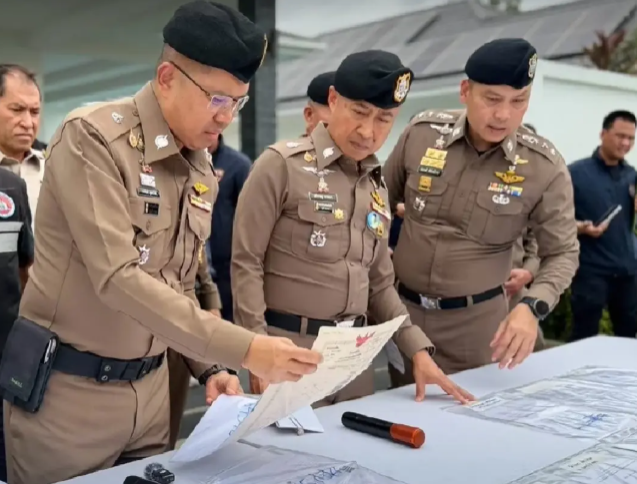
Thai police have intensified enforcement against foreign property ownership schemes, arresting 13 foreign nationals during coordinated raids across 15 locations in the coastal resort town of Hua Hin. The operation represents the sixth major phase of a nationwide campaign targeting the use of Thai nominee shareholders to circumvent Thailand's restrictions on foreign land ownership. The suspects—comprising three British nationals, four Chinese nationals, and single representatives from Italy, France, the Netherlands, Austria, the Philippines and the United States—were detained following searches that mobilised more than 200 police officers and government officials across Prachuap Khiri Khan province on Monday.
The investigation has now expanded to encompass 33 companies suspected of holding valuable properties on behalf of foreign nationals, with estimated total assets exceeding 300 million baht. The Hua Hin phase specifically focused on a high-end residential development featuring detached houses and modern pool villas in Thap Tai subdistrict, where individual properties command prices between 10 and 20 million baht. Police identified six companies within this development alone that allegedly operated using Thai nationals as nominee shareholders, with corporate structures appearing designed primarily to circumvent land ownership prohibitions rather than to conduct legitimate business activities.
According to investigative findings, arrested foreigners claimed they sought legal ways to maintain property interests in Thailand and had engaged law and accounting firms specifically to structure these arrangements. The suspects maintained they believed the corporate nominee model represented a lawful pathway to property ownership, a perception authorities contend reflects widespread misunderstanding of Thai property law among foreign investors. However, police evidence suggests the arrangements operated fundamentally differently, with Thai shareholders admitting they never invested personal funds, received no ownership documentation, and exercised no management control over the companies supposedly bearing their names.
These Thai nominees further disclosed they possessed no financial records or investment evidence related to their purported shareholdings, revealing a system constructed purely to mask foreign beneficial ownership behind local names. The corporate arrangements examined by investigators contained hallmarks of illegal structures: absence of genuine business operations, no legitimate financial flows, complete foreign operational control, and Thai nationals functioning essentially as legal figureheads. Officers seized extensive documentation during the raids, including company registration materials, accounting records, computer equipment and mobile devices, creating investigative foundations for tracking financial pathways and identifying additional network participants both domestically and internationally.
The Hua Hin operation represents escalation of a campaign that commenced investigations on Koh Phangan in Surat Thani province, where authorities initially examined nominee company networks, law firms and accounting intermediaries allegedly facilitating property and tourism business control by foreign entities. Subsequent phases expanded geographic reach and investigative intensity significantly. Phase 3 extended operations to Phuket, Phang Nga and Krabi, where authorities documented 89 land plots and buildings with combined valuations exceeding 1.05 billion baht. Phase 4 moved operations to Chonburi province, while Phase 5 targeted Chiang Mai, examining 31 companies and 29 land plots valued at approximately 633 million baht.
The cumulative scope of the first five phases before Hua Hin demonstrates the scale of suspected circumvention of Thailand's foreign ownership restrictions. Authorities documented examination of 233 land plots and buildings totalling more than 160 rai—equivalent to 25.6 hectares—with estimated combined valuation reaching 2.539 billion baht. Courts approved 133 arrest warrants from these earlier operations, while 20 cases have proceeded to criminal conviction, indicating prosecutors successfully built cases sufficient for courtroom success despite the investigative complexities inherent in untangling international financial structures and nominee arrangements.
Thailand's foreign land ownership prohibitions, rooted in nationalist economic policy dating back decades, have prompted creative legal structuring by foreign investors seeking to maintain property interests. The nominee company model represents the most prevalent workaround, relying on Thai nationals holding formal legal title while foreigners exercise actual control through contractual arrangements. Authorities increasingly recognise that these structures, while technically involving Thai nationals as registered owners, constitute functional foreign ownership operating in contravention of Thai law. The enforcement campaign reflects determination to prevent systematic circumvention that undermines legislative intent and potentially disadvantages Thai citizens competing for developable property, particularly in high-value tourist destinations.
The investigation acknowledges potential involvement of professional intermediaries—including law firms and accounting practices—in establishing and maintaining these nominee networks. Police indicated that inquiries would encompass evaluation of whether government officials demonstrated corruption or provided improper assistance to those perpetrating the schemes. The scope of inquiry now extends beyond individual foreign property holders to encompass entire professional service networks potentially profiting from facilitating illegal arrangements, suggesting authorities view this as organised rather than sporadic activity.
For Malaysian investors and businesses monitoring Thailand's regulatory environment, this enforcement escalation carries significant implications. Malaysia has substantial foreign investment communities throughout Thailand, particularly in Bangkok, Phuket and Chiang Mai, and many Malaysian investors may employ similar corporate structures for property acquisitions. The intensifying enforcement posture suggests Thai authorities increasingly scrutinise such arrangements regardless of investor nationality or apparent legitimacy. Malaysian investors holding Thai property should review corporate structures with qualified Thai legal counsel to ensure compliance with evolving enforcement interpretations.
The Royal Thai Police emphasised that the nationwide campaign specifically targets unlawful nominee operations rather than legitimate foreign investors complying with Thai law. However, the distinction between lawful and unlawful structures appears increasingly narrow in enforcement practice, with Thai authorities adopting the position that any foreign-controlled nominee arrangement constitutes circumvention. This represents a more aggressive interpretative stance than previously observed, potentially affecting foreign investors across Southeast Asia who structured Thai property holdings through Thai corporate vehicles.
Police announced plans to continue investigations against suspected nominee networks and foreign-funded entities allegedly operating unlawfully throughout Thailand's tourist destinations. The campaign demonstrates particular focus on coastal resort areas where foreign property investment concentrates and where premium land prices incentivise circumvention efforts. Investigators indicated they would trace financial transactions to identify additional network participants and beneficiaries potentially operating in Thailand or overseas, suggesting cross-border cooperation and extended investigation timelines. The implicit message to foreign investors appears clear: Thai authorities increasingly view property nominee arrangements with suspicion and will pursue aggressive enforcement regardless of the investor's nationality or perceived legitimacy.

