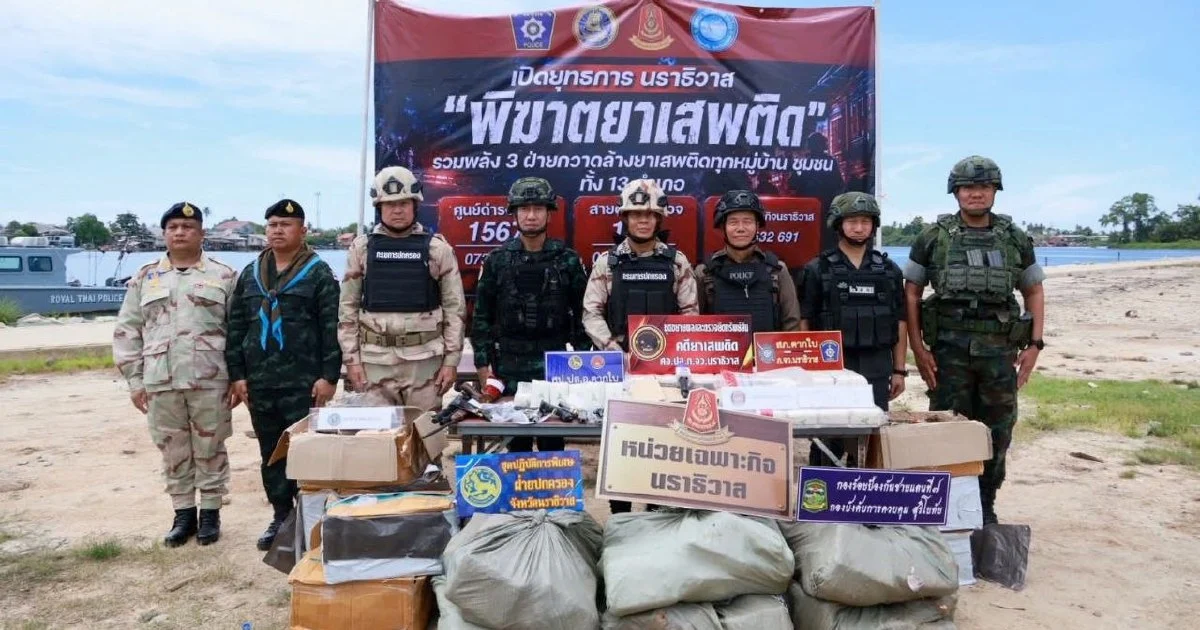
Thai authorities have successfully dismantled a significant component of a cross-border drug trafficking network during an intensive anti-drug operation in Narathiwat province, resulting in the arrest of 233 suspected syndicate members. Intelligence suggests that several of those detained maintain direct connections with Malaysian trafficking organisations, marking yet another example of the intricate criminal networks that operate across the Malaysia-Thailand border region.
The contraband intercepted during the month-long enforcement campaign, valued at approximately RM1.2 million, represents a substantial blow to traffickers attempting to move illicit substances from Thailand into Malaysian territory. The seizure underscores the growing sophistication of smuggling operations in Southeast Asia, where criminal groups exploit porous borders and complex supply chains to distribute narcotics across the region. Law enforcement agencies in both nations have long recognised that many smuggling attempts originate from Thailand's southern provinces, which remain plagued by instability and weak governance in certain areas.
Narathiwat province, situated along Thailand's border with Malaysia, has emerged as a key transit point for drug manufacturing and distribution networks. The strategic location provides traffickers with relatively easy access to Malaysian markets, where demand for synthetic drugs and other controlled substances remains persistently high. The province's geography, combined with limited resources for border surveillance, has historically made it an attractive operational base for criminal syndicates seeking to expand their reach into Southeast Asian markets.
The arrests made during this operation reflect intensified cooperation between Thai law enforcement and international partners in combating transnational crime. Thai police have increasingly recognised that disrupting supply chains at their source proves more effective than attempting interdiction at borders alone. This preventive approach aligns with broader regional strategies to tackle drug trafficking, though critics argue that enforcement efforts must be coupled with addressing underlying socioeconomic factors that drive involvement in the narcotics trade.
For Malaysian authorities, intelligence linking arrested individuals to local trafficking networks carries significant operational value. The Royal Malaysia Police and other enforcement bodies rely heavily on information sharing with Thai counterparts to map out criminal organisational structures and identify key figures within domestic drug markets. Each successful crackdown across the border provides opportunities to trace money flows, identify distribution channels, and potentially preempt smuggling attempts before contraband reaches Malaysian cities.
The RM1.2 million seizure, while substantial, likely represents only a fraction of narcotics moving through illicit channels in the region. Drug enforcement analysts consistently note that successful interceptions account for perhaps 10 to 15 percent of total trafficking volumes, suggesting considerably larger quantities continue evading detection. This reality underscores the ongoing challenge facing law enforcement agencies attempting to contain a global trade valued in the hundreds of billions of dollars annually.
The links identified between Thai and Malaysian criminal networks highlight how transnational trafficking operations function as integrated enterprises rather than isolated groups. Traffickers coordinate procurement, manufacturing, transportation, and distribution across multiple jurisdictions, exploiting differences in law enforcement capacity and legal frameworks to maximise profits whilst minimising exposure to serious prosecution. Malaysian organised crime groups have increasingly outsourced manufacturing to Thailand and elsewhere, focusing instead on distribution and money laundering within domestic and regional markets.
Thailand's own drug situation remains dire, with methamphetamine and synthetic drugs representing particular concerns for public health authorities. However, Thai criminal syndicates view neighbouring markets as increasingly lucrative targets, particularly Malaysia where urbanisation, relative wealth, and youthful populations create conditions favouring drug consumption. The cross-border dimension of this market complicates enforcement, requiring sustained diplomatic coordination and resource commitments that frequently strain bilateral relationships.
The operation also demonstrates that Thai authorities, despite facing considerable domestic security challenges, continue deploying significant enforcement capacity against drug trafficking. Narathiwat province itself remains affected by insurgency-related violence, yet police managed to execute a comprehensive month-long crackdown encompassing 233 arrests. This effort suggests recognition among Thai leadership that allowing trafficking networks to flourish unchecked poses broader security and governance risks beyond the direct harms associated with drug use.
For Malaysian policymakers and enforcement agencies, the Thai operation carries messages about vulnerability and necessity. Cross-border cooperation remains essential, yet reliance on Thai enforcement capacity alone proves insufficient for protecting domestic markets. Malaysian authorities must simultaneously strengthen internal border surveillance, enhance port and airport screening capabilities, and disrupt domestic distribution networks. The identified links to Malaysian traffickers indicate that organised crime groups based domestically maintain active recruitment and operational structures requiring sustained investigation and prosecution.
Longer-term solutions demand investment in demand reduction alongside supply-side enforcement. Treatment facilities, rehabilitation programmes, and community-based prevention initiatives addressing risk factors associated with drug use remain underfunded in many Malaysian jurisdictions. Without addressing demand, even successful interdiction operations produce only temporary supply disruptions before trafficking networks adapt and reorganise. Regional cooperation must therefore extend beyond arrests and seizures to encompass comprehensive public health and social policy approaches.

