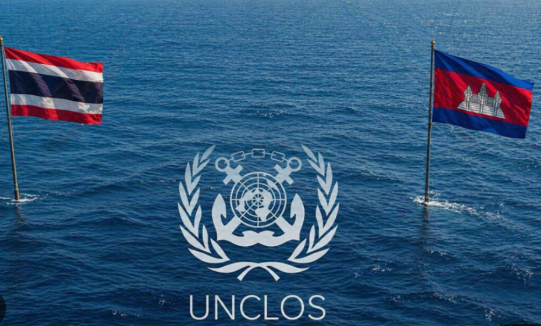
Thailand has formally acknowledged Cambodia's request to participate in a compulsory conciliation process under the 1982 United Nations Convention on the Law of the Sea, marking a significant diplomatic development in the two neighbours' long-standing maritime boundary dispute. However, Bangkok has made clear that it views this process as a non-binding mediation mechanism rather than a legally conclusive proceeding, a distinction that could shape how both nations approach the negotiations ahead.
Thailand's Ministry of Foreign Affairs submitted its formal acceptance on June 19, roughly three weeks after Cambodia transmitted its notification on June 2. The timing of Thailand's response reflects the measured diplomatic approach Bangkok has adopted throughout this dispute, balancing acceptance of international legal mechanisms with reservations about their enforceability. Thai officials have been explicit that the conciliation process should be narrowly construed, focusing exclusively on maritime delimitation issues rather than broader questions of resource sharing and joint development.
The composition of the conciliation team reveals both countries' commitment to credibility and international expertise. Thailand appointed Deputy Prime Minister and Foreign Minister Sihasak Phuangketkeow as its principal agent, a high-level designation that signals the government's seriousness about the matter. Supporting him will be Songchai Chaipatiyut, Thailand's ambassador to Kuwait and a veteran of the Department of Treaties and Legal Affairs, positioned as deputy agent to provide continuity and legal expertise. Thailand has also selected two conciliators: Judge Albert J Hoffmann of South Africa and Judge Rudiger Wolfrum of Germany, both described by the Foreign Ministry as internationally recognised authorities on maritime law.
The mechanics of the conciliation process establish a structured but leisurely timeline that may frustrate those seeking swift resolution. The four conciliators jointly appointed by Thailand and Cambodia have thirty days from Thailand's formal response to identify a fifth conciliator who will chair the entire commission. Once fully constituted, the commission is anticipated to complete its report and formulate recommendations within approximately twelve months, though both nations retain the option to extend this period by mutual agreement. This protracted schedule reflects the complexity of maritime boundary disputes and the need for thorough examination of geological, historical, and legal factors.
Thai officials have repeatedly emphasised that compulsory conciliation under Unclos operates according to fundamentally different principles than conventional litigation or binding arbitration. The conciliators, they have stressed, are not advocates for either party but rather neutral specialists charged with comprehending both countries' positions, contextualising the historical grievances, and facilitating identification of overlapping ground for settlement. This framing is significant because it positions the process as exploratory and collaborative rather than adversarial, potentially lowering the rhetorical temperature around an issue that has periodically threatened bilateral relations.
The non-binding nature of any conciliation outcome is central to Thailand's strategic approach to this dispute. According to Unclos Annex V, a conciliation commission's report and recommendations carry no legal force on the parties involved. This stipulation, which Thailand has highlighted repeatedly, means that regardless of what conclusions the five-member commission reaches, both nations retain complete discretion over whether to adopt or reject its findings. For Thailand, this legal architecture permits engagement with the international process without surrendering negotiating flexibility or accepting outcomes deemed unfavourable to national interests.
Bangkok has consistently maintained that bilateral negotiations represent the ultimate venue for resolving the maritime boundary question. The Foreign Ministry characterises conciliation as providing a helpful framework within which the two countries can work toward mutual agreement, rather than as a mechanism designed to override or supersede direct talks between governments. This position aligns with Thailand's broader diplomatic philosophy, which privileges sovereignty and direct state-to-state negotiation over international procedures that might constrain policy options. The Thai government has signalled that conciliation should complement, not replace, the diplomatic channels through which both nations historically have engaged on this issue.
A substantive disagreement over the scope of conciliation has emerged between the two countries, reflecting deeper tensions about the dispute's nature and resolution. While Thailand insists the process should focus narrowly on defining the maritime boundary, Cambodia's original notification appeared to encompass not only delimitation but also provisional arrangements for joint development and equitable resource sharing. This divergence matters significantly because it reflects competing visions of how overlapping maritime claims should be resolved. Thailand's narrower framing seeks to separate the boundary question from the thornier issues of energy resource allocation, whereas Cambodia's approach appears designed to link them, potentially leveraging boundary discussions to secure more favourable terms for joint exploitation of hydrocarbon reserves believed to exist in the contested waters.
The termination of the 2001 memorandum of understanding, formally known as MoU 44, constitutes a pivotal moment in this dispute's recent history. Thailand's Cabinet approved cancellation of this bilateral framework in May, with Prime Minister Anutin Charnvirakul explicitly attributing the decision not to any acute conflict with Cambodia but rather to the absence of meaningful progress across two and a half decades. The 2001 accord had provided an operational mechanism for managing overlapping continental shelf claims, but Thai leadership judged that two decades of minimal advancement rendered continued reliance on this framework untenable. The decision to terminate the agreement positioned Thailand to pursue a fresh approach grounded in Unclos provisions, which both nations now recognise as the legal foundation for maritime relations.
Thailand has clarified that cancelling the 2001 MoU represented an adjustment to the cooperation framework rather than an abandonment of dialogue. The government has committed to continuing maritime boundary discussions with Cambodia, anchoring these conversations in Unclos principles rather than in the now-defunct bilateral agreement. This pivot signals Thailand's preference for anchoring maritime negotiations in established international law, a strategy that may offer both parties greater legitimacy and clarity than reliance on aging bilateral instruments that reflected very different regional and international contexts.
The underlying stakes in this dispute remain substantial and enduring. The Gulf of Thailand, the maritime zone in question, is believed to harbour significant natural gas deposits and other hydrocarbon resources. Delimitation of the boundary therefore carries profound economic implications for both nations, directly affecting their access to fossil fuel reserves and the revenues they can expect to derive from offshore energy development. This resource dimension explains why the boundary question has resisted resolution across multiple negotiating cycles and why Cambodia's willingness to pursue international conciliation represents a strategic escalation that reflects frustration with the pace of bilateral progress.
Thailand's acceptance of the conciliation process, coupled with its insistence on the non-binding nature of any recommendations, reflects a calculated diplomatic position. Bangkok appears willing to permit international expertise and scrutiny of the maritime boundary question, a move that may enhance Thailand's standing as a responsible actor committed to rule-based international law, while simultaneously preserving its freedom to reject conciliation findings that it judges incompatible with national interest. For observers across Southeast Asia, this dispute exemplifies both the mechanisms available through Unclos for managing maritime conflicts and the limitations of those mechanisms when powerful states retain the ultimate authority to determine outcomes affecting their territorial interests and resource access.

