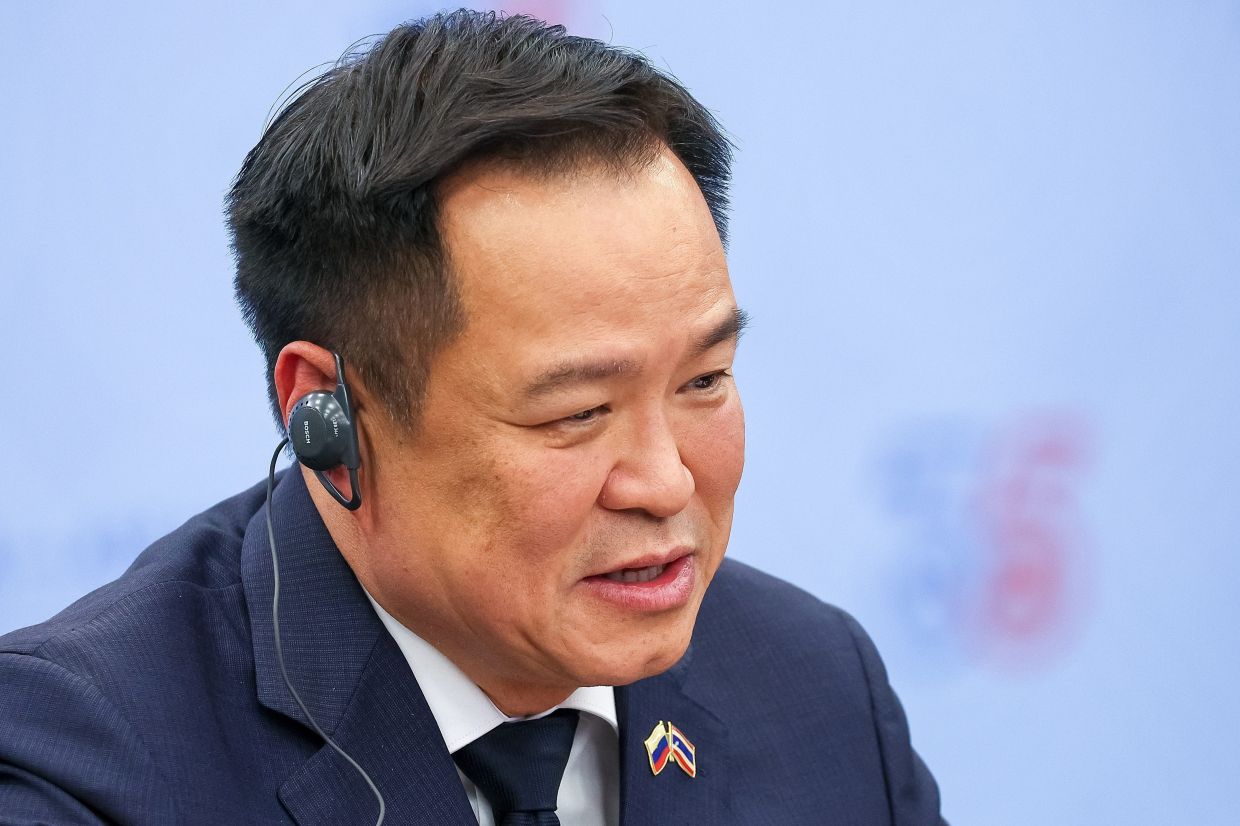
Prime Minister Anutin Charnvirakul has spent his first 100 days since taking office on June 27 consolidating political stability rather than pursuing the transformative agenda that Thai voters appeared to favour. His June 27 milestone marks the moment when initial goodwill from his February 2026 election victory has begun to crystallise into a governing pattern focused on damage control and incremental measures, leaving fundamental structural challenges largely unaddressed.
Anutin, 59, assumed Thailand's top post following his party's strong performance in the February election, itself a political recovery from his earlier September 2025 appointment after the Paetongtarn Shinawatra administration collapsed. His government's opening weeks were dominated by an external shock that tested its crisis management capabilities: the late February US-Israel attacks on Iran triggered severe disruptions to global oil supplies, exposing Thailand's acute vulnerability to Middle Eastern geopolitics. Petrol stations faced shortages, panic buying intensified, and oil prices surged above US$100 per barrel as the Strait of Hormuz shipping route experienced repeated disruptions. For a country dependent on energy imports, the timing proved challenging for a newly formed administration.
The government responded with measures designed to prevent public discontent from escalating into organised protest. By tapping Thailand's national Oil Fuel Fund to subsidise fuel prices and deploying coal-fired power plants at full capacity, authorities managed to avoid the street demonstrations and popular backlash that such crises typically trigger in Southeast Asia. The administration also negotiated increased energy imports from Malaysia, Brunei, and the United States to reduce reliance on Middle Eastern supplies. According to political analysts, including Mathis Lohatepanont from the University of Michigan, this crisis management approach succeeded in "weathering the initial storm" without permitting political instability to compound economic disruption.
Beyond immediate crisis response, Anutin capitalised on nationalist sentiment to deliver visible political wins. His Bhumjaithai Party had campaigned aggressively on a hardline stance toward Cambodia's disputed territorial claims, and as prime minister, Anutin followed through by terminating the 2001 bilateral maritime pact with Phnom Penh and escalating the dispute to UN arbitration. Maintaining military control over border protection reinforced his nationalist credentials among voters who rewarded his party with the most parliamentary seats. This alignment between campaign promises and early executive action suggested a government responsive to its electoral mandate, at least on matters of sovereignty and national pride.
Anutin also delivered rapid results on household economics through the "Thais Help Thais Plus" subsidy scheme launched on June 1. The programme allocates 176 billion baht (US$5.27 billion) to allow around 30 million eligible citizens to purchase selected goods at only 40 per cent of retail price, with the government absorbing the remainder. This generous stimulus proved politically popular and addressed voter frustration over rising living costs. However, analysts including Puangthong Pawakapan from Chulalongkorn University characterised the scheme as temporary relief that "absolutely nothing to solve the underlying economic crisis," acknowledging widespread recognition that subsidies mask rather than remedy structural weakness.
Thailand's longer-term economic outlook presents challenges that cosmetic stimulus cannot resolve. The International Monetary Fund projects growth of merely 1.5 per cent this year, the slowest in Southeast Asia, with Thailand unable to exceed three per cent annual growth over the past five years. By comparison, Vietnam anticipates 7.1 per cent expansion, Cambodia four per cent, and even Myanmar three per cent despite its ongoing civil conflict. This comparative stagnation reflects deep structural problems: ageing demographics, extraordinarily high household debt burdens, and inability to develop new sources of competitive advantage against regional rivals. While Anutin has mentioned aspirations in digital technology, artificial intelligence, and clean energy sectors, observers detect no coherent strategy translating these ambitions into concrete economic transformation.
Perhaps most revealing of the government's limited ambitions is its near-silence on constitutional reform, despite overwhelming public demand. In a February referendum held alongside the general election, nearly 60 per cent of voters—approximately 20 million citizens—endorsed changing Thailand's 2017 Constitution, which many regard as undemocratic because it was drafted under former military ruler Prayut Chan-o-cha following the 2014 coup. This represented explicit voter instruction to address a governance issue central to Thai political dysfunction. Yet Anutin's government has permitted constitutional reform to languish with no meaningful progress, suggesting deliberate choice rather than time constraints.
Stithorn Thananithichot from Chulalongkorn University's Political Science Faculty characterises this pattern as indicative of a government without genuine reform commitment. "A government that intended to reform would have signalled at least one substantive structural commitment at the outset; this one did not, and that absence is by design rather than a matter of time," he observed. The administration's energy has flowed into routine administration and day-to-day crisis management rather than pursuing initiatives aimed at political or economic transformation. Questions about cabinet selections and ministerial competence further suggest that Anutin prioritised coalition stability over bringing transformative talent into government.
Thailand's recent political history explains why such caution carries strategic logic. Two decades of military coups, constitutional rewrites, and short-lived governments have prevented policy continuity necessary for long-term structural reform. Each new administration inherits fractured coalitions, competing constituencies, and pressure to demonstrate immediate results. Yet this cycle of short-term thinking perpetuates the very structural problems that demand sustained attention: Thailand cannot simultaneously maintain political stability through broad coalitions while pursuing reforms that threaten established interests. Anutin appears to have chosen the former, accepting that his government will manage problems rather than solve them.
For Malaysian observers and Southeast Asian policymakers, Thailand's trajectory offers instructive lessons. Anutin's 100 days demonstrate that electoral mandates and popular support for change can evaporate quickly without concrete policy action. His government has maintained stability and proven competent at crisis management—valuable achievements in volatile regional contexts. However, it has also confirmed that stability without reform can become stagnation, leaving underlying problems to accumulate. As Thailand's economy continues underperforming regional peers and voter frustration potentially builds toward the next election cycle, the costs of prioritising stability over structural change may eventually demand the very transformations Anutin currently defers.

