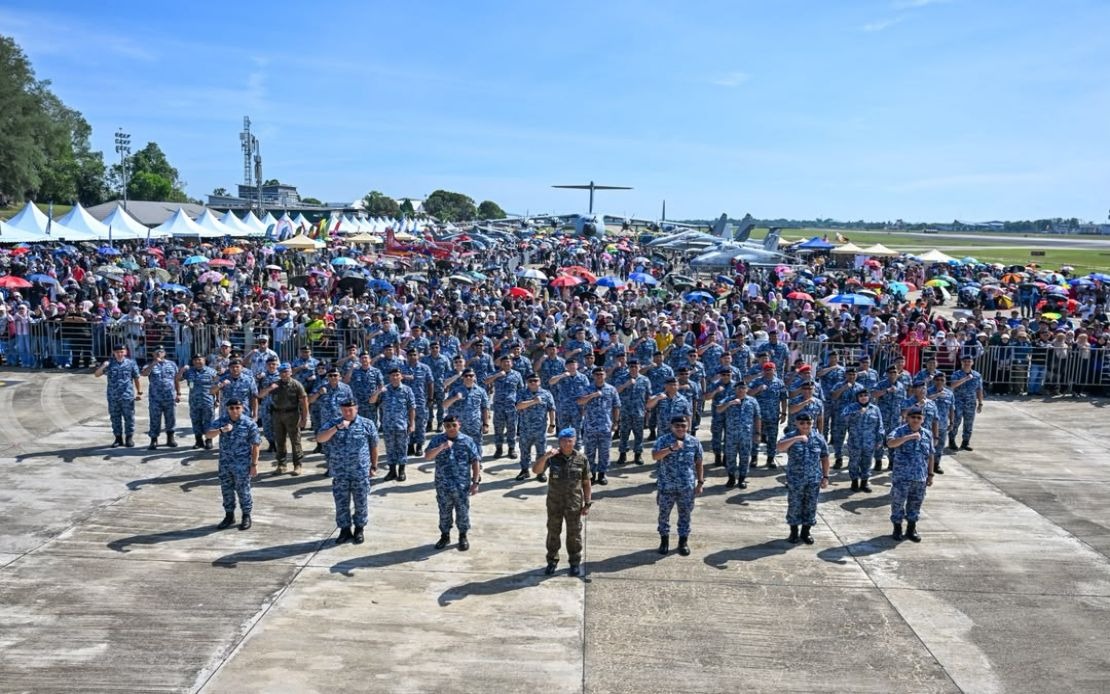
The Royal Malaysian Air Force's 68th Anniversary Open Day at Kuantan Air Base drew thousands of spectators despite scorching weather, with visitors of all ages descending on the facility to experience military aviation up close. The two-day celebration showcased the nation's air defence capabilities while offering civilians rare glimpses into operational aircraft and equipment normally kept from public view. The turnout demonstrated sustained public interest in Malaysia's defence forces and provided valuable engagement opportunities for the RMAF to connect with communities beyond traditional media channels.
RMAF Chief General Tan Sri Muhamad Norazlan Aris characterised the event as deliberately modest in scale, aligning with government fiscal discipline objectives while maintaining meaningful public participation. Rather than compromise the experience, organisers focused on quality interactions and hands-on engagement, allowing visitors to examine key defence platforms and speak directly with military personnel. This approach reflects a broader strategy to balance budget constraints with the necessity of maintaining public confidence in national institutions and demonstrating defence preparedness.
Muhamad Norazlan articulated the open day's strategic purpose: strengthening public understanding of the RMAF's operational mandate and technological advancement. He noted that social media and official announcements often fail to convey the full picture of military capabilities and institutional direction. By facilitating direct dialogue between RMAF officers and civilians, the programme enabled transparent discussion of roles, responsibilities, and future acquisitions—provided discussions remained within national security parameters. This interactive model represents a sophisticated approach to civil-military relations, permitting informed public discourse while protecting classified information.
The aerial demonstration schedule featured the RMAF's most impressive platforms. Visitors witnessed performances by the Sukhoi Su-30MKM multirole fighter, the F/A-18D Hornet strike aircraft, and transport assets including the A400M and C-130H. Complementing the fixed-wing demonstrations, helicopter displays showcased the EC725AP/H225M and AW139 variants, while the RMAF Special Forces (PASKAU) performed Helicopter Insertion & Extraction exercises and parachute demonstrations. These choreographed sequences provided vivid testament to the RMAF's operational proficiency and technological sophistication.
Stationary displays complemented the dynamic demonstrations, allowing prolonged examination of aircraft and support systems. The ground exhibition included Hawk fighter-bombers, CN235 transport aircraft, and Ground Based Air Defence systems, alongside logistical assets such as Prime Movers and fire engines. This comprehensive presentation offered the public tangible evidence of the RMAF's multifaceted operational requirements and the substantial infrastructure sustaining aerial operations. For many attendees unfamiliar with military logistics, these ground displays demystified the support functions enabling combat-ready air forces.
A centrepiece innovation for 2026 was the RMAF Runway Run, scheduled for the event's final day and permitting unprecedented public access to active runway surfaces. Muhamad Norazlan emphasised the exceptional nature of this opportunity, noting that civilian runway access remains extraordinarily restricted globally for safety and security reasons. Nearly 3,000 individuals had registered in advance, though organisers welcomed additional participants. This initiative represented a calculated risk by the RMAF to democratise access while maintaining operational security, reflecting confidence in crowd management protocols and public compliance with safety directives.
Visitor demographics spanned age ranges and backgrounds, illustrating the open day's broad appeal. Mohd Al Muaimin Khairul Amir, a 24-year-old from Perlis attending for the first time, described the experience as profoundly exciting. His personal narrative underscored the event's inclusive design—he brought his 67-year-old mother, Rosnani Itam, who navigates with a wheelchair, enabling her to witness aerial displays from accessible vantage points. Such multi-generational participation demonstrates that thoughtfully organised public events can accommodate diverse mobility needs while fostering family engagement with national institutions.
Beyond aviation-focused content, organisers programmed diverse supplementary activities designed to broaden appeal and extend dwell times. The RMAF Central Band and drumline performances provided musical entertainment, while the Air Force Arts Group contributed cultural dimensions. Career exhibition booths attracted young people considering military service, while aircraft simulators offered hands-on technological engagement. Weapons exhibitions displayed equipment and systems in static contexts, facilitating educational discussion of defence technologies and doctrine.
The event's organisation reflects evolving approaches to defence diplomacy within ASEAN nations, where public engagement has become increasingly sophisticated. Malaysia's RMAF recognises that sustained defence spending and force development require informed public consent and understanding. Unlike security-obsessed approaches that maintain total opacity, the RMAF calculates that controlled transparency regarding capabilities and modernisation programmes strengthens institutional legitimacy. This strategy proves particularly valuable when defence budgets compete for resources with social spending priorities, as informed constituencies prove more likely to endorse military investment when convinced of operational necessity and strategic coherence.
From a regional perspective, Malaysia's defence force engagement activities carry implications for understanding Southeast Asian security postures. Nations throughout ASEAN increasingly recognise that public awareness of defence capabilities, modernisation timelines, and doctrine serves deterrence and confidence-building objectives. When regional populations understand their nation's defence capabilities, they develop stronger identification with national security interests and greater resilience to external pressure. The RMAF's open day therefore represents not merely celebratory spectacle but rather a calculated contribution to national strategic communication and public defence consciousness.
The financial efficiency achieved through scaled-down execution while maintaining experiential quality offers lessons for other government agencies facing resource constraints. Rather than cancelling public engagement activities, the RMAF redesigned programming to prioritise impact while reducing costs. This approach preserved institutional visibility and public relationships despite fiscal pressure. For Malaysian defence planners, such adaptability proves essential given regional tensions and evolving threat perceptions that may constrain future budgets while demanding sustained public support for defence modernisation initiatives.
Looking forward, the success of the Kuantan event likely ensures that subsequent anniversary celebrations and open day activities will employ similar models, perhaps expanding the runway access initiative and enhancing interactive components. Public response to equipment displays and flight demonstrations indicated substantial appetite for defence-related educational content. The RMAF may leverage this demand to schedule regional open days, extending beyond Kuantan to reach populations in other military regions. Such decentralisation would democratise access while strengthening institutional relationships across diverse Malaysian communities and supporting recruitment into defence specialties.

