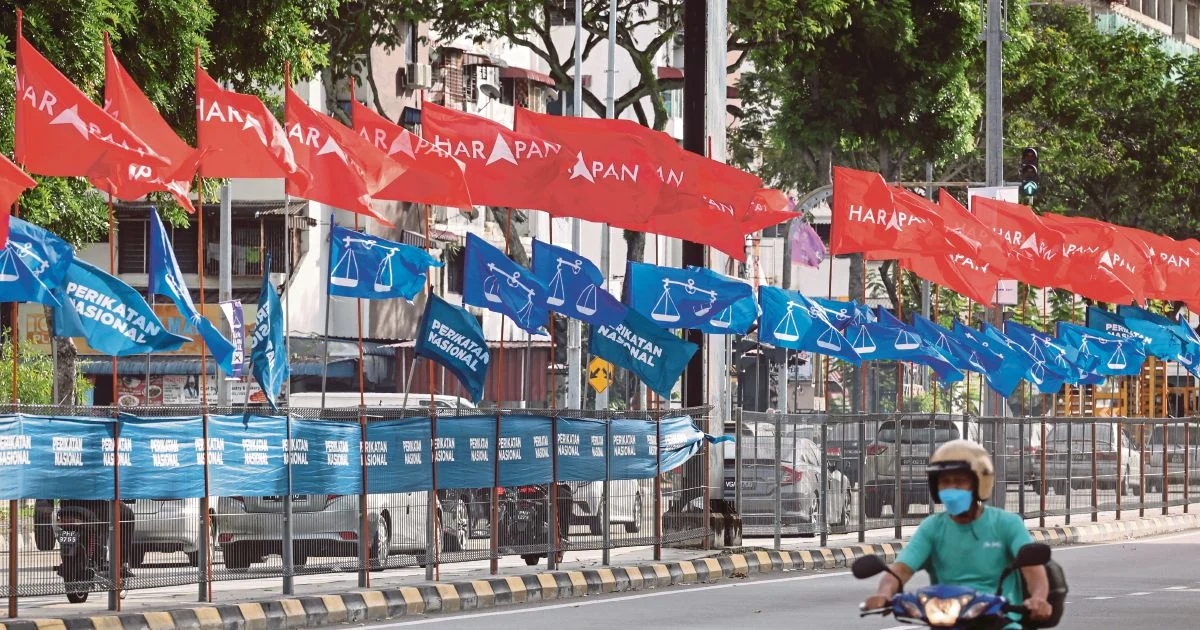
Barisan Nasional, Pakatan Harapan and Perikatan Nasional are bracing for simultaneous contests across 33 of the 56 state seats in Johor's forthcoming election next month, marking a significant departure from the two-coalition dominance that has characterised recent Malaysian electoral contests.
The prevalence of three-way clashes across more than half of the parliamentary constituencies signals an increasingly fragmented political environment in Malaysia's second-largest state by population. This configuration creates unpredictable dynamics that could easily shift outcomes in marginal seats, where the split opposition vote or divided establishment support may prove decisive in determining which coalition emerges victorious.
Historically, Johor has served as a bellwether for national political trends, and the nature of this election contest will carry implications extending well beyond the state's boundaries. The simultaneous participation of three major political blocs, rather than the conventional two-sided contest, reflects the structural realignment of Malaysian politics following the 2022 general election and the subsequent formation of the Malay-Muslim oriented Perikatan Nasional.
For Barisan Nasional, these three-way races present both opportunity and vulnerability. As the traditional establishment coalition with deep organisational roots in Johor, BN maintains substantial grassroots machinery and local patronage networks. However, defending seats against challenges from two well-resourced competitors simultaneously demands efficient vote consolidation and concentrated campaign efforts in strategically important divisions.
Pakatan Harapan enters this contest as the entity that governed Malaysia from 2018 to 2020, retaining significant appeal among urban and younger voters in Johor's cities and suburban areas. The coalition's performance in this election will serve as a critical barometer of its capacity to rebuild organisational strength following its fragmentation and its prospects in approaching federal elections.
Perikatan Nasional's participation in so many constituencies reflects its strategy to establish itself as a credible third force capable of challenging both BN and PH simultaneously. The coalition has expanded systematically across peninsular Malaysia and has cultivated support particularly among more conservative and rural demographics who view it as a stronger representative of Malay-Muslim interests.
The concentration of three-way contests in 33 seats means that in the remaining 23 constituencies, voters will face either two-cornered fights or potentially uncontested situations. These two-cornered seats may offer clearer outcomes and serve as indicators of which coalitions possess stronger local support without the vote-splitting complications that three-way races introduce.
Analysts view the prevalence of multi-cornered contests as fundamentally altering traditional electoral mathematics. In many constituencies, the candidate securing merely 35 to 40 percent of the vote may claim victory if opposition support divides evenly between competing camps. This scenario could advantage whichever coalition deploys its resources most efficiently and identifies which divisions are sufficiently favourable to warrant concentrated effort.
The Johor election thus represents a testing ground for how Malaysian politics functions in an era when no single coalition can assume automatic dominance. The outcome will likely influence calculations by smaller parties and independent operators regarding future coalition alignments, particularly as attention turns toward the next federal election cycle.
For Johor voters themselves, the three-way competition offers choices previously unavailable in many constituencies, though it also risks producing outcomes that fail to reflect majority preference if the opposition vote fragments excessively. The state election ultimately serves as an important indicator of whether Malaysian electoral competition is evolving toward more fluid, multi-polar configurations or whether traditional patterns reassert themselves once voting concludes.
The upcoming polls will also test the ground strength and grassroots mobilisation capacities of all three coalitions in Johor specifically. Ground-level performance and voter turnout in these 33 contested seats will provide the most reliable data regarding which coalition possesses superior campaign organisation and maintains stronger connections to the state's diverse demographic communities. The results should clarify which political forces command genuine support and which rely primarily on strategic alliances or institutional advantages.

