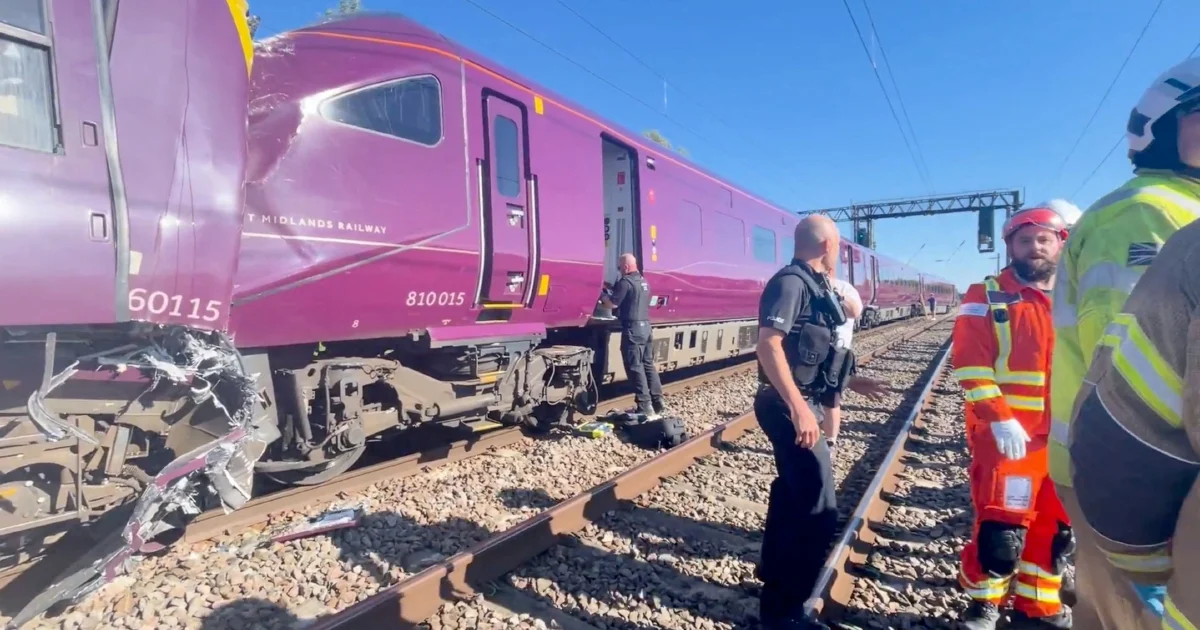
A major transport disaster unfolded north of London on Friday when two passenger trains collided in what proved to be a tragic incident for the United Kingdom's rail network. British emergency services confirmed that the crash resulted in at least one fatality and caused injuries to numerous passengers aboard the trains, with authorities indicating that 11 of the injured were deemed to be in very serious condition requiring immediate medical intervention.
The incident marks a significant occurrence on the British rail system, which carries millions of passengers daily across the country. Such collisions, whilst rare given modern safety protocols, nevertheless represent one of the most serious scenarios within rail transportation and naturally trigger immediate emergency responses involving ambulances, fire services, and police personnel. The location north of the capital placed this incident in a densely populated corridor where major rail arteries converge, making the incident immediately visible to both operational staff and the travelling public.
Emergency responders mobilised rapidly to the scene, with multiple ambulances and specialist rescue teams dispatched to attend to the injured and manage the complex logistics of a multi-casualty transport incident. The fact that 11 victims sustained injuries classified as "very serious" suggests significant trauma requiring advanced medical care, and these individuals would have been prioritised for transfer to nearby hospital facilities equipped to handle severe injuries from railway accidents.
For Malaysian readers accustomed to the generally strong safety record of the country's rail infrastructure, such incidents highlight the inherent risks that persist in even the most developed nations' transport systems. The United Kingdom's extensive rail network, dating back centuries and serving as a backbone for national connectivity, nonetheless faces the same fundamental challenges as any rail system worldwide—the management of complex signalling, speed management, and coordination between multiple services operating in proximity.
The collision raises immediate questions about the circumstances that led to the trains occupying the same section of track. Modern railway systems rely on sophisticated signalling systems, automatic train protection, and operational procedures designed specifically to prevent such scenarios. Yet the occurrence on Friday demonstrates that despite these safeguards, incidents can still occur through mechanical failure, human error, or environmental factors that overwhelm existing protections.
For the rail industry across Southeast Asia, including Malaysia's own Keretapi Tanah Air Berhad and Light Rail Transit operators, such incidents abroad serve as sobering reminders of the critical importance of maintaining rigorous safety standards and continuously upgrading protective systems. The region's growing rail networks, expanded through rapid urbanisation and major infrastructure projects, must remain vigilant against complacency even as safety statistics improve generally across operators.
The passengers aboard these trains would face physical and psychological trauma from their experience, with survivors of such incidents often requiring not only medical treatment but also longer-term support to process the shock of being involved in a major transport accident. Family members and friends awaiting information about their loved ones would also experience considerable stress during the initial hours following the collision, when the identities of those killed and seriously injured remained unclear.
British authorities would now commence a comprehensive investigation into the collision's root causes, a process that typically examines signal systems, train maintenance records, driver actions, weather conditions, and any other factors that might have contributed. The Rail Accident Investigation Branch, the UK's specialist body for such inquiries, would lead this technical examination, producing findings that would be scrutinised not only by British operators but also by international rail safety experts monitoring trends in railway accidents globally.
The incident inevitably raises broader discussions about rail infrastructure investment and maintenance across the United Kingdom, where ageing systems in some regions continue to operate alongside more modern installations. Regular modernisation of track, signalling equipment, and rolling stock can reduce accident risks significantly, yet resource constraints and the sheer geographical expanse of the network mean that comprehensive upgrades proceed gradually.
For passengers and commuters throughout Britain, such incidents reinforce concerns about transport safety despite statistically strong overall records. Public confidence in rail travel, though generally robust given the comparative safety of train journeys against road transport, can be affected by high-profile accidents that receive extensive media coverage and public attention, particularly when deaths occur.
The coordination between different emergency services—ambulance trusts, fire and rescue services, and police forces—becomes critical in managing the immediate aftermath, ensuring that the injured receive prompt treatment and that scenes are preserved for investigators whilst simultaneously allowing for continued operations on other parts of the rail network. Such large-scale incidents test the resilience of emergency response systems and often lead to reviews of protocols and response times.
As investigations proceed and more details emerge about what occurred on Friday, both passengers and the broader British public will be seeking answers about how such a collision could occur on a major rail corridor, and what measures might be implemented to prevent similar incidents in the future. The tragedy underscores fundamental realities about transportation safety—that risks, whilst minimised through technology and procedure, can never be entirely eliminated from any transport system operating at scale.

