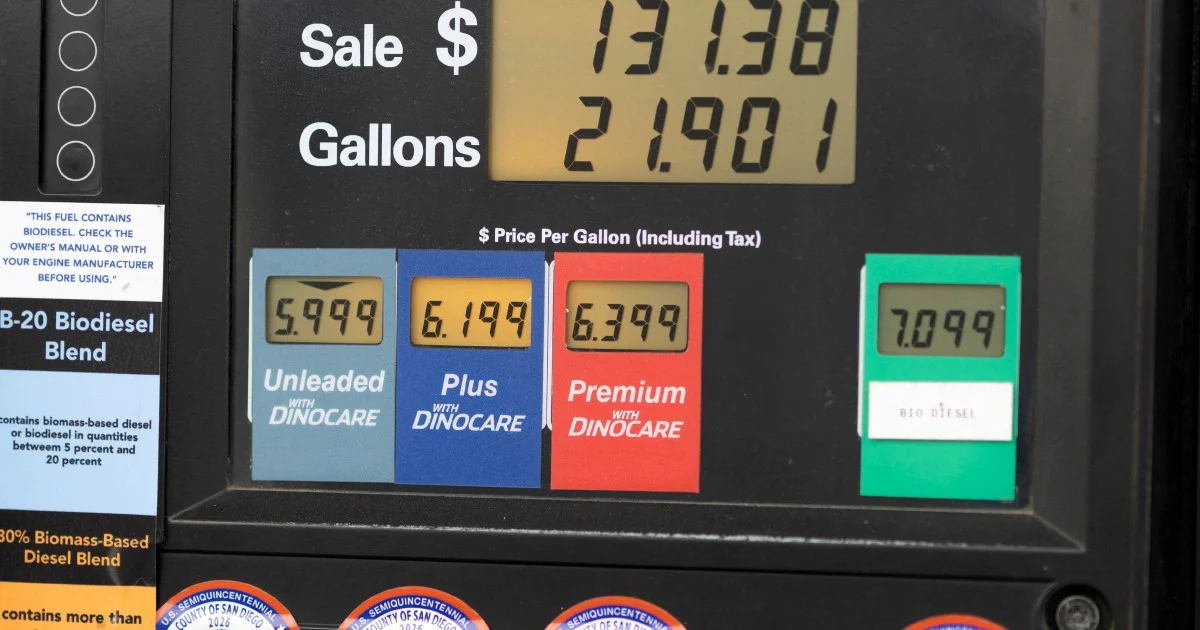
Donald Trump announced Wednesday that he has instructed authorities to examine the conduct of major oil companies, expressing frustration that petrol prices have not fallen as rapidly as he expected. The US President's decision to open an inquiry comes at a moment when his administration faces mounting criticism for its handling of energy policy and the broader implications of regional conflict in the Middle East on fuel markets worldwide.
The investigation represents an attempt by Trump to demonstrate responsiveness to public concern over pump prices, a perennial political flashpoint that directly affects consumer sentiment and household budgets. Gasoline costs remain elevated by historical standards, and despite modest fluctuations, have resisted the sharp downward trajectory that might alleviate voter frustration heading into the political cycle. By directing scrutiny toward oil corporations, Trump seeks to shift accountability away from policy decisions and toward industry players, framing the probe as a defense of ordinary Americans against potential profiteering.
The timing of the inquiry is significant given the ongoing instability in the Middle East. Regional tensions, including recent military escalations, have created uncertainty in global energy markets and weighed on crude oil supply dynamics. Traders and analysts have pointed to geopolitical risk premiums embedded in oil prices, meaning that even moderate concerns about potential supply disruptions push costs higher than fundamentals alone would justify. Trump's announcement implicitly acknowledges this pressure while attempting to pin responsibility elsewhere.
For Malaysian readers and Southeast Asian economies broadly, developments in US energy policy warrant close attention. The region remains heavily dependent on stable global oil markets. Malaysia, as a net energy exporter with significant crude production and refining capacity, has competing interests—higher prices benefit energy producers but elevated fuel costs constrain manufacturing and transportation sectors. Additionally, any investigation into US oil companies could reshape international energy trading patterns and investment flows that directly touch regional economies.
The inquiry also reflects a broader political calculation within Trump's administration. Across developed economies, incumbent leaders face voter anger over cost-of-living pressures, and energy prices remain highly visible contributors to inflation and everyday expenses. By launching an investigation, Trump demonstrates action on a deeply felt issue without necessarily committing to specific policy reforms that might prove economically contentious or politically divisive within his political coalition.
Economists remain divided on whether investigations into oil company pricing practices yield meaningful results. Unlike some commodity markets with more transparent price formation, crude oil and refined products trade through complex networks of producers, refiners, traders, and distributors, making definitive attribution of price movements challenging. Previous government probes into fuel pricing have occasionally revealed inefficiencies or anti-competitive behavior, but structural market forces—global supply constraints, refinery capacity limitations, and geopolitical risk—typically dominate short-term price movements.
The oil industry has historically resisted criticism that excessive profits drive pump prices, instead pointing to capital intensity, thin margins on refined products, and volatile input costs. Major corporations have emphasized their investments in exploring new reserves and maintaining refinery infrastructure. Nevertheless, periods of elevated fuel costs inevitably trigger political pressure, and oil firms have learned to expect scrutiny during such episodes.
For Southeast Asia, the investigation's outcome matters less than its potential to establish policy precedent. Should Trump's administration implement measures that affect US oil company operations—from export restrictions to taxation changes—the effects would ripple through global markets affecting regional supply and pricing. ASEAN nations with energy-intensive industries or commodity export economies face exposure to whatever policy shifts emerge from Washington.
The investigation also underscores how energy markets remain embedded within geopolitical competition. Trump's willingness to scrutinize oil companies partly reflects broader tensions over Middle Eastern stability and US energy independence. The administration's broader strategic objectives—reducing reliance on unstable regions, supporting domestic energy production, and managing relationships with key suppliers—all intersect with current fuel price debates.
Looking forward, the inquiry's scope and timeline remain undefined. Whether investigators focus narrowly on recent pricing decisions or examine broader industry practices will determine significance. Quick findings might yield headlines without substantive change, while comprehensive examination could identify genuine market dysfunctions requiring legislative remedy. Either way, the investigation signals that energy policy remains a front-and-center political priority for the Trump administration, with implications extending far beyond American consumers to energy markets and economies throughout the Asia-Pacific region.

