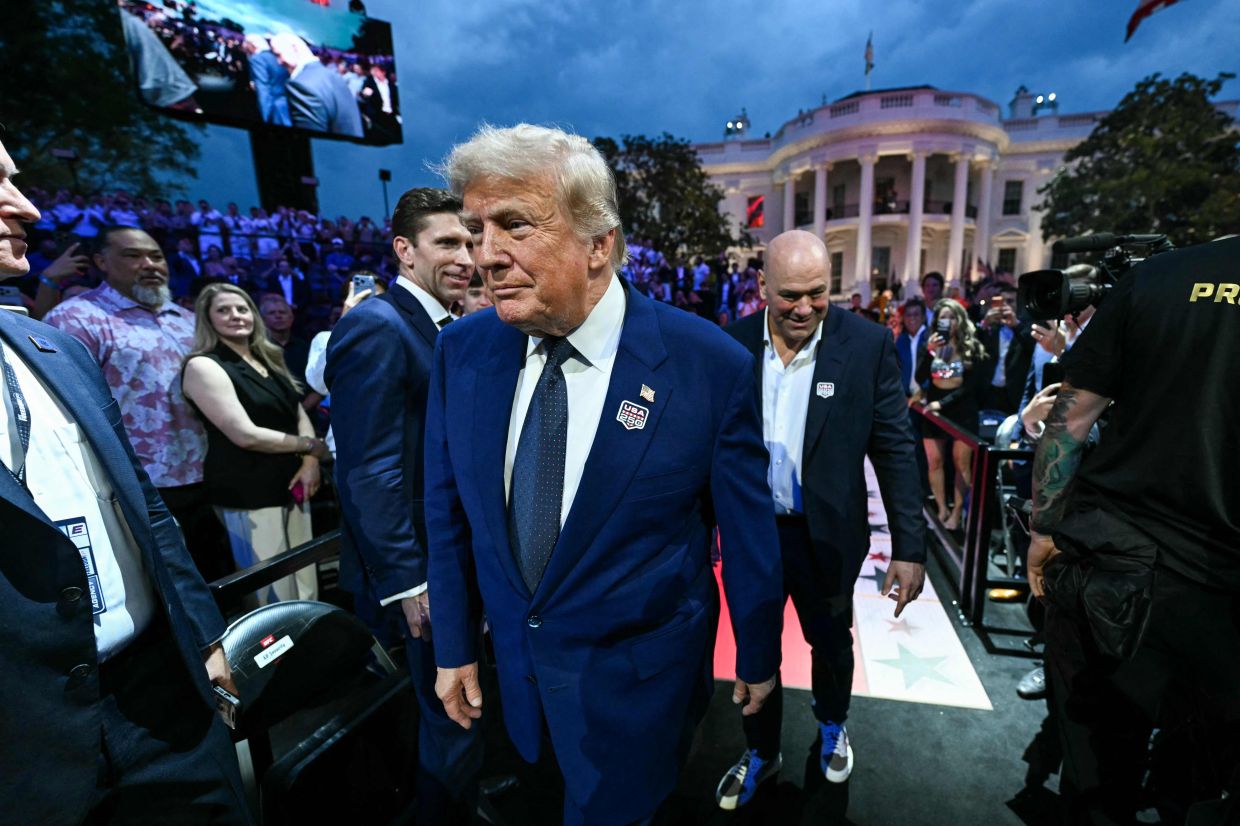
Donald Trump rang in his 80th birthday on Sunday evening by hosting what amounted to one of the most unconventional spectacles ever staged at the White House—an Ultimate Fighting Championship event on the South Lawn that blended mixed martial arts brutality with political pageantry. The decision to hold the fights before heading to France for tense international negotiations offered a revealing glimpse into how the incoming administration intends to wield presidential resources and symbolism. The event served as both a personal celebration and a deliberate cultivation of the demographic coalition that secured Trump's 2024 election victory.
The UFC showcase unfolded just before 8:30 p.m. as Trump and UFC President Dana White proceeded through the White House to an enormous custom-built arena nicknamed the "Claw," a structure towering nearly 100 feet and dwarfing previous temporary installations on the presidential grounds. The event's commencement experienced a brief delay owing to threatening weather conditions, with lightning and thunder rolling across Washington, though organisers proceeded as planned. The scale of the undertaking represented a dramatic departure from the staid functions typically held on the South Lawn, where events such as the Easter Egg Roll and Congressional Picnic had traditionally maintained a more formal decorum.
The attendance roster revealed the interconnected nature of Trump's political coalition and business interests. Meta Platforms CEO Mark Zuckerberg sat alongside Paramount Skydance chief David Ellison and Treasury Secretary Scott Bessent, while family members occupied prominent seating. Perhaps most significantly, popular podcast host Joe Rogan provided ringside commentary, his presence signalling the importance Trump's team places on reaching younger male voters through digital media personalities. Military servicemembers populated sections of the arena, with television coverage cutting to watch parties at bases including one in Okinawa, Japan, creating the impression of nationwide military endorsement for the spectacle.
The ceremonial dimensions extended beyond mere entertainment. Medal of Honor recipients and first responders escorted fighters into the arena, framing combat sport within a patriotic narrative tied to Trump's broader plans to commemorate the nation's 250th anniversary. This fusion of military honour with celebrity sport represented a calculated symbolic message about how Trump intends to reshape the cultural relationship between the presidency and popular entertainment. The event formed part of a larger commemoration strategy encompassing commemorative gold coins bearing Trump's likeness, an extensive National Mall fair, and an August IndyCar race through Washington's streets.
The financial and political dimensions of the event generated considerable controversy. UFC reportedly expended over US$60 million to stage the fights, while more than seven federal agencies allocated substantial resources and personnel to security and logistics, according to court filings. The Public Integrity Project launched a legal challenge characterising the event as a "volcano of corruption," though the lawsuit ultimately failed to prevent the spectacle from proceeding. A YouGov poll released June 5 found that 51 percent of Americans disapproved of hosting UFC fights at the White House, with only 27 percent expressing approval, indicating meaningful public division over the event's appropriateness.
The Trump administration's embrace of the UFC reflects a broader strategy to strengthen bonds with the organisation and its audience demographics. The UFC's young, predominantly male fanbase represented a crucial voting bloc in Trump's electoral coalition, and the administration has formalised this relationship through State Department and Federal Bureau of Investigation partnership agreements. Dana White, a longtime ally of Trump, has consistently championed the president's affinity for mixed martial arts. During a news conference at the Lincoln Memorial, fighters engaged in traditional pre-fight theatrics, trading insults and making victory predictions while media gathered in one of the nation's most historically significant venues.
The commercial entanglements surrounding the event underscored the blurred boundaries between entertainment, business interests, and presidential functions. The UFC Freedom 250 website listed Crypto.com and Dodge's Ram truck brand among official sponsors. Most notably, World Liberty Financial, a Trump family venture, provided an additional US$250,000 bonus to the top two fighters competing at the event, creating a direct financial link between Trump's commercial interests and the entertainment spectacle. While the White House claimed that UFC covered all event costs and handled sponsorship negotiations independently, the extensive federal resource allocation and the family venture's direct involvement suggested deeper entanglement.
Despite White's public assertions that the event would prove financially unprofitable for the UFC, other executives and observers suggested potential long-term commercial benefits remained unclear. The spectacle generated substantial publicity for the organisation and aligned it with a political figure commanding fierce loyalty among its target demographic. The structure itself—a custom-built arena accommodating 4,300 spectators with an additional 120,000 expected on the nearby Ellipse where free lottery tickets were distributed—represented an unprecedented use of White House grounds for commercial entertainment purposes.
The physical transformation of the presidential grounds provoked discussion about the precedent being established. Trump himself appeared to toy with the idea of permanence, comparing the Claw structure to the Eiffel Tower and suggesting during a June 2 TikTok video that it might remain indefinitely. He later claimed these remarks were made in jest, though the administration's court filings committed to dismantling the structure beginning at 10 a.m. Monday morning. Nonetheless, Trump's apparent fascination with leaving a monumental structure before the White House illustrated the impulse to reshape how the presidency presents itself and interacts with popular culture.
The timing of the celebration—immediately before Trump's departure for Group of Seven negotiations with world leaders in France—created an intriguing juxtaposition. The president would carry with him a UFC championship belt, departing from an evening of American sporting spectacle to engage in discussions regarding international economic coordination and diplomatic relations. This sequence symbolised a broader transformation in how the Trump administration conceptualised presidential duties and the relationship between entertainment, commercial interests, and governmental authority. The event demonstrated both the expanded boundaries of what a contemporary president considers suitable for the nation's most iconic residence and the deep integration of entertainment media into political strategy and coalition-building.
For Malaysian and Southeast Asian observers, the White House UFC event illuminated broader trends in American political culture and the rising intersection of entertainment and governance. The spectacle reflected how contemporary political leaders leverage popular entertainment venues and celebrities to reinforce demographic coalitions, a pattern increasingly visible across democratic systems globally. The event also underscored American military's integration with entertainment and commercial interests, with military bases and servicemembers participating in what was fundamentally a private business entertainment property. As regional democracies grapple with how political leaders should engage popular culture and entertainment industries, the Trump White House case study offers both cautionary lessons and examples of how traditional presidential decorum continues eroding in an era of social media-driven politics and celebrity-politician fusion.