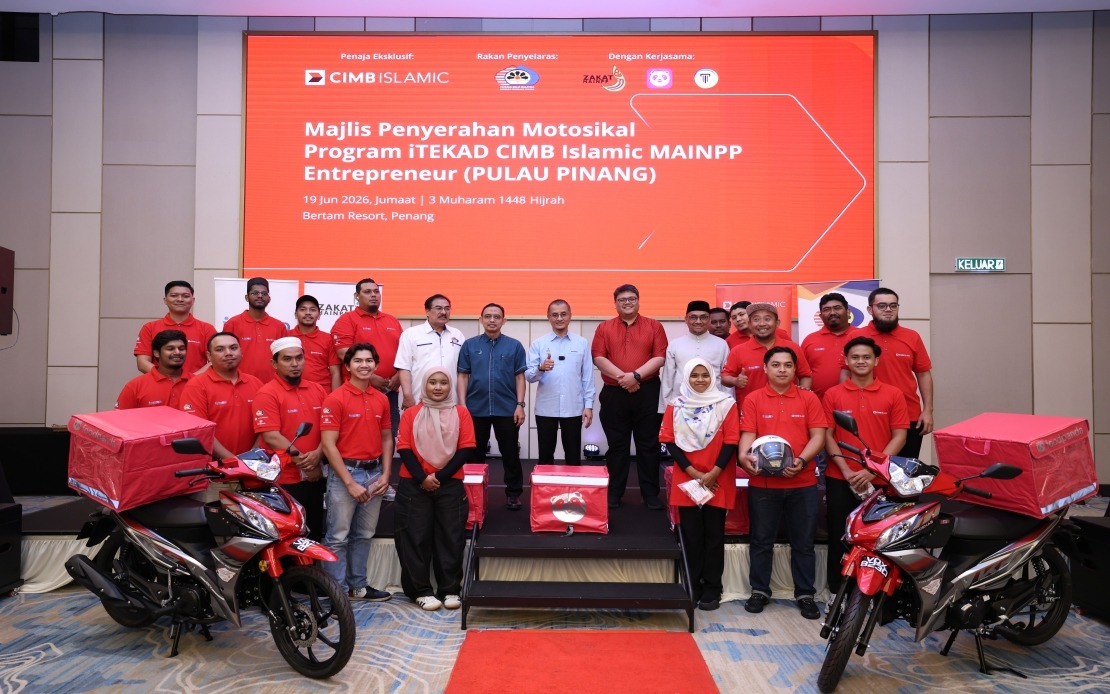
Twenty selected entrepreneurs received motorcycles at a handover ceremony in Kepala Batas today, marking a significant milestone in the iTEKAD CIMB Islamic-MAINPP Entrepreneur programme's mission to lift low-income households out of poverty through structured employment opportunities. The initiative, unveiled at Bertam Resort, represents a collaborative effort by multiple stakeholders committed to transforming lives within vulnerable asnaf communities across Penang.
The programme emerged from a strategic partnership between CIMB Islamic Bank Berhad and the Penang Islamic Religious Council (MAINPP) through its Zakat MAINPP division, supported by a roster of implementation partners including the Malaysian Youth Foundation (YBM), Taylor's Community and foodpanda Malaysia. This multi-stakeholder model underscores a shift in how Islamic social finance approaches poverty alleviation, moving beyond simple cash transfers to comprehensive ecosystem support designed to sustain long-term economic improvement.
According to Penang Deputy Chief Minister I Datuk Dr Mohamad Abdul Hamid, the programme operates on a RM400,000 seed fund structured as a matching grant. The funding split reveals institutional commitment from both the private and public sectors: RM200,000 originates from the CIMB Islamic Bank Berhad Wakalah Zakat fund, while Bank Negara Malaysia contributes an equivalent RM200,000. This dual-source financing mechanism demonstrates how central bank and commercial banking sectors can collaborate in zakat distribution and Islamic social responsibility initiatives.
The selection process employed rigorous criteria reflecting confidence in programme outcomes. From an initial pool of 151 applications, potential participants underwent intensive evaluation including formal interviews and an immersive Entrepreneurship Camp held between May 31 and June 3, 2026. This bootcamp approach ensured that final beneficiaries possessed foundational entrepreneurial aptitude alongside demonstrated commitment, reducing the likelihood of motorcycle grants becoming underutilised assets within recipient households.
Beyond motorcycle provision, the programme equips participants with delivery equipment specifically configured for foodpanda partnership opportunities, creating immediate income pathways. Complementing the physical assets, beneficiaries receive structured training covering fundamental financial management, workplace discipline protocols, and entrepreneurship principles. This tripartite support structure—asset provision, practical equipment, and skills development—addresses a recognised gap in conventional poverty programmes that often focus exclusively on capital without complementary capability building.
Datuk Dr Mohamad emphasised that asnaf development demands integrated approaches rather than siloed interventions. The programme's design reflects this philosophy by requiring genuine synergy among participating organisations, each contributing specialised expertise. CIMB Islamic brings Islamic banking and zakat fund management capability, MAINPP provides community networks and religious legitimacy, YBM supplies youth development experience, Taylor's Community contributes social development expertise, and foodpanda offers immediate market access for delivery services. This ecosystem approach mirrors emerging best practices in Southeast Asian social entrepreneurship.
The initiative aligns with Penang's broader Islamic Religious Development Agenda 2030 (APAI2030), which articulates a comprehensive vision encompassing education, economic participation, family welfare, and youth empowerment. Rather than treating poverty reduction as an isolated policy concern, the government integrates entrepreneurship support within a holistic framework addressing multiple dimensions of ummah development. This integrated approach suggests that religious institutions increasingly function as development catalysts beyond traditional welfare roles.
For Malaysia and the wider Southeast Asian region, the programme demonstrates how zakat institutions can evolve into sophisticated economic development agents. Historically, zakat distribution emphasised immediate poverty relief; this model emphasises poverty exit through sustained income generation. The emphasis on employment pathways through delivery services reflects pragmatic alignment with gig economy expansion across major Asian cities, where ride-hailing and delivery platforms have created accessible income opportunities for individuals with limited formal qualifications or capital.
The programme also signals how Islamic banking institutions can leverage their zakat obligations as platforms for social enterprise development rather than mere charitable dispensation. CIMB Islamic's participation extends beyond financial contribution to incorporate ecosystem building through partner coordination. This approach positions Islamic banks as development stakeholders rather than philanthropic institutions, potentially improving long-term outcomes through sustained engagement and accountability mechanisms.
Datuk Dr Mohamad articulated broader aspirations for the initiative, characterising the motorcycle handover as symbolic validation of recipient potential rather than mere asset transfer. This framing acknowledges a critical psychological dimension in poverty alleviation: beneficiary confidence and perceived social recognition significantly influence entrepreneurial persistence and personal motivation. The ceremonial public handover—rather than anonymous distribution—intentionally builds dignity and community acknowledgement around participants' entrepreneurial journey.
The programme's emphasis on structured support extending beyond programme completion addresses a recognised failure mode in conventional poverty initiatives. Many beneficiaries struggle when external support ends; this model includes ongoing guidance to sustain momentum through critical early business phases. Continuous mentorship and support networks reduce the probability that motorcycles become abandoned assets, instead functioning as genuine livelihood foundations.
Looking forward, the programme's success metrics will encompass income sustainability, motorcycle retention rates, and progression into expanded economic activities beyond initial delivery services. For policymakers across Malaysia and Southeast Asia, the iTEKAD model offers a replicable framework for leveraging Islamic finance infrastructure toward poverty reduction objectives. As asnaf communities face persistent economic barriers, programmes demonstrating that structured asset provision combined with skills development and community support can generate meaningful transitions toward financial stability warrant serious policy attention and potential scaling.

