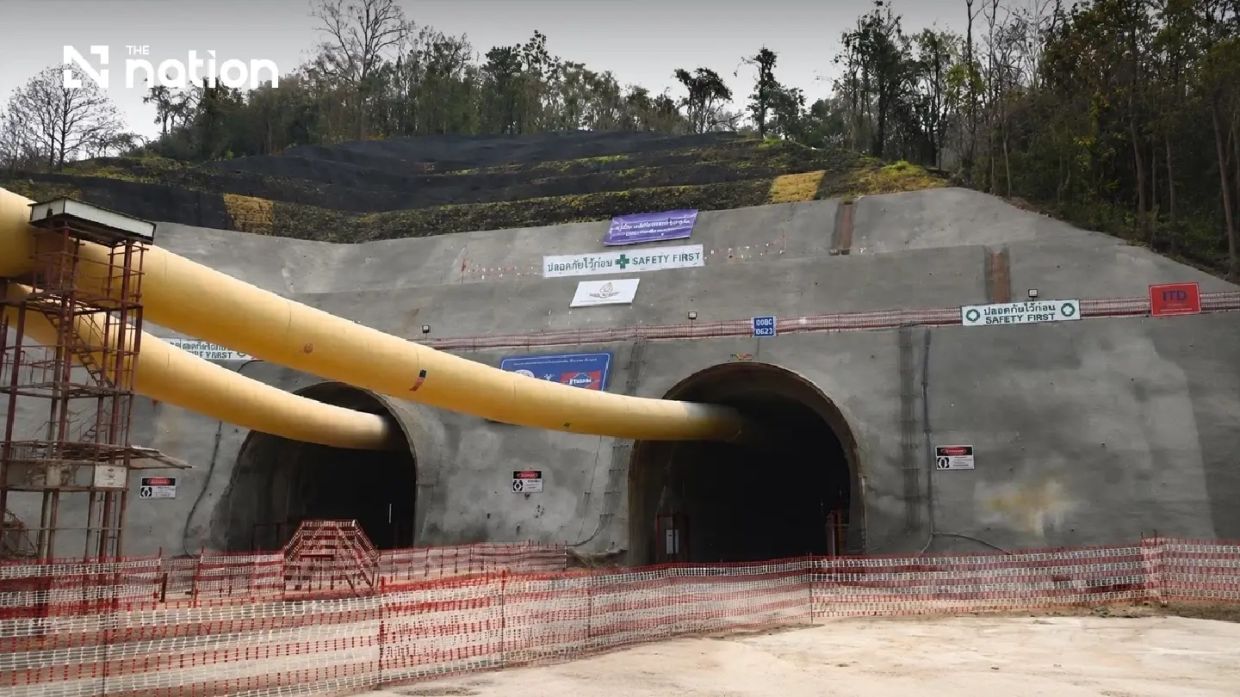
A construction accident at Thailand's Doi Luang railway tunnel has claimed two lives and left seven workers injured, marking a serious safety incident on a major northeastern rail infrastructure project. The collapse occurred on Saturday evening at the 3.4-kilometre tunnel located in Chiang Saen district, Chiang Rai province, while workers were engaged in installing waterproofing systems. The tunnel is part of the State Railway of Thailand's ambitious Den Chai-Chiang Rai-Chiang Khong railway line, which aims to improve regional connectivity and trade along Thailand's northern border.
According to Deputy Transport Minister Siripong Angkasakulkiat, the accident was first reported at 8.35pm. Preliminary investigations suggest that rocks dislodged from the tunnel wall during the waterproofing installation work triggered the incident, though officials cautioned that the full cause remained under examination. Earlier accounts had pointed to problems in the shotcrete application area, but investigators are still piecing together the precise sequence of events that led to the structural failure.
The human toll has been categorised as two deaths, three individuals with serious injuries, and four sustaining minor injuries. All casualties were evacuated to medical facilities for treatment. The response from authorities was immediate, with the project's safety division establishing control of the site and implementing cordons around the affected area to prevent further incidents and allow for thorough examination of structural conditions.
The Doi Luang tunnel represents a critical component of Contract 3 for the Chiang Rai-Chiang Khong section, a package valued at 19.385 billion Thai baht. This particular contract encompasses extensive earthworks, construction of grade-separated and elevated track sections spanning approximately 87 kilometres, three passenger stations, three halts, the tunnel itself, and integrated signalling and telecommunications infrastructure. The project is being executed by the CKST-DC3 Joint Venture, a consortium comprising CH. Karnchang Public Company Limited, Sino-Thai Engineering & Construction Public Company Limited, and Chiangmai Construction Co., Ltd.
The Den Chai-Chiang Rai-Chiang Khong railway initiative represents a substantial investment in Thailand's rail network modernisation, designed to facilitate passenger and freight movements into the Chiang Rai region. For neighbouring Southeast Asian nations including Malaysia, such infrastructure developments carry implications for regional trade and transport connectivity. The project has long been positioned as facilitating smoother cross-border commerce and tourism in the Golden Triangle region where Thailand, Laos, and Myanmar converge.
Scaffold failures during tunnel construction, particularly in waterproofing and shotcrete operations, are recurring challenges in underground works. The hazardous nature of these tasks—working overhead, in confined spaces, with active water seepage and falling rock hazards—demands rigorous safety protocols and equipment maintenance. The structural stresses on temporary supports in tunnel environments differ significantly from above-ground construction, making engineering oversight especially critical.
The State Railway of Thailand's Special Projects and Construction Department has mobilised to conduct detailed site inspections and forensic analysis. Transport ministry officials pledged to provide comprehensive findings as the investigation proceeds. The broader question emerging from this incident concerns whether current safety frameworks, worker supervision ratios, and equipment standards across Thai construction sites are adequately calibrated for the complexity and risk profiles of major underground railway projects.
Thailand's railway modernisation agenda encompasses several long-term corridors intended to strengthen regional integration and economic development. However, such projects inherently involve construction risks that require meticulous planning, investment in worker training, and enforcement of protective measures. The accident underscores the tension between development timelines and occupational safety, a balance that developing nations often struggle to maintain under commercial and budgetary pressures.
For Malaysian companies operating in regional construction markets or considering joint venture participation in Thai infrastructure projects, incidents such as these carry important lessons. They highlight the necessity of stringent due diligence on contractor safety records, transparent incident reporting mechanisms, and alignment with international best practices in underground construction. The consortium overseeing this contract will likely face increased scrutiny regarding site management and risk mitigation protocols going forward.
The sealed-off accident site will become a focal point for understanding what systemic weaknesses may have contributed to the collapse. Whether the failure stemmed from design flaws in the temporary support structures, inadequate installation procedures, material degradation, or staffing and coordination breakdowns will shape recommendations for the remainder of Contract 3 and potential implications for other projects in the same portfolio.
The broader regional significance of this incident extends to how Southeast Asian nations are approaching safety regulation in high-visibility infrastructure schemes. The railway corridor project carries strong political backing from Thailand's leadership as part of national connectivity goals. Yet public confidence in such initiatives depends substantially on demonstrated commitment to worker welfare and transparent safety management during construction phases. The investigation findings will likely inform safety standards across comparable projects in the region.

