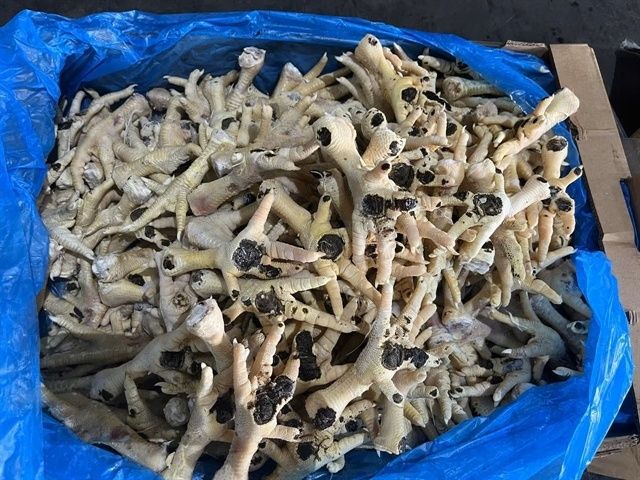
Hanoi police have brought formal charges against two company executives for orchestrating a major smuggling operation involving frozen chicken feet valued at more than US$13 million. The investigation, completed on Friday, June 19, centred on a deliberate scheme to circumvent Vietnamese food safety and customs regulations by importing poultry products from disease-affected regions and illegally distributing them throughout the country's food supply chain.
The two suspects, identified as Nguyen Thi To Loan, 47, and Trang Tuyet Ngoc, 45, held senior management positions in companies that facilitated the illicit trade. Loan directed operations at ABF Food Import-Export JSC, headquartered in Ninh Binh Province, while Ngoc served as head of the assistant department at An Binh Group. According to police, both women have admitted to all charges levelled against them, streamlining the legal process considerably.
The scheme operated with systematic deception across Vietnamese customs procedures. Between 2023 and 2026, the operation imported 339 shipping containers of frozen chicken feet through official channels, with paperwork falsely declaring the entire shipment as goods destined for processing and subsequent re-export. Vietnamese law explicitly prohibits the domestic sale of poultry products originating from countries experiencing active poultry disease outbreaks; such imports may only enter Vietnam's territory under strict conditions for processing before being shipped abroad again. This regulatory framework exists to protect consumers from potential disease transmission through the food chain.
Rather than adhering to the re-export requirement, Loan systematically redirected Ngoc to distribute the chicken feet across Vietnam's domestic market. The scale of the operation proved substantial, with investigators establishing that over 10,000 metric tonnes reached food service establishments scattered across multiple provinces including Hanoi, Cao Bang, Ninh Binh, Quang Ninh and several others. The geographical dispersion of distribution points suggests an extensive network of restaurants, institutional food suppliers and retailers had unknowingly purchased poultry products that violated import regulations and posed potential health risks.
The financial dimensions of the smuggling operation underscore its profitability and premeditation. Authorities calculated the total value of imported goods at approximately VNĐ347 billion, equivalent to US$13 million. Significantly, no import duty was paid on any of these shipments, representing a dual loss to the Vietnamese state through both evaded taxes and compromised food safety standards. The absence of duty payments suggests the operation maintained deliberate financial records or cash-based transactions to obscure the true nature of the imports.
When authorities conducted raids on facilities associated with the operation, they uncovered physical evidence of the scheme's magnitude and disregard for food safety. Police discovered over 2,000 metric tonnes of frozen chicken feet across multiple storage locations. The An Viet 2 freezer facility, located in Hanoi's Quang Minh Industrial Zone, held more than 1,000 metric tonnes, including approximately 260 metric tonnes that had visibly deteriorated. These expired products displayed visible mold growth and offensive odours, yet investigators determined they were being prepared for further distribution, indicating a flagrant disregard for consumer health.
A second raid at the THL cold-storage warehouse in Lang Son Province in northern Vietnam yielded additional evidence, uncovering more than 1,030 metric tonnes of frozen chicken feet. The existence of multiple storage facilities across different provinces demonstrates the operation's infrastructure was deliberately designed to distribute goods widely while maintaining operational secrecy. The discovery of deteriorated products apparently staged for sale raises serious questions about whether consumers had already purchased compromised poultry products before authorities intervened.
Hanoi police formally charged both suspects under Article 188 of Vietnam's 2015 Penal Code, which addresses smuggling offences. The charges reflect authorities' determination that the operation constituted deliberate customs violations rather than administrative oversights. The confessions from both defendants should facilitate prosecution, though sentencing will depend on how courts interpret the severity of importing contaminated food products into the domestic supply chain.
The investigation remains ongoing, with authorities actively working to identify other individuals and organisations that may have participated in the broader smuggling network. Investigators are examining whether importers, distributors, retailers and food service businesses knowingly purchased chicken feet despite their suspicious origin, or whether they were deceived about the products' provenance. This expanded investigation could implicate numerous additional parties and potentially extend far beyond the two primary suspects currently charged.
The case carries significant implications for Southeast Asia's food safety landscape. Vietnam, like other regional economies, has struggled with ensuring the integrity of imported food products and the compliance of domestic companies with international disease prevention standards. The scale of this operation, with over 10,000 metric tonnes distributed across multiple provinces over several years, demonstrates how vulnerabilities in customs enforcement and cold-chain monitoring can be systematically exploited. For Malaysian and other regional consumers and food importers, the case underscores the importance of rigorous supplier verification and the risks associated with poultry products imported from regions experiencing disease outbreaks, even when products appear to originate from established companies with legitimate infrastructure.

