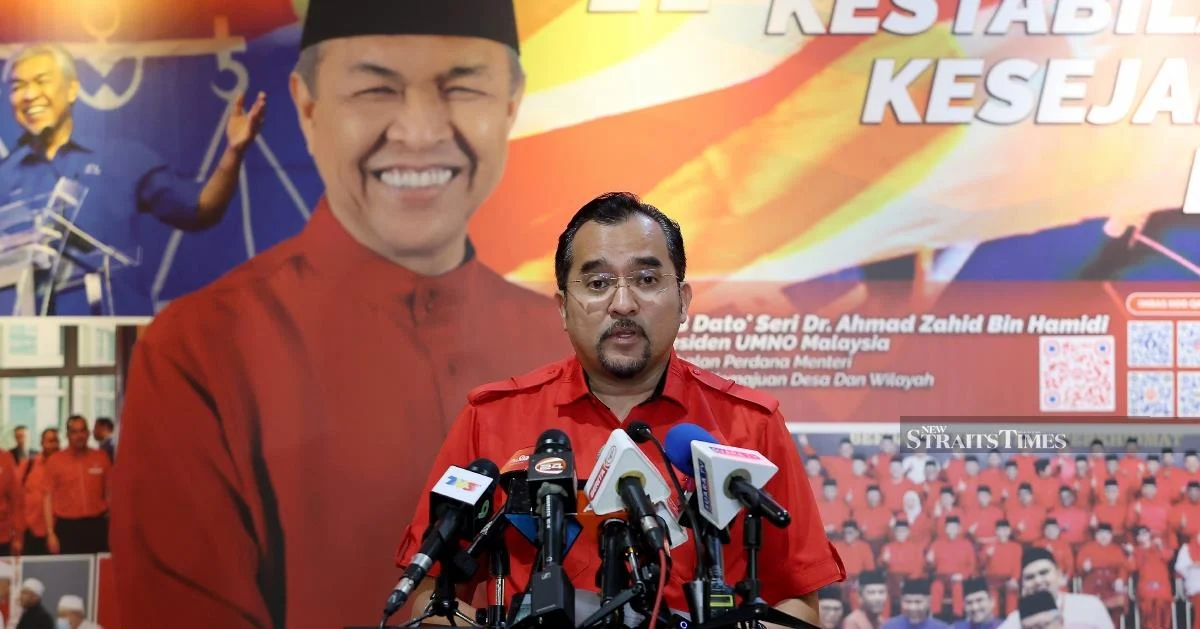
The United Malays National Organisation has committed itself to conducting a campaign rooted in constructive policy dialogue rather than personal attacks for the upcoming state elections in Johor and Negri Sembilan. Party Secretary-General Datuk Dr Asyraf Wajdi Dusuki made this declaration, signalling Umno's intention to contest the elections on the strength of its proposals for addressing voter concerns and improving public services in both states.
This strategic positioning represents a notable statement about campaign conduct at a time when electoral politics in Malaysia has been marked by increasingly heated partisan exchanges. By explicitly ruling out negative campaigning, Umno appears to be attempting to capture the moral high ground whilst setting expectations for how the contest should unfold. Such pronouncements from national party leadership carry weight with state-level candidates and party machinery, effectively establishing parameters for campaign behaviour across organisational structures.
Johor and Negri Sembilan both hold considerable political significance within the broader Malaysian context. Johor, Malaysia's second-largest state by population and a traditional Umno stronghold, carries outsized influence in national coalition politics. Negri Sembilan, whilst smaller, remains strategically important for maintaining Barisan Nasional's grip on federal government support bases. Elections in either state can influence perceptions of momentum heading into subsequent national contests, making campaign messaging particularly consequential.
Umno's emphasis on policy offerings suggests the party recognises that Malaysian voters increasingly demand substantive engagement with governance issues. The party faces pressure on multiple fronts: managing cost-of-living concerns, addressing infrastructure development, improving public healthcare and education, and demonstrating competent administration. By foregrounding these themes rather than engaging in character assassination of opponents, Umno signals confidence in its record and forward agenda, at least rhetorically.
The commitment to avoiding mudslinging also reflects broader calculations about voter sentiment and coalition dynamics. The Barisan Nasional coalition, of which Umno is the dominant component, has been rebuilding its electoral competitiveness after suffering significant losses in 2018. Campaigns perceived as dirty or overly aggressive risk alienating moderate swing voters and reinforcing negative perceptions about establishment politics that have dogged the coalition's rehabilitation efforts. A cleaner campaign posture therefore serves coalition interests beyond Umno alone.
However, the practical implementation of such commitments often diverges from rhetorical positioning. Party candidates, grassroots activists, and affiliated media outlets frequently operate with considerable autonomy, and informal networks sometimes pursue aggressive tactics that cannot be directly traced to official party direction. The distinction between what party leadership officially endorses and what occurs across sprawling campaign machinery on the ground frequently becomes blurred in the intensity of electoral competition.
For Johor and Negri Sembilan voters, this pledge carries implications for the campaign environment they will experience over coming weeks. A policy-focused election would theoretically provide clearer information about competing visions for state governance, allowing voters to make decisions based on substantive differences in platforms and track records. Conversely, if campaigns devolve into personal attacks despite leadership's stated intentions, voters may view the pledges as empty rhetoric and become further cynical about political discourse quality.
The statement also carries significance for Umno's internal dynamics and its positioning within the broader political landscape. The party has navigated considerable turbulence in recent years, managing factional tensions, leadership transitions, and the challenge of reinvention following the 1MDB scandal and subsequent electoral defeats. Emphasising policy substance and administrative competence allows Umno to redirect narrative focus toward forward-looking governance concerns rather than dwelling on historical grievances or internal conflicts.
Opposition parties will likely respond to Umno's clean campaign pledge by either matching such commitments to appear similarly responsible, or by testing the pledge's credibility through their own campaign conduct. The Democratic Action Party, People's Justice Party, and other non-Barisan forces will need to calibrate their own messaging strategies in light of this declaration, recognising that voters in both states will be evaluating not merely policy substance but also the character and tone of political engagement across all competing parties.
The timing of Asyraf's statement also merits consideration. Made from Kuala Lumpur rather than at campaign rallies, the declaration carries weight as official party positioning whilst allowing sufficient distance that state-level campaign teams can operate with tactical flexibility. This represents a carefully calibrated communication strategy that establishes high-level commitments without constraining operational flexibility in actual campaign execution.
Ultimately, the success or failure of Umno's clean campaign pledge will depend on sustained leadership discipline and voter assessment of whether the party's actions align with its words. Malaysian electoral politics has matured considerably, with voters becoming more sophisticated in distinguishing between campaign rhetoric and substantive governance capability. For Umno, demonstrating that this commitment is genuine rather than merely opportunistic positioning for elections will prove crucial to rebuilding trust and credibility that extends beyond the immediate contest in Johor and Negri Sembilan.