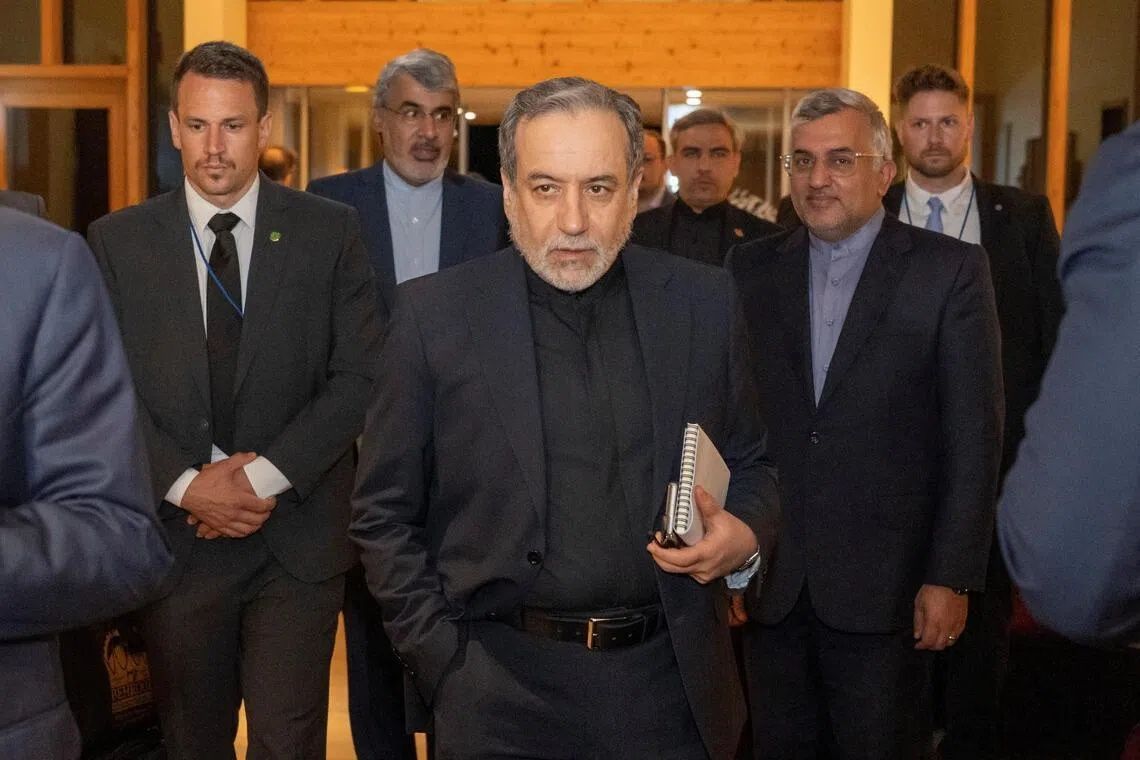
The long-awaited peace negotiations between the United States and Iran have officially begun at the Buergenstock resort in Switzerland, marking a pivotal moment in efforts to end a devastating four-month conflict. US Vice President JD Vance and Iran's chief negotiator Mohammad Baqer Qalibaf arrived Sunday morning at the scenic mountaintop location, which sits accessed only through a winding mountain road and multiple security checkpoints. The summit represents the most significant diplomatic engagement between Washington and Tehran since both nations agreed to a 60-day ceasefire framework brokered by Pakistan earlier in the week, when Presidents Donald Trump and Masoud Pezeshkian signed an interim agreement aimed at halting hostilities.
The timing and location of these talks carry particular significance for regional stability and global energy security. Both delegations bring substantial teams reflecting the complexity of the negotiations ahead. The American side includes not only Vance but also envoys Steve Witkoff and Jared Kushner, the latter serving as a trusted Trump family representative. Iran's delegation encompasses Foreign Minister Abbas Araqchi alongside senior officials from security agencies, the central bank, and the oil ministry, indicating that economic and financial matters rank prominently among their concerns. Pakistan has also dispatched Prime Minister Shehbaz Sharif and Field Marshal Syed Asim Munir to participate directly in the discussions, underscoring that nation's investment in achieving a sustainable settlement.
However, the talks commence amid immediate and serious complications that threaten to derail negotiations before substantive progress can be achieved. Iran's Islamic Revolutionary Guard Corps declared on Saturday that it had shut the Strait of Hormuz, one of the world's most strategically vital waterways through which approximately one-fifth of global petroleum supplies transit. The announcement came in response to Israeli military operations in Lebanon, which Iran characterizes as violations of the ceasefire agreement's terms. This closure declaration creates a direct point of contention: the US military and commercial shipping data indicate that normal maritime traffic has continued unimpeded, with 55 merchant vessels transiting the strait on Saturday alone and carrying more than 17 million barrels of oil destined for global markets. This fundamental disagreement over whether the passage is actually closed sets a troubling tone for negotiations premised on factual accuracy and mutual implementation.
The Lebanon ceasefire component of the broader agreement remains unstable and contested, complicating the nuclear and broader strategic discussions that the parties hope to advance. Despite the formal truce taking effect, Israeli forces and the Iranian-backed militant organization Hezbollah engaged in mutual attacks on Saturday, including strikes that Lebanese civil defence officials reported claimed at least 20 lives. Israel maintains that it is responding to Hezbollah provocation and has no intention of withdrawing from Lebanese territory it currently occupies, while Hezbollah declares it will not permit Israel any freedom of movement within Lebanon. Israeli military leadership has reportedly instructed forces to refrain from major offensive operations, yet the Israeli government explicitly states it is not party to the US-Iran deal and will maintain its military position regardless of diplomatic progress.
For Malaysian and Southeast Asian observers, the geopolitical implications deserve careful attention. The Strait of Hormuz closure dispute directly affects regional economies dependent on Middle Eastern oil imports, and any extended disruption to traffic through this chokepoint would elevate energy costs across Asia-Pacific markets. Malaysia, as a significant crude oil importer and a nation positioned within critical sea lanes, has substantial economic interests in ensuring the waterway remains open and functional. The precedent being set regarding great power negotiation techniques, ceasefire implementation, and the role of third-party mediators like Pakistan will influence how regional disputes are managed in Southeast Asia going forward.
Trump administration officials have signaled confidence that the ceasefire framework will hold despite immediate tensions. Vance stated before departure that he anticipated making progress on nuclear issues and Lebanon arrangements within a couple of days of talks, while also asserting he had observed no credible evidence supporting Iran's Strait of Hormuz closure claim. Trump himself has made an unusual declaration that no tolls or fees will be charged for passage through the strait during the 60-day negotiation period or subsequently, unless the talks fail and the US determines it necessary to implement such measures. In provocative social media commentary, the president referenced the possibility of Washington levying a toll for providing guardian services to Middle Eastern nations, language that reveals the transactional framework underlying current American diplomatic strategy.
Iran's negotiating position hinges significantly on its insistence that the other party—principally the United States and Israel—must demonstrate genuine commitment to implementing the agreement's provisions. Mohammad Mokhber, an adviser to Iran's supreme leader Ayatollah Mojtaba Khamenei, has stated that Iran will not consider the accord more than paper unless the first of 14 enumerated points is fulfilled, particularly the ceasefire on all fronts including Lebanon. This position reflects historical grievances about broken commitments and serves as leverage in ongoing negotiations. Conversely, Iran's Oil Minister Mohsen Paknejad has articulated a more positive outlook, suggesting that hundreds of investment opportunities and contract possibilities are available should Western parties respect the agreement's spirit, indicating that sanctions relief and economic engagement represent important incentives for Iranian compliance.
The broader Middle Eastern and global context adds urgency to successful conclusion of these talks. Casualty figures from the conflict remain contested but staggering. Lebanon's health ministry attributes 4,057 deaths to Israeli operations since March 2, including medical personnel, women, and children, though the breakdown between combatants and civilians remains unclear. Israel reports at least 32 military personnel and four civilians killed in combat with Hezbollah. Public opinion polling within Israel reveals substantial skepticism about the conflict's outcome and the government's achievements, with approximately 92 percent of respondents believing Iran has benefited more substantially than Israel from the military campaign, while less than 30 percent credit Prime Minister Benjamin Netanyahu's claims of major successes. Nearly 90 percent assess that stated war objectives remain unmet.
The nuclear dimension represents perhaps the most complex and consequential element of the broader negotiation framework. Both Washington and Tehran have indicated that resolving questions about Iran's nuclear programme constitutes a central objective of these talks, though their respective positions on acceptable enrichment levels, inspections regimes, and sanctions relief remain far apart. The success or failure in reaching accommodation on these technical and political issues will likely determine whether the ceasefire proves durable or deteriorates into renewed conflict within or shortly after the 60-day window. Switzerland's neutral status and the Buergenstock resort's isolation and security infrastructure make it an appropriate venue for such sensitive discussions, yet the fundamental structural challenges—contested facts on the ground, unresolved previous agreements, and incompatible strategic objectives—suggest that even optimal negotiating conditions may prove insufficient.
For regional observers and policymakers in Southeast Asia, these talks merit sustained attention for several reasons beyond immediate Middle Eastern stability. The approach being demonstrated—whereby military campaigns precede diplomatic settlements, and interim agreements attempt to freeze conflicts while deeper political differences are negotiated—may find application elsewhere. The role of Pakistan as principal mediator, and the involvement of Qatar as host nation for the venue, illustrate how medium and smaller powers can exert influence disproportionate to their material strength through diplomatic positioning. Additionally, the evident economic dimensions of the negotiation, including oil markets, sanctions architecture, and reconstruction investment, underscore that modern conflict resolution increasingly requires coordinated management of financial and commercial systems alongside military and political questions. Malaysia and other ASEAN members should monitor how these precedents develop.

