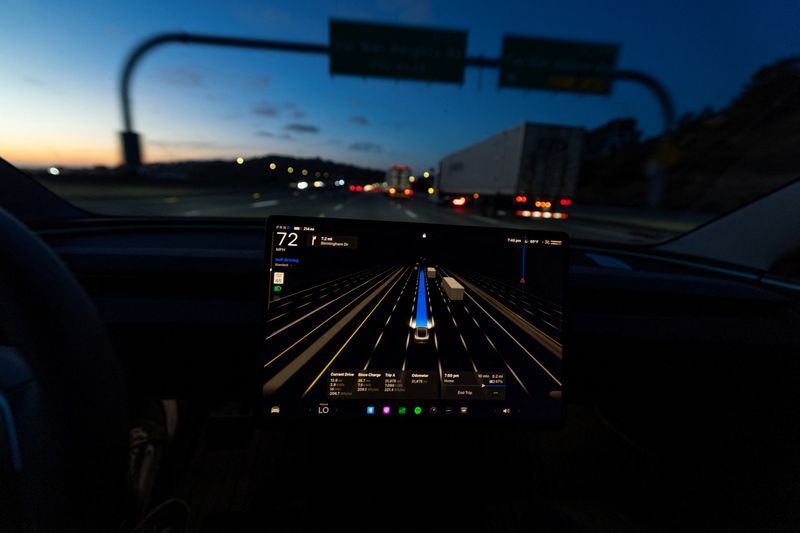
Two Democratic senators are pressing the United States' top vehicle safety regulator to conduct a thorough review of Tesla's safety statistics for its Full Self-Driving driver-assistance technology, raising concerns that the electric vehicle manufacturer has systematically misrepresented crash data to mislead consumers and regulators. Edward Markey of Massachusetts and Richard Blumenthal of Connecticut submitted a formal letter to the National Highway Traffic Safety Administration on Monday, demanding answers about whether the agency has independently verified Tesla's widely publicised claims that its autonomous driving system is up to ten times safer than human drivers.
The senators' intervention comes in the wake of a detailed Reuters investigation published last month that exposed significant methodological flaws in how Tesla calculates its safety statistics. The analysis, which drew on interviews with independent researchers and engineers, revealed that company executives including Chief Executive Officer Elon Musk have repeatedly cited carefully selected data points to construct an inflated picture of the Full Self-Driving system's performance. Rather than relying on transparent, industry-standard metrics, Tesla has instead cherry-picked comparisons that mask the technology's genuine limitations and vulnerabilities.
At the core of the controversy lies Tesla's approach to measuring crash safety. The company compares airbag-deployment rates in vehicles using Full Self-Driving with overall national crash statistics that encompass a much broader range of collision severity. This creates an inherently unbalanced comparison, as airbag deployment represents only the most serious accidents, while the national average includes fender-benders and minor incidents that do not trigger such safety systems. Researchers and safety experts who reviewed Tesla's methodology pointed out that this approach fundamentally distorts the relative safety profiles of the two groups being compared.
Compounding this problem is Tesla's decision to benchmark its technology against the average United States vehicle fleet, which includes decades-old automobiles lacking modern safety features that have become standard in contemporary vehicles. Since the automotive industry has progressively integrated advanced collision-avoidance systems, automated braking, and enhanced structural designs over the past two decades, comparing Tesla vehicles to this older average fleet skews the results heavily in Tesla's favour. An equivalent-year comparison would present a far more realistic assessment of how Full Self-Driving actually performs relative to modern cars.
In their letter to the National Highway Traffic Safety Administration, Markey and Blumenthal characterise Tesla's analytical framework as "weak and misleading," contending that the situation represents an immediate threat to public safety. They have requested that the regulatory agency respond by July 7 with details about whether it has independently evaluated Tesla's claims or demanded access to the underlying crash data that supports the company's assertions. The senators also want to know what steps the agency intends to take to verify that the statistics being promoted to the public bear any genuine relationship to real-world performance.
Beyond demanding answers about Tesla specifically, the senators are using this moment to push for broader regulatory reform. They are urging the National Highway Traffic Safety Administration to establish and enforce more rigorous reporting requirements for all manufacturers developing self-driving technologies and advanced driver-assistance systems. Currently, companies operating in this space face minimal regulatory oversight regarding the claims they make about safety performance, leaving consumers and policymakers with limited reliable information about how these systems actually function in practice. The senators argue that without standardised, mandatory reporting frameworks, the agency has no credible way to determine whether public safety assertions are genuine or marketing hyperbole.
The timing of the senators' intervention carries particular significance given that Reuters has additionally reported Tesla presented these same inflated safety metrics to European Union regulators as part of its campaign to secure approval for Full Self-Driving deployment across Europe. This suggests the problem extends beyond domestic American markets and raises questions about whether European authorities, which generally maintain stricter safety standards than their US counterparts, were adequately informed about the methodological controversies surrounding Tesla's data.
Tesla declined to respond to questions about the senators' letter or the underlying safety claims being scrutinised. The National Highway Traffic Safety Administration similarly provided no immediate comment, though the deadline of July 7 will require some form of official response from the agency. The silence from both Tesla and regulators reflects the contentious nature of the autonomous vehicle safety debate, which pits the commercial interests of technology companies against public health concerns and the credibility of government oversight bodies.
For Southeast Asian markets and companies developing autonomous vehicle technologies, this controversy offers important lessons about the necessity of transparent, standardised safety reporting. As Malaysia, Singapore, Thailand, and other regional nations begin developing regulatory frameworks for autonomous and semi-autonomous vehicles, the Tesla case demonstrates how easily safety claims can be manipulated through selective methodology. Regional regulators are watching how American and European authorities handle this situation, and the outcome will likely inform the approach taken in Southeast Asia as local manufacturers and foreign companies seek to deploy these technologies across the region.
The broader implications extend to consumer trust and the pace of autonomous vehicle adoption. If manufacturers can successfully obscure the true performance characteristics of their systems through statistical sleight of hand, the public becomes unable to make informed decisions about whether to accept these technologies on roads alongside human drivers. This erosion of transparency ultimately undermines the social licence that autonomous vehicles need to achieve meaningful market penetration, potentially slowing innovation across the entire industry. The senators' push for stronger oversight reflects a recognition that maintaining public confidence in emerging technologies requires demonstrable honesty from both manufacturers and regulators.