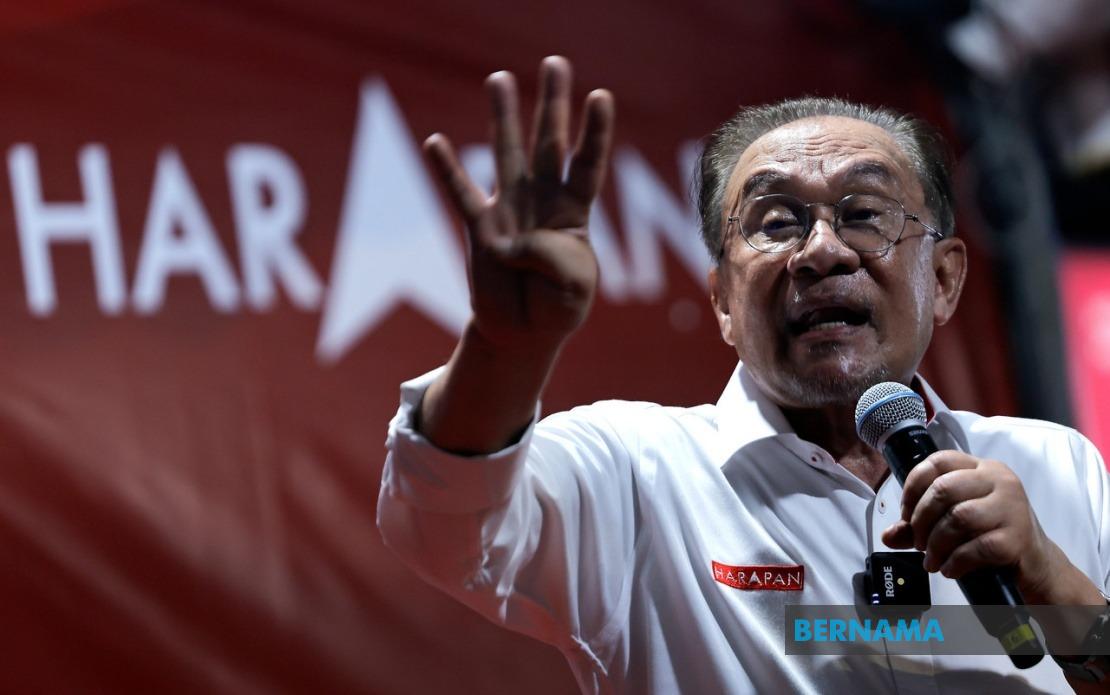
Prime Minister Datuk Seri Anwar Ibrahim has made a direct appeal to voters in Johor to select leaders characterized by integrity, wisdom, and humility when wielding political power, emphasizing that such choices will safeguard the interests of ordinary citizens and vulnerable communities. Speaking at a Pakatan Harapan grand rally in Muar on June 15, the opposition coalition's chairman stressed that the calibre of elected officials will fundamentally shape the state's trajectory in the years ahead.
Anwar drew a sharp distinction between leaders motivated by genuine public service and those who leverage divisive tactics to accumulate political support. He cautioned voters against political factions that weaponize racial and religious sentiments to mobilize their base, only to neglect their responsibilities once securing office. This observation reflects broader concerns within Malaysian politics about the persistence of identity-based politicking that often overshadows substantive policy debates on healthcare, education, and economic opportunity.
The Prime Minister articulated a vision of responsible governance that prioritizes long-term national and state development over short-term electoral victories. His remarks suggest a fundamental tension within Malaysian politics: the ongoing competition between those who advance narratives of fear and division versus those promoting inclusive growth and institutional accountability. He urged voters to contemplate the profound implications of their electoral decisions, invoking the wellbeing of future generations and the quality of public services their children will inherit.
A critical component of Anwar's message centred on the necessity of synchronization between state and federal administrations. He argued that political fragmentation between these two tiers undermines the efficient delivery of benefits from major national projects to ordinary Malaysians. When state governments operate at cross-purposes with federal development strategies, he contended, grassroots communities miss out on economic opportunities and infrastructure improvements designed to enhance their living standards.
Anwar highlighted the Johor-Singapore Special Economic Zone and the expansion of Tanjung Pelepas port as examples of transformative federal initiatives that require complementary state-level policies to maximize community benefit. While acknowledging the Johor state government's contributions to these undertakings, he emphasized the federal government's central role in negotiating and driving these projects. His argument implied that Pakatan Harapan's victory in the July 11 state election would ensure these major economic corridors generate tangible returns for ordinary Johor residents, rather than benefiting only politically connected elites.
The Prime Minister's vision extended beyond infrastructure to encompass a fundamental reorientation of state governance priorities. He called for elected state representatives and executive council members to focus their attention and resources on addressing the concrete challenges faced by working-class and low-income constituents. This framing represents an implicit critique of governance models that prioritize grand projects and headline-grabbing initiatives while neglecting basic service delivery and quality-of-life improvements for marginalized populations.
Anwar also directed an appeal to Johor residents living outside the state to return home and participate in the electoral process. He characterized voter participation as a solemn civic responsibility with implications extending far beyond individual electoral outcomes. Each ballot cast, he suggested, contributes to a mandate for policy change and ensures that economic gains are distributed equitably rather than concentrated among favoured communities or classes.
The emphasis on diaspora voters reflects practical political arithmetic in Malaysian elections, where voter turnout variation between constituencies can determine electoral outcomes. It also underscores the interconnectedness of Malaysia's regions in an era of internal migration and economic integration. Johor's significance as an economic engine linking Malaysia to Singapore and the broader Southeast Asian region makes its governance particularly consequential for national prosperity.
Anwar's rhetoric throughout the rally positioned Pakatan Harapan as the custodian of anti-corruption values and inclusive development, contrasting this vision with an implicit characterization of opponents as pursuing factional interests and exploiting communal tensions. This framing has become a recurring theme in Malaysian politics, with rival coalitions each claiming moral and developmental superiority. The effectiveness of such messaging often depends on voters' lived experience of governance quality and their assessment of whether electoral promises translate into tangible improvements.
The timing of these remarks, slightly more than three weeks before the state election, suggests they form part of a broader Pakatan Harapan campaign strategy designed to mobilize its base and persuade persuadable voters. The emphasis on integrity and humility appears calculated to distinguish the coalition from narratives of political entitlement and personality-centric leadership that critics associate with some opposition figures.
Johor's political complexion carries significance for national politics beyond the state itself. As a major economic contributor and a state with substantial Malay-Muslim majority populations, its electoral verdict can influence perceptions about the viability of multiracial coalitions and patterns of support for competing national narratives. A Pakatan Harapan victory would suggest voter appetite for federal-state alignment and prioritization of development over identity politics, whereas an alternative outcome would indicate different voter preferences regarding governance models and political priorities.
For Southeast Asian observers, Johor's electoral dynamics reflect broader regional tensions between inclusionary and divisive approaches to politics, with implications for democratic governance and economic cooperation across borders. Anwar's Johor campaign messaging ultimately represents a bet that Malaysian voters, when presented with clear choices, will opt for leaders demonstrating accountability, ethical conduct, and commitment to broad-based prosperity rather than narrow factional advantage.
%22%2F%3E%3C%2Fpattern%3E%3C%2Fdefs%3E%3Crect%20width%3D%22100%25%22%20height%3D%22100%25%22%20fill%3D%22url(%23ph54t2sg)%22%2F%3E%3Crect%20width%3D%22100%25%22%20height%3D%22100%25%22%20fill%3D%22url(%23ph54t2sp)%22%2F%3E%3Ctext%20x%3D%2250%25%22%20y%3D%2250%25%22%20text-anchor%3D%22middle%22%20dominant-baseline%3D%22central%22%20fill%3D%22rgba(255%2C255%2C255%2C0.95)%22%20font-family%3D%22Georgia%2C%20'Times%20New%20Roman'%2C%20serif%22%20font-weight%3D%22700%22%20font-size%3D%22226%22%20letter-spacing%3D%22-0.02em%22%3EPolice%3C%2Ftext%3E%3C%2Fsvg%3E)