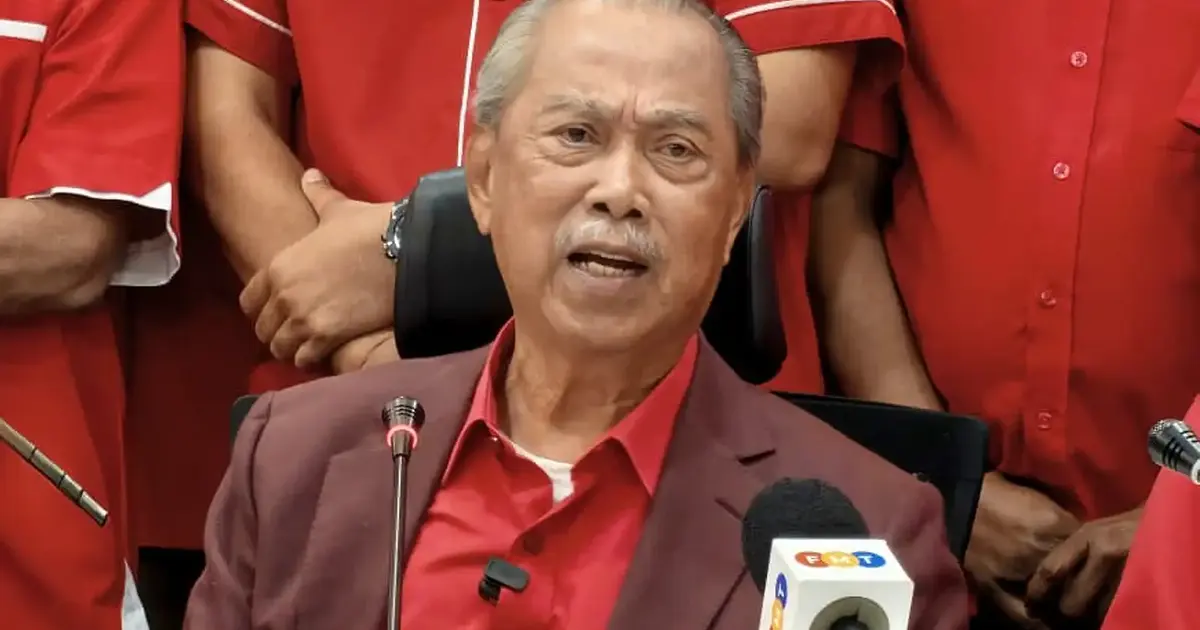
Muhyiddin Yassin, the former Prime Minister and current Bersatu chairman, has signalled his party's readiness to confront PAS across all dimensions of political competition, marking a significant escalation in intra-coalition tensions ahead of upcoming state elections. The statement reflects deepening fractures within the Perikatan Nasional alliance, which has served as the primary opposition force in Malaysian politics over the past two years.
Muhyiddin's combative rhetoric represents a substantial shift in the political landscape, particularly given that both Bersatu and PAS have been positioned as partners within the PN framework. The willingness to engage in multi-front competition suggests that ideological and strategic differences between the two parties have reached a critical juncture, with neither side willing to maintain the pretence of unified cooperation that has characterised the coalition since its 2022 formation. This development carries profound implications for opposition politics in Malaysia, potentially fracturing the PN brand that emerged as a credible alternative to the Barisan Nasional-led government.
The confrontational stance becomes particularly significant when considered against the backdrop of Bersatu's historical positioning. As the party founded by Muhyiddin himself, Bersatu has endeavoured to position itself as a centrist political force capable of bridging Malaysia's ethnic and religious divides. However, its alliance with PAS, a party with a distinctly Islamic-centric ideological framework, has consistently generated internal contradictions. This tension has now apparently reached the breaking point, with Muhyiddin apparently concluding that direct competition offers better prospects for the party's political future than continued collaboration.
The decision to contest the Johor state elections under the PN banner, rather than attempt a joint slate with PAS or abandon the coalition entirely, represents a calculated middle position. Johor, as Malaysia's second-largest state and an economically significant region, represents crucial electoral territory. A strong performance in state-level competition could provide Bersatu with a platform to rebuild its political relevance and demonstrate to voters that it remains a viable alternative centre-right force in Malaysian politics. The party's positioning in Johor will consequently serve as a crucial barometer for its broader electoral viability.
Negeri Sembilan carries somewhat different strategic importance for Bersatu's calculations. As a traditionally more competitive state politically, with a smaller electoral base than Johor, Negeri Sembilan nonetheless represents important ground for testing Bersatu's message and organisational capacity. The party's performance in this state could provide valuable intelligence regarding voter receptivity to Bersatu's political positioning independent of PAS influence. Both state contests together will offer Bersatu an opportunity to demonstrate that it possesses a distinct electoral appeal capable of translating into substantive political power.
The implications of Bersatu's apparent decision to prioritise competition over cooperation extend beyond the two states in question. The broader PN coalition, which includes smaller partners such as the Gabungan Parti Sarawak and various other state-based parties, faces potential destabilisation if its two major components engage in direct electoral confrontation. This fragmentation could ultimately benefit the ruling Barisan Nasional government by dividing opposition votes and reducing the collective impact of anti-establishment political forces. The strategic miscalculation embedded in Bersatu's aggressive posture may ultimately weaken rather than strengthen the opposition's electoral position.
Muhyiddin's willingness to articulate such forthright opposition to PAS simultaneously reflects calculation regarding Bersatu's internal political dynamics. The party includes members who view PAS with considerable suspicion, particularly regarding its approach to Islamic law and religious affairs. These Bersatu members perceive PAS as ideologically distant from their own centrist positioning, and Muhyiddin's combative rhetoric may serve to energise this faction while reassuring them that the party leadership prioritises their concerns over the demands of coalition management. This internal consolidation may ultimately prove more important to Muhyiddin than the external implications for opposition unity.
The timing of Muhyiddin's statement, preceding the actual conduct of elections in Johor and Negeri Sembilan, suggests that both parties are engaged in serious preparation for substantially different political trajectories. Rather than viewing these state elections as opportunities for unified opposition positioning, both Bersatu and PAS apparently perceive them as competitive battlegrounds where winning the most seats and demonstrating superior electoral performance carries paramount importance. This zero-sum competitive mindset fundamentally undermines any possibility of collaborative governance should they win significant representation.
For Malaysian voters, Muhyiddin's declaration introduces considerable uncertainty into opposition politics. Rather than presenting a cohesive alternative government capable of managing complex national challenges, the fractured opposition increasingly resembles competing factions motivated more by internal rivalry than programmatic alternatives to the ruling coalition. This fragmentation may inadvertently strengthen the incumbent government's political position, even as it faces its own internal pressures and declining popularity in some demographics. The paradox of Malaysian opposition politics is that its competitiveness and ideological diversity, theoretically advantageous characteristics, become liabilities when they prevent coordinated action and unified messaging.
The practical consequences of Bersatu's confrontational positioning will become apparent during the actual campaign periods in Johor and Negeri Sembilan. Whether Muhyiddin's rhetorical toughness translates into effective vote-gathering and organisational capacity remains uncertain. Conversely, PAS must determine whether it maintains a united front against Bersatu or similarly adopts combative competitive strategies. The outcome in these two states will significantly shape Malaysian opposition politics for the medium term, establishing patterns that may persist through future national-level electoral contests. Muhyiddin's declaration thus represents far more than temporary political theatre; it signals a fundamental recalibration of opposition political strategy with consequences extending well beyond the immediate electoral contests.
%22%2F%3E%3C%2Fpattern%3E%3C%2Fdefs%3E%3Crect%20width%3D%22100%25%22%20height%3D%22100%25%22%20fill%3D%22url(%23ph54t2sg)%22%2F%3E%3Crect%20width%3D%22100%25%22%20height%3D%22100%25%22%20fill%3D%22url(%23ph54t2sp)%22%2F%3E%3Ctext%20x%3D%2250%25%22%20y%3D%2250%25%22%20text-anchor%3D%22middle%22%20dominant-baseline%3D%22central%22%20fill%3D%22rgba(255%2C255%2C255%2C0.95)%22%20font-family%3D%22Georgia%2C%20'Times%20New%20Roman'%2C%20serif%22%20font-weight%3D%22700%22%20font-size%3D%22226%22%20letter-spacing%3D%22-0.02em%22%3EPolice%3C%2Ftext%3E%3C%2Fsvg%3E)